
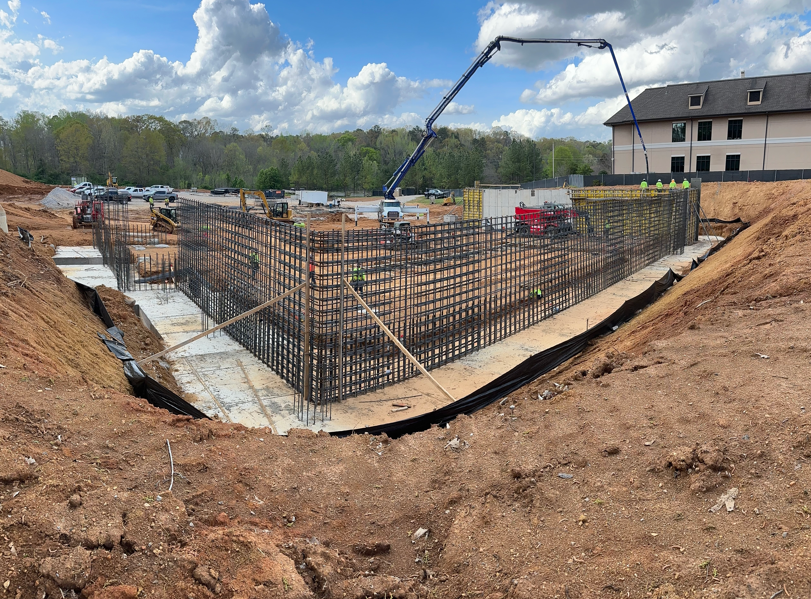
A building is only as strong as its base. For warehouses, manufacturing plants, and municipal facilities, that base is made of industrial strength concrete. But commercial concrete foundations are far more than just simple slabs. They are complex, engineered systems designed to support immense weight, withstand environmental stresses, and provide a stable platform for decades of operation.
Getting these foundations right involves a deep understanding of design principles, material science, and precision construction. From planning with facility engineers to managing pours in freezing temperatures, every step is critical. This guide breaks down the essential concepts every project manager and property owner should know about commercial concrete foundations.
Essential Pre-Pour Checklist
Before the first transit mixer arrives, ensure these five pillars of site prep are met:
Geotechnical Report: Has the soil bearing capacity ($lb/ft^2$) been verified?
Subgrade Compaction: Is the dirt compacted to at least 95% Modified Proctor density?
Formwork Integrity: Are forms braced to withstand the hydraulic pressure of “wet” concrete?
Utility Sleeving: Are all electrical and plumbing conduits sleeved and mapped?
Moisture Management: Is the crushed stone base leveled to prevent “pumping” under heavy loads?
Planning and Designing Your Foundation
Success starts long before the first scoop of dirt is moved. A well planned foundation prevents costly problems down the road.
Starting with Collaboration: Owner and Plant Engineer Planning
The best commercial concrete foundations begin with a conversation. This collaborative planning stage brings together the construction team, the property owner, and the plant or facility engineer. The owner provides the business context, such as operational schedules and future expansion goals. The plant engineer offers the technical details, including equipment weight, anchor bolt layouts, and utility hookups.
This early teamwork is key to addressing unique challenges and ensuring the final foundation perfectly aligns with the facility’s needs. By planning together, everyone can agree on a schedule, design, and budget that minimizes disruption and meets all operational goals.
Specialized Foundation Design for Unique Challenges
Not all sites or structures are created equal. When standard designs won’t cut it due to extreme loads, difficult soil conditions, or heavy machinery, a specialized foundation design is necessary. This custom engineering approach tackles specific problems head on.
Common scenarios requiring a specialized design include:
Vibrating Machinery: Foundations for generators or large presses often need to be extra massive or isolated from the main floor slab to dampen vibrations. A poorly designed foundation can allow vibrations to damage the equipment or the building itself.
Poor Soil: On sites with soft clay or a high water table, engineers design deep foundation systems to transfer the building’s weight to more stable ground far below the surface.
Extreme Loads: Structures like wind turbines or massive industrial cranes require unique foundations engineered to handle immense weight and powerful rotational forces.
Choosing the Right Foundation Construction Method
The design of commercial concrete foundations generally falls into two main categories, chosen based on the building’s load and the soil’s strength.
Shallow Foundations: These are used when the soil near the surface is strong enough to support the structure. They transfer the load to the ground over a wide area and include common types like spread footings and slab on grade foundations. They are cost effective and straightforward when conditions are right.
Deep Foundations: When surface soil is weak, deep foundations are required to bypass the unstable layers. This method involves sending support elements deep into the earth to rest on solid rock or stable soil.
One of the most common deep foundation elements is the reinforced pier.
Deep Foundation Systems: Piers vs. Piles

When the surface soil cannot support the building’s weight, we move the load deeper.
Drilled Piers (Caissons): Cast-in-place columns created by augering a hole and filling it with reinforced concrete. Best for high-capacity loads in stable soils.
Driven Piles: Pre-manufactured steel or concrete columns hammered into the earth until they hit “refusal” (solid rock). Ideal for wet or loose soil conditions.
Helical Piles: Large steel screws turned into the ground; these are excellent for sensitive environments where vibration must be kept to a minimum.
The Core Components: Concrete Mix and Precision
With a solid plan in place, the focus shifts to the materials and the accuracy of the installation. In the world of commercial concrete foundations, there is no room for error.
What’s in the Mix? The Science of Foundation Concrete
The concrete itself is a carefully engineered recipe. A concrete mix for a foundation is designed to achieve specific strength and durability requirements. It’s a precise blend of cement, water, sand, and gravel (aggregate), often with chemical admixtures to enhance its properties.
For most commercial concrete foundations, the mix is designed to reach a compressive strength of 3,000 to 4,000 psi (pounds per square inch) after 28 days of curing. To put that in perspective, a properly cured foundation can support heavy machinery and an entire building without failing. The mix may also include tiny air bubbles (a process called air entrainment) to help it resist damage from freeze thaw cycles in colder climates.
2026 Commercial Concrete Standards
Feature | Standard Requirement | Purpose |
Compressive Strength | 3,000 – 5,000+ PSI | Load-bearing capacity & durability |
Slump Range | 4″ to 6″ (Typical) | Workability and consistency |
Reinforcement | Grade 60 Rebar | Tensile strength & crack control |
Air Entrainment | 4% – 7% (In freeze/thaw zones) | Durability against ice and salt |
Vapor Barrier | 15-mil Polyethylene | Preventing moisture migration |
Why Foundation Precision is Non Negotiable
Building a foundation to exact specifications is crucial. Even a small mistake in elevation or anchor placement can create huge problems for the rest of the construction project. The industry has very tight tolerances, or acceptable deviations, for foundation work. For example, the standards for placing anchor bolts set by the American Institute of Steel Construction (AISC) are even stricter than those from the American Concrete Institute (ACI). In fact, one analysis found that for an anchor bolt to meet both standards simultaneously, it would need to be placed within a nearly impossible ±1/16 of an inch of its designed location.
Because perfect precision is so difficult, experienced contractors use templates, advanced surveying tools, and quality checks to get as close as possible. This commitment to precision at the foundation stage prevents delays and costly fixes later on.
Equipment Alignment: The Ultimate Test of Precision
Nowhere is precision more important than with equipment alignment requirements. When a foundation is built to support heavy machinery, its anchor bolts and surface must be perfectly positioned and level. If an anchor bolt is off by even a fraction of an inch, the machine’s base plate may not fit. A common field problem is misplaced anchor bolts, which can halt a project until a fix is approved by an engineer. Per OSHA regulations (29 CFR 1926.755), anchor bolts cannot be bent or modified without the structural engineer’s approval, as unauthorized changes can compromise safety.
Building Foundations for Demanding Environments
Many commercial concrete foundations are built for specific, high stress applications or in challenging conditions. This requires specialized knowledge and techniques.
Heavy Equipment Footings and Machine Pads
A heavy equipment footing is a foundation built specifically to support a massive piece of machinery, like an industrial press or a generator. It’s much thicker and contains more steel reinforcement than a typical footing. The design must account for not only the static weight of the machine but also any dynamic forces or vibrations it produces during operation. These equipment pads are often isolated from the surrounding floor to prevent vibrations from traveling through the building. When you consider that a standard forklift can weigh up to 14,000 pounds when loaded, you can imagine the robust foundation required for a stationary machine that weighs many tons.
The Workhorse: Loading Dock Foundations
Loading docks are among the most abused areas of any commercial facility. See why concrete is ideal for industrial loading docks. The loading dock foundation must withstand the immense weight of semi trucks (which can weigh around 80,000 pounds), the constant impact of trailers backing in, and the focused pressure from heavy forklifts. A single forklift tire can exert up to 350 psi on the floor surface.
These foundations include thick, reinforced concrete dock walls, durable approach slabs, and precisely formed pits for dock leveler equipment. Building strong commercial concrete foundations for loading docks is a specialty of experienced contractors like Wright Construction Company, who understand the unique stresses these areas face.
Cold Weather Foundation Concreting

Pouring concrete in low temperatures (typically below 40°F) requires special procedures known as cold weather concreting. If freshly poured concrete freezes before it gains enough strength, it can be permanently damaged. To prevent this, contractors follow guidelines like ACI 306, which may involve heating the water and aggregates, using additives that speed up curing, and covering the fresh foundation with insulating blankets or heated tents. Adhering to these measures is critical for ensuring the long term safety and durability of commercial concrete foundations built during winter.
Working in Sensitive Environments
Foundation work sometimes happens in or near sensitive environments. This could be an environmentally protected area, like a wetland, where erosion and pollution must be strictly controlled. Learn how a good paving company mitigates drainage issues. It could also be an active operational environment, like a hospital or a running manufacturing plant, where dust, noise, and vibration have to be minimized. In these cases, contractors use tailored methods like drilled piers instead of loud pile drivers and implement strict dust and noise control measures to avoid disrupting ongoing activities.
Managing the Build: Scheduling and Regulations
A successful foundation project isn’t just about design and materials; it’s also about process and compliance.
Keeping on Track: Schedule Control for Concrete Pours
Effective schedule control is essential for foundation pours. The entire project timeline often depends on the foundation being completed on schedule. This involves careful planning around weather (including how rain affects concrete paving jobs), coordinating a steady stream of concrete trucks, and scheduling inspections.
Once concrete is mixed, it typically must be discharged within about 90 minutes, so logistics are critical. After the pour, the schedule must also account for curing time and how long concrete takes to dry and why waiting matters. You can’t start erecting steel columns on a foundation until the concrete has reached a specific strength, which often takes at least a week. Rushing this step is a major safety risk.
Navigating the Paperwork: Permit Coordination
Before any work can begin, the project needs a building permit. Permit coordination is the process of managing the applications, paperwork, and inspections required by local authorities. A contractor typically handles this process, submitting detailed foundation plans for review and approval.
During construction, a city or county inspector must visit the site at critical stages. For instance, an inspector must approve the footing excavation and rebar placement before any concrete is poured. Missing an inspection or pouring without approval can result in stop work orders and expensive delays. An experienced contractor knows how to navigate this process smoothly.
Foundation Regulatory Compliance
Beyond permits, all foundation work must comply with a web of regulations. This includes:
Building Codes: The International Building Code (IBC) and local codes dictate everything from minimum concrete strength to footing sizes and reinforcement details.
Workplace Safety: OSHA regulations govern excavation safety and other construction site hazards to protect workers.
Environmental Rules: Depending on the site, there may be regulations for managing soil erosion and concrete washout water.
Adhering to these regulations is fundamental to building safe, legal, and durable commercial concrete foundations. For projects in the industrial and municipal sectors, working with a contractor who is well versed in compliance provides critical peace of mind. If you have a complex project, consider consulting with an expert team to ensure all requirements are met from day one.
What Drives Commercial Foundation Costs?
Site Access: Can mixers get close to the pour, or is a concrete pump truck required?
Reinforcement Density: “Heavy” industrial slabs require double-mat rebar, significantly increasing labor and material costs.
Admixtures: High-performance additives (accelerators for winter or plasticizers for flow) add to the per-yard price.
Testing Requirements: Third-party cylinder testing and slump tests are standard for municipal and industrial builds.
Frequently Asked Questions About Commercial Concrete Foundations
What makes commercial concrete foundations different from residential ones?
Commercial concrete foundations are designed to support much heavier loads from larger structures, heavy machinery, and significant traffic. They typically use higher strength concrete mixes (e.g., 3,000 to 4,000 psi vs. 2,500 psi for many residential projects), contain significantly more steel reinforcement, and are subject to more stringent engineering and inspection requirements.
How strong does the concrete for a commercial foundation need to be?
The required strength depends on the project’s engineering specifications, but most commercial concrete foundations use a mix designed for a compressive strength between 3,000 and 4,000 pounds per square inch (psi). This ensures the foundation can safely support the building and any equipment inside it.
How deep should commercial concrete foundations be?
The depth is determined by the local frost line, soil conditions, and the building’s load requirements. In cold climates, footings must be placed below the frost line to prevent shifting. If surface soils are weak, the foundation may need to be much deeper, using piers or piles to reach stable ground.
What are the most common problems with commercial foundations?
Common issues include cracking and spalling due to improper concrete mix or curing, settlement from poor soil compaction or inadequate design, and water intrusion problems. Many of these issues can be prevented with proper planning, engineering, and quality construction practices.
Can you pour concrete foundations in the winter?
Yes, but it requires special procedures for cold weather concreting. Contractors must take steps to protect the concrete from freezing, such as heating materials, using chemical accelerators, and covering the foundation with insulating blankets.
Why is precision so important for industrial building foundations?
Industrial buildings often house heavy, sensitive, or precision machinery. The foundations for these buildings and the equipment inside them must be perfectly level and dimensionally accurate. Even tiny errors in anchor bolt placement can prevent equipment from being installed correctly, leading to major delays and costly rework.