
TL;DR
Truck court paving is not parking lot paving with thicker material. Dock aprons, landing gear zones, and tight turning areas face point loads, slow-speed shear, and summer heat that standard asphalt cannot handle. For most high-volume distribution centers and warehouse docks, reinforced concrete or a concrete-heavy hybrid is the safest long-term choice. Heavy-duty asphalt works in circulation lanes and lower-load areas, but only when the base, drainage, mix design, and thickness are engineered specifically for truck traffic.
Quick Answer: What Is the Best Truck Court Paving Material?
For most warehouse and distribution centres, the best truck court paving solution is a hybrid design that uses reinforced concrete at dock aprons, trailer landing gear areas, and tight turning zones, while using heavy-duty asphalt in circulation lanes and lower-stress areas. The right choice depends on truck traffic, axle loads, drainage, subgrade strength, climate, and operational downtime. Pavement should always be engineered as a complete system rather than selecting asphalt or concrete alone.
Key Takeaways
– Reinforced concrete performs best under static trailer loads.
– Heavy-duty asphalt works well for truck circulation lanes.
– Poor drainage causes more failures than surface material.
– A weak base will cause both asphalt and concrete to fail.
– Life-cycle cost matters more than initial installation cost.
Why Truck Court Paving Is a Different Problem
A standard commercial parking lot might fail slowly over a decade. A truck court can fail directly in front of your dock doors, under trailer landing gear, in a turning lane, or around a drain. That is exactly where downtime costs the most.
Federal law limits commercial vehicles to 20,000 lb on a single axle, 34,000 lb on tandem axles, and 80,000 lb gross vehicle weight. Combine those loads with slow maneuvering, static trailer drops, braking shear, forklift traffic at dock faces, and Southeastern summer heat, and you get a pavement system that punishes weak design fast. Understanding truck traffic pavement design is the first step toward getting the section right.
The right truck court paving option depends on where the load happens, how the base and drainage perform, how much downtime operations can absorb, and what the true life-cycle cost looks like. Not just the installed price per square foot.
Request a truck court paving assessment from Wright Construction.
Wright Construction provides commercial and industrial concrete and asphalt services, including truck court expansion paving, subgrade remediation, stone base installation, drainage, and industrial concrete maintenance. The company operates from offices in Memphis, Nashville, Chattanooga, Birmingham, and Huntsville, serving most of the Southeast.
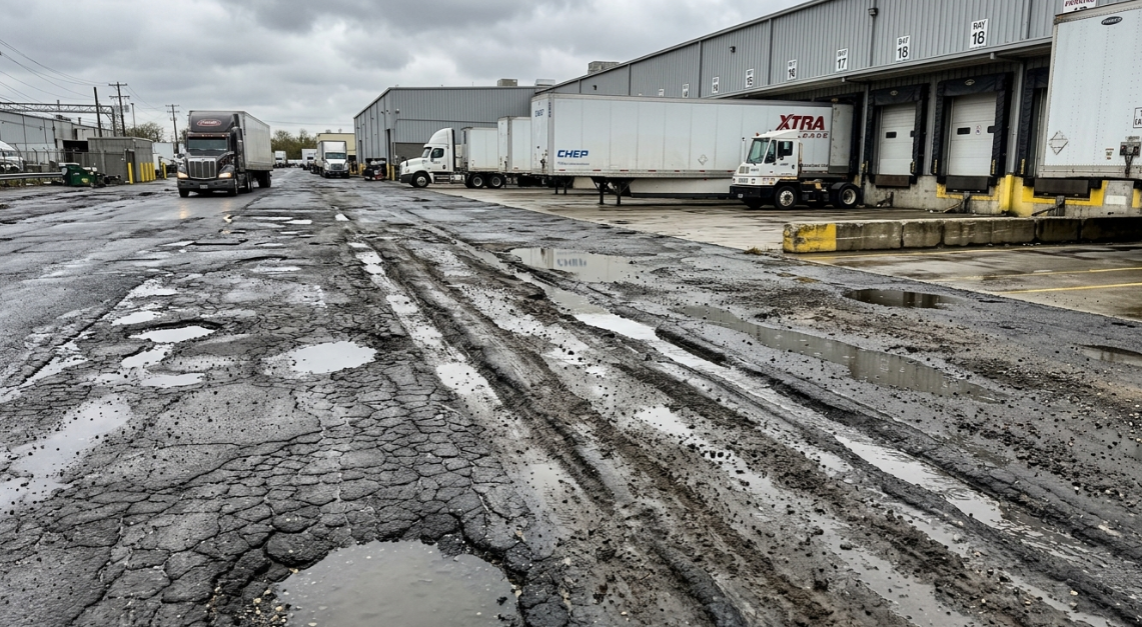
Common Truck Court Failures and Their Causes
|
Pavement Problem |
Likely Cause |
Typical Solution |
|---|---|---|
|
Rutting |
Weak asphalt or base |
Reconstruction or thicker section |
|
Alligator cracking |
Base failure |
Full-depth reclamation |
|
Ponding water |
Drainage issues |
Regrade and improve drainage |
|
Shoving |
Slow truck turning |
Concrete or thicker asphalt |
|
Joint spalling |
Poor joint maintenance |
Joint repair |
|
Pumping |
Saturated subgrade |
Drainage and stabilisation |
|
Settlement |
Weak soils |
Subgrade remediation |
|
Landing gear holes |
Asphalt deformation |
Concrete landing pads |
At-a-Glance Comparison: 9 Truck Court Paving Options
|
Rank |
Option |
Best for |
Planning cost signal |
Main advantage |
Main tradeoff |
|---|---|---|---|---|---|
|
1 |
Wright Construction full-service truck court paving |
Distribution centers, warehouses, and industrial facilities across the Southeast needing concrete, asphalt, base, drainage, and ADA work from one contractor |
Project-based pricing |
Multi-trade self-performance eliminates subcontractor coordination; five regional offices for fast mobilization |
Southeast regional focus |
|
2 |
Reinforced concrete truck court |
High-volume docks, landing gear zones, tight turns |
~$17.50/sf (8″ reinforced, 2026 GA public bid) |
Best resistance to point loads, rutting, shoving, heat |
Higher upfront cost; curing and phasing required |
|
3 |
Hybrid concrete apron + heavy-duty asphalt |
Facilities needing cost control with heavy dock loading |
Blended; depends on concrete/asphalt split |
Concrete where loads concentrate, asphalt where it works |
Requires smart zoning and good transition detailing |
|
4 |
Heavy-duty asphalt section |
Circulation lanes, lower-volume truck routes, trailer parking |
$4 to $10/sf new; heavy-duty higher |
Faster install, easier future repairs |
Vulnerable to heat, turning, braking, point loads |
|
5 |
Roller-compacted concrete (RCC) |
Large industrial yards, ports, high-load areas |
Often competitive with asphalt; depends on availability |
Concrete strength placed with asphalt-style equipment |
Surface finish and contractor experience critical |
|
6 |
Concrete overlay / whitetopping |
Structurally sound asphalt needing surface upgrade |
Project-specific; avoids full removal if base qualifies |
Upgrades failing surface to rigid pavement |
Not suitable when base or subgrade has failed |
|
7 |
Mill and overlay |
Surface wear on sound base, budget resurfacing |
~$2.50 to $4.50/sf |
Faster, cheaper than reconstruction |
Does not fix base failure or structural rutting |
|
8 |
Full-depth reclamation (FDR) |
Widespread base failure, alligator cracking, soft subgrade |
~$4.50 to $7.00/sf in some markets |
Rebuilds structural support, reuses material |
Needs engineering, testing, equipment access |
|
9 |
Targeted concrete pads and repairs |
Landing gear holes, dolly pads, dock-adjacent failures |
High per-sf mobilization on small jobs |
Solves local failures without full court shutdown |
Only works if surrounding pavement is sound |
Cost benchmarks: A 2026 public Georgia concrete price sheet lists 8-inch reinforced slab at $17.50/sf. Commercial asphalt new installation commonly falls around $4 to $10/sf depending on depth, base, and site prep. These are planning signals, not project quotes.
For a deeper look at how distribution center paving zones break down by material and function, that guide covers dock aprons, trailer staging, circulation lanes, and employee parking in detail.
Which Truck Court Paving Option Fits Your Facility?
|
Facility Type |
Recommended Solution |
|---|---|
|
Regional warehouse |
Hybrid concrete + asphalt |
|
Distribution centre |
Reinforced concrete |
|
Manufacturing plant |
Hybrid or RCC |
|
Truck terminal |
Reinforced concrete |
|
Intermodal yard |
RCC |
|
Trailer storage yard |
Heavy-duty asphalt or concrete pads |
|
Cold storage facility |
Reinforced concrete |
|
Food distribution |
Hybrid |
|
Logistics hub |
Reinforced concrete |
|
Industrial plant |
Depends on traffic analysis |
Why Subgrade Matters More Than Surface Material
Many truck court failures begin below the pavement rather than within the concrete or asphalt itself. Weak soils, poor compaction, trapped moisture, and inadequate drainage reduce structural support, allowing pavement to flex, settle, or crack long before its expected service life.
Common subgrade improvements include:
-
Proof rolling
-
Undercutting unsuitable soils
-
Geotextiles
-
Geogrids
-
Cement stabilisation
-
Lime stabilisation
-
Crushed stone replacement
-
Compaction testing
Even the strongest reinforced concrete cannot compensate for poor subgrade preparation.
The 9 Options, Ranked
1. Wright Construction Full-Service Truck Court Paving
Best for: Commercial and industrial facilities across the Southeast that need concrete paving, asphalt paving, base work, drainage, industrial concrete repairs, and ADA remediation handled by a single contractor, without coordinating multiple subcontractors.
Most truck court projects involve more than one material and more than one trade. A typical scope might include demolition, subgrade remediation, stone base installation, concrete dock aprons, asphalt circulation lanes, storm drainage, inlet collars, bollards, striping, and ADA compliance work. When those trades are split across separate subcontractors, scheduling gaps, finger-pointing over failed sections, and coordination delays are common pain points.
Wright Construction self-performs across concrete paving, asphalt paving, industrial concrete maintenance, site services, drainage, and ADA remediation. The company operates from five offices in Memphis, Nashville, Chattanooga, Birmingham, and Huntsville, covering most of the Southeastern United States including Tennessee, Alabama, Georgia, Mississippi, Arkansas, the Carolinas, and surrounding states.
Key features:
-
Self-perform crews for structural concrete, concrete paving, asphalt paving, industrial concrete repairs, site work, and ADA compliance
-
Truck court expansion paving, dock apron construction, subgrade remediation with stone base or cement treatment, and storm drainage installation
-
Industrial concrete maintenance including joint repairs, slab repairs, dock leveler pit construction, and heavy-duty truck ramp construction
-
Asphalt lifecycle services including milling, overlays, sealcoating, and crack sealing
-
Demonstrated capacity for large, fast-turnaround projects (200,000 sq ft paving completed in 5 days at Whitesburg Shopping Center; 150,000+ sq ft at a Kohler facility)
-
Tennessee DOT prequalification
Tradeoffs:
-
Regional focus on the Southeast; not a nationwide contractor
-
Project-based pricing requires site evaluation rather than standardized rate cards
Wright Construction’s multi-trade capability means one contractor handles the concrete dock apron, the asphalt circulation lanes, the stone base, the drainage, and the striping. That reduces coordination risk and keeps accountability in one place. For facilities running 24/7, that single point of contact matters during phased construction.
Contact Wright Construction for truck court paving, expansion, repair, or phased reconstruction across the Southeast.
2. Reinforced Concrete Truck Court
Best for: High-volume distribution centers, dock aprons, landing gear zones, yard jockey turning areas, dumpster and dolly pads, and any zone where repeated maintenance downtime costs more than upfront pavement investment.
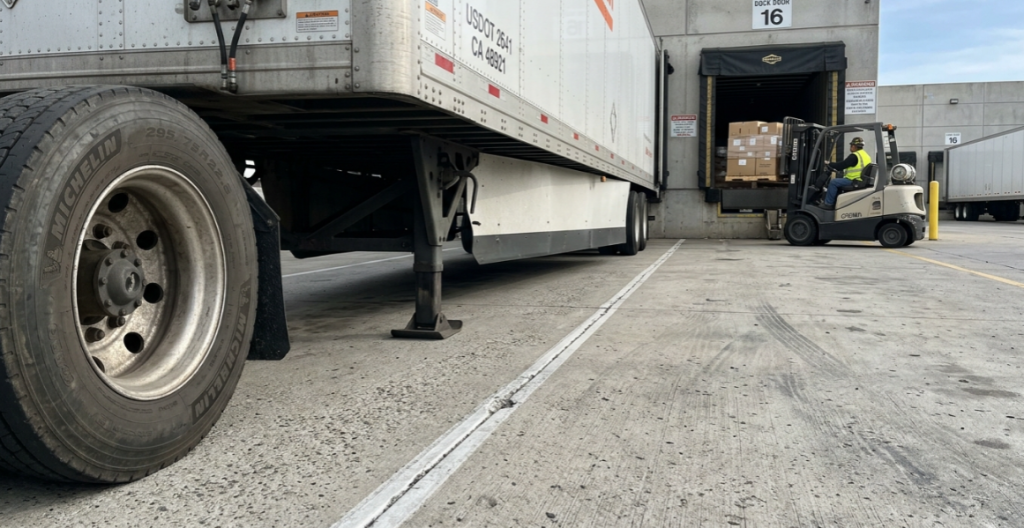
A truck court dock apron sees static trailer loads, landing gear point loads, forklift traffic entering trailers, dock impacts, and braking. ACI publishes a dedicated guide (PRC-330.2-17) specifically for concrete paving at industrial and trucking facilities, covering pavement support systems, thickness design, joint spacing, load-transfer devices, and trailer bearing stresses. That guide exists because industrial truck pavement is its own engineering category.
Dock equipment manufacturer LODEM recommends designing landing gear pads for two 25,000-lb point loads spaced 6 feet apart when supporting loaded trailers or trailers with forklifts on board. That is 50,000 pounds concentrated on two small footprints. Asphalt softens under that kind of static pressure, especially in warm weather. Concrete does not.
Key features:
-
Rigid pavement that resists point loads, rutting, and shoving
-
Can be reinforced with rebar or wire mesh for additional load capacity
-
Doweled joints, thickened edges, and edge beams available where needed
-
Joint layout, curing plan, and sawcut timing are part of proper installation
-
Better performance under static and slow-moving loads than asphalt
What practitioners say. Truckers on Reddit have shared real examples of trailer landing gear punching into hot asphalt at dock areas. Users on TruckersReport made the same point: hot asphalt can allow landing gear to fall through, while concrete holds up far better for dropped trailers. These are not edge cases. They are everyday problems at busy docks in warm climates.
Tradeoffs:
-
Higher installed cost than asphalt
-
Requires curing time and phased access planning
-
Joint maintenance is essential for long-term performance
-
Poor subgrade can still ruin concrete; rigid pavement is not a substitute for proper base support
-
Repairs can be more disruptive than small asphalt patches
Wright Construction’s concrete paving services cover new truck court construction, dock apron installation, industrial concrete repairs, and concrete joint maintenance for commercial and industrial facilities across the Southeast.
3. Hybrid Concrete Apron + Heavy-Duty Asphalt Circulation
Best for: Facilities with heavy dock loading but large circulation areas, budget-conscious owners who still want concrete where it matters most, and warehouses where trucks concentrate static loads near dock doors but circulate over bigger footprints.
Blue Giant’s dock planning guidance states it directly: if the dock area is surfaced with asphalt, a concrete landing strip must be poured to keep trailer landing gear from sinking in warm temperatures. That single recommendation is the strongest case for a hybrid system. Put concrete where loads are worst. Use heavy-duty asphalt where trucks are rolling, not sitting.
Key features:
-
Reinforced concrete at dock face, landing gear zones, and tight-turn areas
-
Heavy-duty asphalt in drive aisles, circulation lanes, and trailer parking
-
Concrete pads at dumpsters, compactors, dolly pads, and heavy turning pockets
-
Transition detailing between concrete and asphalt sections
-
Requires traffic flow analysis and phasing plan
Tradeoffs:
-
Bad zoning defeats the purpose; the concrete must go where the loads actually land
-
Asphalt-to-concrete transitions can fail if not detailed and built correctly
-
Asphalt zones still need proper base, thickness, drainage, and maintenance
-
Owners sometimes under-spec the asphalt portion to cut costs, creating a weak link in the system
This is the default recommendation for many existing Southeast facilities. Concrete where trucks stop, drop, turn, or load. Asphalt where trucks roll and loads are less concentrated.
4. Heavy-Duty Asphalt Section
Best for: Truck circulation lanes, lower-volume routes, trailer parking with limited landing gear concentration, facilities needing faster reopening, and sites where future utility work or reconfiguration is likely.
Asphalt is not inherently wrong for truck courts. The problem is treating it like standard parking lot asphalt. NAPA’s heavy-duty pavement guidance specifies that large-stone and heavy-duty mixes are needed for high-stress pavements exposed to heavy vehicle traffic, including truck facilities, container yards, and intermodal areas.
Heavy-duty designs often call for 4 to 6 inches of asphalt over 10 to 12 inches or more of aggregate base, sometimes with a stabilized subbase. That is a completely different section than a 3-inch parking lot surface.
Key features:
-
Flexible pavement system that is easier to mill, patch, and overlay
-
Can use heavy-duty asphalt mixes designed for high-stress loads
-
Faster construction and reopening than concrete
-
Needs proper lift thickness, tack coat between lifts, compaction control, and strong base
What practitioners say. In a Reddit discussion about garbage trucks damaging asphalt, users emphasized that the base is often more important than the surface. One user reported that a year of weekly heavy-truck visits destroyed a thin asphalt section, creating potholes and rutting. The thread repeatedly pointed out that wheel turning tears up asphalt. These observations apply directly to truck court conditions.
Tradeoffs:
-
More vulnerable than concrete under static trailer landing gear
-
Slow-speed turning, braking, and summer heat increase rutting risk dramatically
-
A 2025 study found that when surface temperature rose from 34°C to 70°C, asphalt rutting depth increased 4.83 times
-
Oil, fuel, and hydraulic fluid accelerate deterioration
-
Thin asphalt over a weak base will fail quickly regardless of the mix
For a detailed comparison of how asphalt and concrete handle Southeastern weather conditions, that guide breaks down heat, moisture, and freeze-thaw performance by material. Wright Construction’s Memphis office supports both concrete and asphalt truck court paving across the Mid-South, where summer heat makes material selection especially consequential.
5. Roller-Compacted Concrete (RCC)
Best for: Large industrial yards, ports and intermodal facilities, industrial haul roads, and large exterior pavements where speed, durability, and cost efficiency all matter.
RCC is zero-slump concrete placed with asphalt-style paving equipment and compacted with rollers instead of conventional finishing. FHWA’s technical brief describes RCC as a concrete pavement that uses asphalt-type paving and rolling methods and identifies truck terminals, rail yards, and container ports as primary applications.
Key features:
-
Strong, concrete-like pavement installed faster than conventional concrete on large areas
-
Good resistance to rutting and heavy loads
-
Often promoted as cost-competitive with asphalt on large projects
-
Does not require forms or conventional finishing for large placements
What practitioners say. Civil engineers on Reddit gave mixed feedback. One reported that RCC worked well on a long-term haul road and was easy to place. Another warned that surface finish can be rough and joint quality can disappoint if the contractor or owner expects the look of conventional concrete.
Tradeoffs:
-
Contractor experience is critical; not every crew can do RCC well
-
Surface finish is rougher than conventional concrete
-
Not every ready-mix plant can produce the zero-slump mix
-
Jointing, curing, and compaction still matter
-
Local availability controls pricing more than national averages
RCC can be excellent when the project is big enough, the contractor has real experience, and the owner understands the surface finish tradeoff. It is not a commodity replacement for conventional concrete.
6. Concrete Overlay / Whitetopping
Best for: Existing asphalt truck courts with surface distress but structurally stable base, facilities wanting concrete performance without full-depth excavation, and sites where grade elevations allow adding a layer.
A concrete overlay places a new concrete layer over existing asphalt, turning part of the existing pavement into the support system. It can be bonded or unbonded depending on the design.
Key features:
-
Can upgrade a failing asphalt surface to rigid pavement without full reconstruction
-
May reduce demolition and haul-off compared to complete tear-out
-
Requires evaluation of existing asphalt thickness, cracking, rutting, drainage, and base condition
-
Grade increases must be checked against dock heights, drainage, bollards, and ADA routes
Tradeoffs:
-
Not a fix for pumping, settlement, soft subgrade, or base failure
-
Reflective cracking and bonding issues can occur
-
Grade changes may affect dock leveler range and trailer approach angles
-
Requires engineering review and often pavement cores before specifying
Practitioners on Reddit emphasize that cores and borings are important before deciding whether resurfacing, overlay, or full-depth work is appropriate. A concrete overlay is smart when the existing asphalt is competent enough to serve as support. If the base is failing, skip the overlay and rebuild the section.
7. Mill and Overlay
Best for: Asphalt truck areas with surface-level wear, oxidation, or cracking on a structurally sound base, and budget-conscious resurfacing where base failure is not the problem.
The contractor mills off the deteriorated asphalt surface (typically 1.5 to 2 inches), applies tack coat, and places a new asphalt lift. It refreshes the wearing course without disturbing the underlying structure. For more detail on when asphalt resurfacing makes sense and when it does not, that guide covers overlay decisions, depth, and limitations.
Key features:
-
Faster and cheaper than reconstruction
-
Can be phased by area to maintain partial operations
-
Improves ride, appearance, drainage profile, and surface durability
-
Works best when the underlying pavement section is structurally adequate
What practitioners say. In a Reddit civil engineering thread, practitioners noted that resurfacing typically covers only the top 1.5 to 2 inches, and pavement cores are necessary to confirm existing depth and condition. They warned that visible base or subgrade failure after milling must be repaired before any new surface goes down.
Tradeoffs:
-
Does not fix soft subgrade, base failure, or severe structural rutting
-
Does not fix poor drainage unless grading and inlets are also addressed
-
Can temporarily hide problems and make the next repair more expensive
-
Not appropriate where landing gear, turning, or static loads are the primary failure cause
Mill and overlay is a surface solution. If your truck court is failing from the bottom up, overlaying it is buying time, not solving the problem. As one practitioner on Reddit put it bluntly, sealcoating and cosmetic treatments “will do jack” to fix structural pavement issues.
8. Full-Depth Reclamation or Stabilized Base
Best for: Widespread alligator cracking, repeated potholes, rutting from weak subgrade, settlement across large areas, and old truck courts with a patch-on-patch history where the base has given out.
Full-depth reclamation (FDR) pulverizes the existing asphalt and base, blends the material, adds a stabilizer (cement, lime, or asphalt emulsion), and recompacts it into a stronger foundation. New asphalt or concrete is then placed over the rebuilt base.
Key features:
-
Reuses existing material rather than hauling it all off
-
Rebuilds structural support from the ground up
-
Can use cement, lime, or other stabilizers depending on soil conditions
-
New surface (asphalt or concrete) placed over a properly designed base
What practitioners say. A civil engineer on Reddit described FDR as expensive but said that when done correctly, the resulting pavement can hold up for a long time. Multiple threads emphasized that cores, borings, and geotechnical input are essential before specifying any repair. The takeaway: do not pave over bad dirt.
Tradeoffs:
-
Requires large equipment and enough room to operate
-
Not always feasible in tight or constrained dock areas
-
Needs material testing and mix design
-
Utilities, grades, drainage, and edge conditions must be managed
-
Quality of reclaimed base varies based on existing material
Understanding grading and base preparation is essential before specifying any new truck court surface. If the subgrade is the problem, no surface material will save it.
Wright Construction’s site services include storm drainage, stone base installation, subgrade remediation with stone base or cement treatment, curb and gutter, and related work that addresses the root causes of truck court pavement failure.
9. Targeted Concrete Pads, Joint Repairs, and Slab Replacement
Best for: Trailer landing gear holes, dolly pad failures, dumpster pad replacement, dock-adjacent slab damage, broken concrete panels, and isolated problem areas where the surrounding pavement is still serviceable.
The contractor sawcuts and removes the failed section, repairs the base or subgrade underneath, installs a reinforced concrete pad or replacement slab, ties into adjacent concrete if needed, and seals joints after curing.
Key features:
-
Solves localized high-load failures without shutting down the entire truck court
-
Can be phased around active dock operations
-
Works for landing gear pads, dolly pads, dumpster pads, and damaged dock apron panels
-
Allows targeted fixes while the facility plans for broader reconstruction later
Tradeoffs:
-
Mobilization costs can be high relative to the small area of work
-
Local repairs do not solve systemic base or drainage problems
-
Mismatched patch elevations can create issues for forklifts, plows, or trailer movement
-
Repeated patching eventually becomes more disruptive and expensive than planned reconstruction
-
Adjacent asphalt may continue to fail if the underlying loading pattern has not changed
This is the maintenance triage option. It captures a real buyer need: “Can you fix the failing dock area without shutting down the whole court?” For many facilities, the answer is yes, as long as the surrounding pavement still has structural life.
How to Choose the Right Truck Court Paving Option
The decision should start with zones, not materials. Most paving contractors talk about asphalt or concrete as if the entire property gets one answer. Truck courts do not work that way.
Dock apron: Static trailer loads, forklift movement, landing gear, braking. Reinforced concrete is the strong default.
Landing gear strip and trailer staging: Point loads from detached trailers. Concrete pads or strips are the safer material.
Turning pockets and yard jockey lanes: Slow turning, lateral shear, braking, heat. Concrete or heavy-duty asphalt depending on traffic intensity.
Circulation lanes: Repeated axle loads with less static concentration. Heavy-duty asphalt can work with proper base and drainage.
Employee and visitor parking: Standard commercial pavement. No need to overbuild unless trucks cross the area.
Drainage and inlets: Fix drainage and base before surfacing. Always.
Before choosing any option, use a pavement inspection checklist to document existing conditions, failure modes, and priority areas.
Ten Questions to Answer Before Bidding
-
How many trucks use the court per day?
-
Are trailers dropped or always attached to tractors?
-
Are forklifts entering trailers while they are spotted at the dock?
-
Are yard jockeys making tight turns near dock faces?
-
Is there visible rutting, shoving, or landing gear damage?
-
Is there alligator cracking or water pumping at joints and cracks?
-
Does water pond after rain?
-
Will grade changes affect dock doors, drains, bollards, or ADA routes?
-
How many dock doors can be offline at once?
-
Is phased construction required for 24/7 operations?
What Truck Court Paving Costs
Truck court paving costs vary more than standard parking lot paving because the expensive part is often not the surface. Demolition, subgrade remediation, stone base, cement treatment, drainage, phasing, dock access coordination, reinforcement, jointing, striping, and traffic control can all change the final number significantly.
Planning benchmarks (not project quotes):
-
Commercial asphalt new installation: Commonly $4 to $10/sf depending on depth, base, lot size, and site prep.
-
8-inch 5000 PSI reinforced concrete slab: A 2026 Georgia public bid sheet lists $17.50/sf with rebar; unreinforced at the same thickness is around $14.25/sf.
-
Mill and overlay: Commonly $2.50 to $4.50/sf for commercial resurfacing.
-
Full-depth reclamation: One 2026 commercial guide cites $4.50 to $7.00/sf in its market.
These figures are market-dependent planning signals. Actual pricing varies by region, project size, base condition, phasing requirements, and material markets. Wright Construction uses project-based pricing.
Separate installed cost from real cost. A cheaper mill-and-overlay can end up expensive if it fails again in three years and shuts down docks. Think about cost in three buckets:
-
Installed cost: Demolition, base, material, labor, and striping.
-
Operational cost: Dock closures, rerouting, staging disruptions, and lost throughput during construction.
-
Life-cycle cost: Future maintenance, repairs, overlays, joint sealing, and eventual reconstruction.
Infrastructure professionals on LinkedIn frequently frame concrete vs. asphalt as a life-cycle and operational availability decision, not a first-cost comparison. That framing applies directly to truck court paving. The cheapest option is rarely the cheapest over ten years.
Expected Pavement Service Life
|
Pavement Type |
Typical Life* |
|---|---|
|
Reinforced concrete |
30–40+ years |
|
Heavy-duty asphalt |
15–25 years |
|
RCC |
30–40 years |
|
Concrete overlay |
15–25 years |
|
Mill and overlay |
8–15 years |
|
Full-depth reconstruction |
Depends on surface installed |
Phasing: Can You Pave Without Shutting Down Operations?
Often yes, but it requires planning beyond the paving itself.
A documented project at a Harbor Freight distribution center replaced 260,000 sq ft of truck court pavement while only six loading dock doors could be taken offline at a time and truck routes had to remain functional throughout construction. The scope included removing 12 inches of existing asphalt, excavating 9 inches of subgrade, installing soil cement base, pouring a 9-inch concrete slab, joint sealing, and restriping. That kind of execution requires coordination beyond basic paving capability.
Wright Construction has completed a 200,000 sq ft paving project in 5 days, demonstrating the kind of high-speed execution that active facilities require.
Practical phasing questions to resolve before construction starts:
-
How many dock doors can be offline simultaneously?
-
Can inbound and outbound traffic be separated during construction?
-
Can work happen by lane, bay group, or during night and weekend shifts?
-
Where will trailers stage during concrete curing?
-
How will emergency access be maintained?
-
When can striping, bollards, and dock equipment be restored?
What to Ask Before Hiring a Truck Court Paving Contractor
-
Have you built or repaired truck courts, dock aprons, trailer staging areas, or distribution-center pavement?
-
Do you self-perform concrete, asphalt, base, and site work, or subcontract most of it?
-
Will you core the existing pavement before recommending an overlay?
-
Will you evaluate subgrade, drainage, and base condition?
-
Can you phase work around dock operations?
-
How do you handle landing gear zones?
-
What concrete thickness, reinforcement, joint layout, and curing plan are you recommending?
-
What asphalt mix, lift thickness, base thickness, and compaction testing are included?
-
Are inlet collars, trench drains, bollards, striping, and ADA routes included in the scope?
-
What is excluded from the bid?
Truck court paving requires a contractor who understands concrete, asphalt, site work, drainage, and industrial operations. A multi-trade contractor reduces coordination risk and keeps accountability in one place. Wright Construction self-performs across concrete paving, asphalt paving, industrial concrete maintenance, site services, drainage, ADA remediation, and related work from five regional offices.
Contact Wright Construction for truck court paving, expansion, repair, or phased reconstruction across the Southeast.
Truck Court Paving Standards and Design References
Truck court pavement should be designed using recognised engineering standards rather than rule-of-thumb thicknesses.
Common references include:
|
Standard |
Purpose |
|---|---|
|
ACI 330.2R |
Concrete parking lots and industrial paving |
|
AASHTO Pavement Design Guide |
Structural pavement design |
|
PCA Industrial Pavement Guidance |
Concrete pavement design |
|
NAPA Heavy Duty Pavement Guide |
Asphalt truck facilities |
|
FHWA RCC Technical Brief |
Roller-compacted concrete |
|
ASTM Soil Testing Standards |
Subgrade evaluation |
These standards help engineers determine pavement thickness, reinforcement, joint spacing, drainage, and expected service life.
Frequently Asked Questions
What is truck court paving?
Truck court paving is the construction, replacement, repair, or expansion of pavement in the truck maneuvering, loading, staging, and dock approach areas of a warehouse, manufacturing plant, or distribution center. It covers dock aprons, landing gear zones, trailer staging, circulation lanes, and related infrastructure like drainage, bollards, and striping.
Is concrete or asphalt better for truck courts?
Concrete is usually better for dock aprons, trailer landing gear zones, and tight turning areas because it resists point loads, rutting, and heat-related deformation. Heavy-duty asphalt can work in circulation lanes and lower-risk truck areas when the base, thickness, drainage, and mix design are correct. Most facilities benefit from a hybrid approach that uses both materials in the right zones.
How thick should truck court pavement be?
There is no universal thickness. It depends on truck volume, axle loads, trailer staging patterns, subgrade strength, base design, drainage, climate, and material choice. ACI publishes a dedicated guide for concrete site paving at industrial and trucking facilities, which is why engineered design matters more than rules of thumb.
Why do trailer landing legs sink into asphalt?
Landing gear creates concentrated point loads, sometimes exceeding 25,000 pounds per leg. In warm weather, asphalt softens and deforms under static pressure. Dock planning guidance from manufacturers recommends concrete landing strips or pads whenever asphalt is used at loading docks.
Can a truck court be repaired without shutting down the facility?
Often yes, but it requires phasing. Work can be divided by dock groups, lanes, nights, weekends, or temporary traffic patterns. Documented projects have replaced hundreds of thousands of square feet of pavement while keeping limited dock doors and truck routes active throughout construction.
Is mill and overlay enough for a failing truck court?
Only if the base is sound and the damage is mainly surface wear. If there is rutting, pumping, alligator cracking, settlement, or drainage failure, mill and overlay will hide the problem temporarily rather than fix it. Pavement cores and a base evaluation should come before any resurfacing decision.
What causes truck court pavement to fail?
Common causes include rutting from slow heavy trucks and summer heat, shoving near turns and stops, landing gear point loads on asphalt, alligator cracking from base or subgrade failure, ponding from poor drainage, and broken concrete joints from inadequate load transfer. Most failures start below the surface, not at it.
How do I budget for truck court paving?
Start with a site evaluation, not a per-square-foot guess. Demolition, subgrade repair, stone base, drainage, reinforcement, phasing, and dock coordination can all change the cost dramatically. Get pavement cores, evaluate the base, define the phasing requirements, and then request proposals based on real conditions.