
TL;DR
Commercial parking lot maintenance covers everything from routine sealcoating and crack sealing to full-depth pavement replacement. Asphalt, which makes up roughly 90% of U.S. parking lots, lasts 20 to 30 years with proper upkeep but can fail in half that time without it. Proactive maintenance costs three to five times less than reactive repairs. This glossary defines every term property managers and commercial owners encounter when maintaining, budgeting for, and extending the life of their parking lots.
A parking lot is often the first thing a customer, tenant, or visitor notices about a commercial property. It is also, for many property managers, the asset they understand least. The terminology alone can be a barrier. What exactly is alligator cracking? How is crack sealing different from crack filling? What does a Pavement Condition Index score actually tell you?
This glossary exists to close that gap. It covers the full vocabulary of commercial parking lot maintenance, organized by category so you can jump to what you need. Each definition includes context on why the term matters and, where relevant, cost benchmarks and compliance requirements that affect real decisions.
Quick Takeaway: How long does a commercial parking lot last?
On average, a commercial asphalt parking lot lasts 20 to 30 years, while concrete lasts 30 to 40 years. However, lifespan is entirely dependent on proactive maintenance. Property managers can extend pavement life and reduce total cost of ownership by following this benchmark:
Sealcoating: Every 2–4 years.
Crack Sealing: Annually or as soon as cracks appear.
Annual Budget: $0.10 to $0.25 per square foot.
Cost Savings: Proactive maintenance is 3x to 5x cheaper than reactive “emergency” repairs.
Jump to a section:
Pavement Types and Materials
Asphalt (Hot-Mix Asphalt / HMA)
The dominant surface material for commercial parking lots. Asphalt accounts for approximately 90% of all parking lots in the United States, made from aggregate (stone, sand, gravel) bound with liquid asphalt cement. Property owners favor it because it is cost-effective, quick to install, and repairable in sections rather than requiring wholesale replacement.
On average, constructing an asphalt parking lot costs between $2 and $4.50 per square foot, with total project costs typically ranging from $10,000 to $150,000 depending on lot size. With consistent maintenance, asphalt offers a lifespan of 20 to 30 years. Without it, expect half that.
There is a reason asphalt dominates commercial parking lot maintenance planning. It is the surface most property managers will spend their careers maintaining. For a deeper comparison, read about why asphalt is the preferred choice for commercial parking lot paving.
Expert Tip: For high-traffic entrances and dumpster pads, always specify concrete. Asphalt is flexible but will “shove” or rut under the constant weight of heavy waste trucks or 18-wheelers.
Concrete Pavement
Used in areas where asphalt would fail under concentrated or static loads: truck courts, loading docks, dumpster pads, and drive-through lanes. Concrete costs more upfront ($4 to $7 per square foot) but delivers a longer service life of 30 to 40 years. Many commercial lots use a combination of both materials, with asphalt covering the main parking field and concrete at high-stress points.
For properties that rely on concrete surfaces, understanding preventative maintenance for concrete pavement is just as important as knowing how to maintain asphalt.
Subgrade
The native soil beneath the pavement structure. Everything built on top of it depends on its strength. Clay-heavy soils (common across Tennessee and Alabama) are particularly problematic because they expand when wet and shrink when dry, creating movement that cracks the pavement above. Weak subgrade requires stabilization, typically with crushed stone base or cement treatment, before any paving begins.
Stone Base (Aggregate Base Course)
A layer of crushed stone placed between the subgrade and the asphalt surface. It serves two purposes: structural support and drainage. Water that penetrates the asphalt needs somewhere to go, and the stone base layer channels it away from the subgrade. Commercial lots typically require 4 to 6 inches of asphalt over a properly compacted stone base. Each additional inch of asphalt adds roughly $0.50 to $1.00 per square foot to the project.
Maintenance Services and Methods
This section covers the core services that make up a commercial parking lot maintenance program. Understanding what each one does (and when it is appropriate) is the difference between spending wisely and wasting money.
Sealcoating
A protective coating, typically coal tar or asphalt emulsion, applied to the parking lot surface. Sealcoating shields against UV degradation, water penetration, and chemical spills from oil and gasoline. It is the single most cost-effective maintenance task for commercial lots.
Cost: $0.14 to $0.25 per square foot for basic applications, $0.20 to $0.50 per square foot depending on project complexity. Combined with crack sealing, expect $0.60 to $0.80 per square foot. Add line striping and the range moves to $0.65 to $0.90 per square foot.
Frequency: Every 2 to 4 years. The first sealcoat should be applied 6 to 12 months after installation. Learn more about the benefits of asphalt sealcoating and when to sealcoat after paving.
Temperature requirements: Pavement sealers require a minimum of 55°F and rising, with temperatures not falling below 50°F for 48 hours after application.
One important practitioner warning: Steven Brahney, a commercial paving consultant with over 30 years of experience, notes that sealcoating applied after October 31 in areas where overnight freezing occurs within 30 days will “wear off the asphalt by the spring.” He recommends that property managers require a one-year irrevocable warranty and 20% retainage until spring inspection for any late-season sealcoat work. Contractors motivated by revenue will sometimes push late-season applications despite knowing the results will be poor.
Crack Sealing vs. Crack Filling
These are two distinct methods, and confusing them leads to wasted money.
Crack sealing uses rubberized, flexible sealant designed to move with the pavement. It is the right choice for active (working) cracks that expand and contract with temperature changes. More durable but more expensive.
Crack filling uses rigid material to fill non-working cracks, those that have stabilized and no longer move. Less expensive, less durable.
Both methods prevent water infiltration, which is the primary cause of pavement failure. In the Southeast, where heavy rain events are frequent and intense, keeping water out of cracks is critical. For strategies beyond filling, read about how to keep asphalt pavement from cracking in the first place.
Pothole Repair
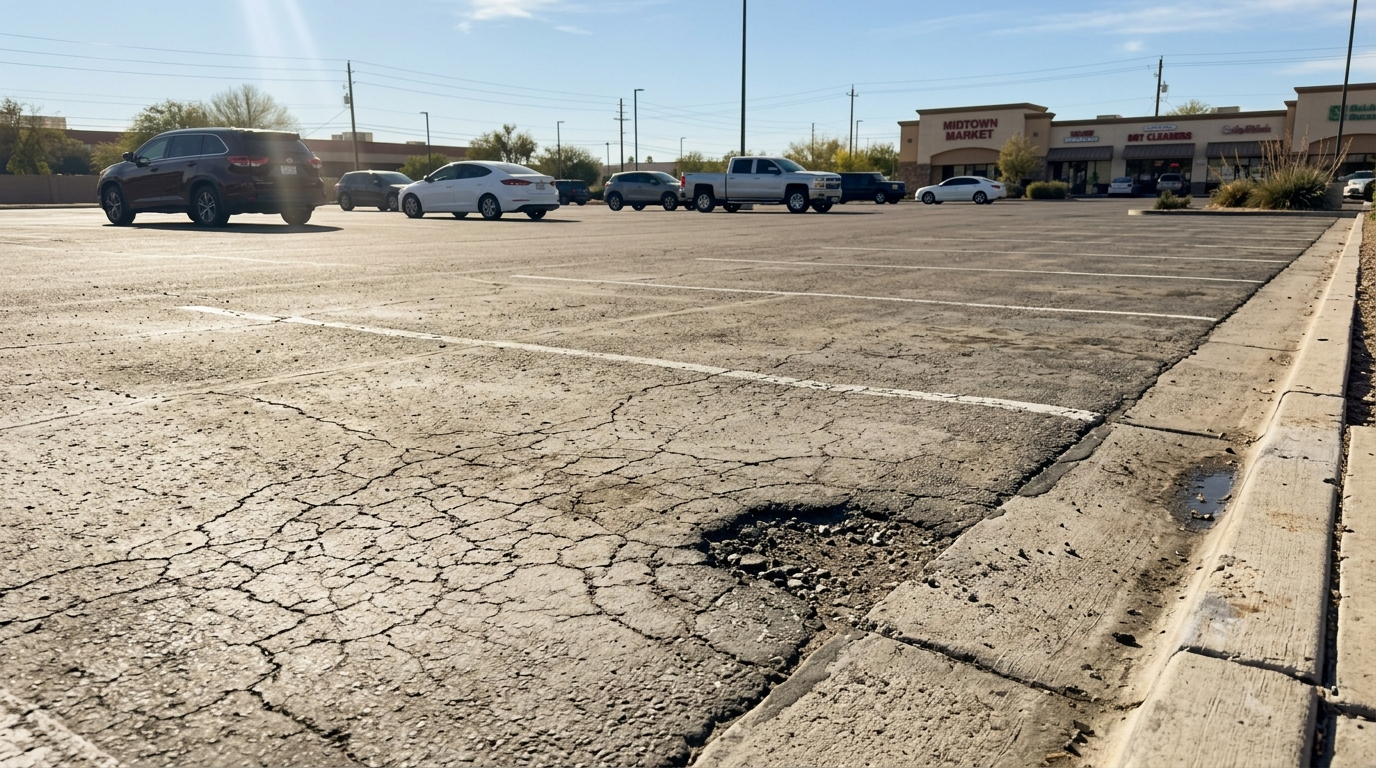
A pothole forms through a specific sequence: water penetrates the surface through cracks, erodes the base layer beneath, and the asphalt above collapses under traffic loads. There are three common repair approaches:
Cold patch: Pre-mixed material applied as a temporary fix. It does not bond well to the surrounding pavement and fails quickly. Think of it as a bandage, not a cure.
Hot-mix patch (saw-cut and replace): The permanent repair standard. Crews cut clean edges around the damaged area, compact the base, and place fresh hot-mix asphalt. The result is a structurally sound repair with defined joints.
Infrared repair: Heats the existing asphalt in place, mixes it with fresh material, and recompacts. This creates a seamless, thermally bonded patch with no cold joints. Faster than saw-cut and replace, and the finished surface blends with the surrounding pavement.
Milling (Asphalt Milling / Cold Planing)
The process of grinding away the top layer of existing asphalt using a milling machine. Milling removes damaged surface material while maintaining curb heights, drainage grades, and the existing base structure. It is almost always performed before an overlay. The milled surface also creates a rough texture that helps the new asphalt layer bond properly.
Asphalt Overlay
A new layer of asphalt (typically 1.5 to 3 inches) placed over the existing pavement after milling or surface preparation. Resurfacing with an overlay typically costs $1.50 to $3.00 per square foot, which is 40 to 60% less than full-depth replacement while extending pavement life by 15 to 20 years.
This is one of the most important decisions in commercial parking lot maintenance: repair, resurface, or replace? Practitioners at C Brooks Paving offer a useful rule of thumb. Repair is the right call when less than 25% of the lot area is affected and the base is sound. Resurfacing makes sense when the surface is generally worn but the structural base remains intact. Full replacement becomes necessary only when the base has failed or drainage problems are severe and widespread.
Not sure which category your lot falls into? Here is how to tell whether your parking lot needs resurfacing or full replacement.
Striping (Line Striping / Pavement Marking)
Painted traffic markings on the parking lot surface, including parking stalls, directional arrows, fire lanes, handicap symbols, and crosswalks. Striping typically fades over 1 to 3 years depending on traffic volume and UV exposure. It must be reapplied after every sealcoating project since the sealcoat covers existing markings.
Striping is often treated as an afterthought, but it directly affects traffic flow, liability exposure, and ADA compliance. Poorly striped lots create confusion, reduce capacity, and invite legal risk. Read more about why parking lot striping is an underrated art.
Sweeping
Regular cleaning removes debris, sand, leaves, and trash from the pavement surface. Beyond aesthetics, sweeping reveals developing problems (new cracks, potholes, drainage issues) that might otherwise go unnoticed. Commercial lots with heavy leaf or trash accumulation should be swept monthly at minimum. Organic debris retains moisture against the pavement surface and accelerates deterioration.
Full-Depth Replacement
Complete removal of the existing pavement structure (asphalt and base) down to the subgrade, followed by reconstruction. This is the most expensive option and is reserved for lots where the base has failed, drainage is fundamentally compromised, or the pavement has reached the end of its structural life.
Summary of Parking Lot Maintenance Costs & Lifespan
Service | Primary Purpose | Frequency | Est. Cost (per sq. ft.) |
Sealcoating | UV/Water Protection | 2–4 Years | $0.14 – $0.25 |
Crack Sealing | Prevent Water Infiltration | Annually | $0.50 – $1.00 (per linear ft) |
Asphalt Overlay | Surface Renewal | 15–20 Years | $1.50 – $3.00 |
Full Replacement | Structural Overhaul | 25+ Years | $2.00 – $4.50+ |
Pavement Distress Types

Knowing how to name what is wrong with your parking lot is the first step toward getting it fixed correctly. These are the distress types you will encounter in commercial parking lot maintenance.
Alligator Cracking (Fatigue Cracking)
One of the most common and most serious forms of asphalt deterioration. The pattern resembles scales on a reptile’s back, which is where the name comes from. Alligator cracking signals structural failure, not just surface wear. The pavement base beneath the surface has failed. This cannot be fixed with sealcoating alone. It requires base repair and patching, or in severe cases, full-depth replacement. Ignoring alligator cracking always makes the problem worse and more expensive.
Block Cracking
Large rectangular crack patterns that divide the pavement surface into blocks. Caused by thermal cycling (repeated expansion and contraction) as the asphalt binder ages and loses flexibility. Common in parking areas with low traffic, because vehicle loading actually helps keep asphalt flexible. Block cracking is a sign of binder oxidation, which means sealcoating was either skipped or delayed too long.
Longitudinal Cracking
Cracks running parallel to the direction the asphalt was laid. Causes include joint failure between adjacent paving passes, reflective cracking from an underlying layer, or poor compaction during the original installation. Longitudinal cracks should be sealed early before water penetrates the base.
Transverse Cracking
Cracks running perpendicular to the paving direction. Usually caused by thermal contraction during cold weather or reflective cracking from joints in the base layer. In the Southeast, these tend to appear at transitions between sunny and shaded areas where temperature differentials are greatest. For seasonal guidance, here are cold weather parking lot surface maintenance tips.
Rutting
Permanent surface depressions in wheel paths. In parking lots, rutting shows up most often at entrance and exit points and in high-traffic drive lanes. Causes include insufficient pavement thickness, subgrade failure, or an asphalt mix that is too soft for the traffic loads. Truck courts and drive-throughs are particularly vulnerable.
Raveling
The progressive loss of aggregate particles from the pavement surface. The surface becomes rough and gritty, exposing the underlying binder. Raveling is often the first visible sign of oxidation and aging. When you see a parking lot shedding small stones, that lot is overdue for sealcoating.
Ponding (Standing Water / Birdbaths)
Water that remains on the pavement surface more than 48 hours after rain. Ponding indicates drainage failure or pavement depressions. It accelerates deterioration by saturating the base layer through any available cracks. Even small ponding areas expand over time as water weakens the pavement beneath them.
Pavement Assessment and Planning
Pavement Condition Index (PCI)
A numerical rating system between 0 and 100 used to evaluate the overall condition of a pavement section. Originally developed by the United States Army Corps of Engineers for airfield pavements, the PCI was later adapted for roads and parking lots and standardized under ASTM D6433.
Here is what the scores mean in practical terms:
PCI Score | Condition | What It Means for Your Lot |
|---|---|---|
85 to 100 | Good | Routine maintenance only (sealcoating, sweeping) |
70 to 85 | Satisfactory | Crack sealing and sealcoating needed |
55 to 70 | Fair | Patching and localized repairs required |
40 to 55 | Poor | Overlay or major rehabilitation |
0 to 40 | Very Poor / Failed | Full reconstruction |
A pavement survey that generates PCI scores gives property managers an objective basis for budgeting and prioritizing work across multiple lots. Instead of guessing which lot needs attention first, you have data.
Pavement Survey (Condition Assessment)
A systematic inspection of a parking lot’s surface, drainage, and structure. Surveys document distress types, severity levels, and locations. The output is typically a PCI score and a prioritized repair plan. For multi-site commercial portfolios, pavement surveys are the foundation of any long-term parking lot maintenance program.
ADA Compliance and Regulatory Terms
ADA compliance is non-negotiable in commercial parking lot maintenance. Violations carry fines, invite lawsuits, and create genuine barriers for people with disabilities. Here are the terms and requirements every property owner must know.
Accessible Parking Spaces
Federal law requires accessible parking spaces in all commercial parking lots. The number required depends on total lot capacity:
Total Parking Spaces | Minimum Accessible Spaces Required |
|---|---|
1 to 25 | 1 |
26 to 50 | 2 |
51 to 75 | 3 |
76 to 100 | 4 |
101 to 150 | 5 |
151 to 200 | 6 |
201 to 300 | 7 |
301 to 400 | 8 |
401 to 500 | 9 |
501 to 1,000 | 2% of total |
1,001+ | 20 plus 1 per 100 over 1,000 |
Car accessible spaces must be at least 96 inches wide with an access aisle at least 60 inches wide. These are minimum dimensions, not suggestions.
Van Accessible Spaces
Van accessible spaces must be at least 132 inches wide with an access aisle at least 60 inches wide (or 96 inches wide with a 96-inch aisle). At least one of every six accessible spaces must be van accessible. This is the requirement that catches the most property owners off guard during inspections.
Access Aisle
The striped area adjacent to an accessible parking space that provides room for wheelchair ramps, lifts, and mobility devices. Access aisles must be level, clear of obstructions, and marked with diagonal hatching. They are not extra parking, and blocking them (even with shopping carts or landscape debris) is a compliance violation.
Accessible Route
The path a person with a disability takes from the parking space to the building entrance. Accessible parking must be located on the shortest accessible route to the entrance. This means the best spots in the lot, not the ones left over after everything else was laid out.
For a broader look at the impact on paving projects, read about how ADA compliance affects paving projects.
Tactile Warning Mats (Detectable Warning Surfaces)
Truncated dome surface panels installed at curb ramps and pedestrian crossings. Required at transitions between pedestrian and vehicular areas per ADA guidelines. These bright yellow or red panels provide a tactile cue under foot that alerts visually impaired pedestrians to a change in surface condition, specifically the transition from sidewalk to roadway or parking area.
Fire Lane
A designated area that must remain clear for emergency vehicle access, typically marked with red curbing and “No Parking, Fire Lane” stenciling. Requirements vary by local fire codes but generally require a minimum width of 20 feet. Fire lane markings must be maintained as part of any parking lot striping program.
Budget and Lifecycle Terms
This is the section where commercial parking lot maintenance becomes a financial conversation, which is exactly how property managers and facility directors need to think about it.
Pavement Lifecycle
Every parking lot moves through four predictable phases:
Years 0 to 5: Minimal maintenance required. The first sealcoat is applied 6 to 12 months after installation. The pavement is at peak condition.
Years 5 to 10: Cracks begin appearing and small potholes form. Crack sealing and sealcoating on a regular schedule become critical to preventing water infiltration and base damage.
Years 10 to 20: Larger repairs become necessary. Patching, possible partial milling and overlay. This is the stage where the quality of earlier maintenance either pays dividends or punishes neglect.
Years 20+: High-quality asphalt pavement can last an average of 25 years with proper maintenance, but heavy traffic, harsh weather, and poor drainage can shorten that considerably. At this stage, the decision between a major overlay and full replacement depends on base condition.
Understanding where your lot falls in this lifecycle is essential. Here are 5 reasons property owners repave their parking lots and the warning signs that precede each one.
Preventive Maintenance vs. Reactive Maintenance
The math here is not subtle. Proactive maintenance costs 3 to 5 times less than reactive repairs. Preventive work (sealcoating, crack sealing, regular inspections) extends pavement life and avoids costly emergency repairs.
Deferred maintenance compounds at approximately 7% annually. A $5,000 repair ignored this year becomes a $5,350 problem next year, and a $50,000 problem within a decade. The compounding effect is real, and it is the reason so many commercial lots end up needing full replacement far sooner than they should.
Maintenance Budget Benchmarks
Industry guidance recommends allocating 3 to 5% of gross rental income annually toward pavement maintenance for commercial properties. For property managers without rental income to use as a baseline, a practical alternative is budgeting $0.10 to $0.25 per square foot per year.
These numbers may seem modest, but they add up to meaningful prevention over a pavement lifecycle. The property manager who budgets $15,000 per year for a 100,000 square foot lot will spend far less over 25 years than the one who waits until the lot needs a $300,000 full replacement.
Capital Expenditure (CapEx) vs. Operating Expense (OpEx)
This distinction matters for accounting and lease structures. Routine maintenance (sweeping, crack sealing, sealcoating, striping) is an operating expense, deducted in the year it occurs. Full repaving, major overlays, and structural reconstruction are capital expenditures that may be depreciated or amortized over their useful life. Your accountant and property manager need to be on the same page about which category each project falls into.
CAM Charges (Common Area Maintenance)
In multi-tenant commercial properties, parking lot maintenance costs are typically passed to tenants as CAM charges. Routine items like sweeping, striping, and crack sealing are standard CAM pass-throughs. Major repaving projects, however, may be classified as capital improvements and excluded from CAM or amortized differently depending on lease terms. This is a frequent source of landlord-tenant disputes, and clear lease language about what constitutes “maintenance” versus “capital improvement” prevents most of them.
Site Infrastructure

A parking lot is more than pavement. These supporting infrastructure elements are essential to the overall maintenance picture.
Curb and Gutter
Concrete structures along the pavement edge that manage stormwater runoff and define lot boundaries. Curbs protect landscaping, direct traffic, and channel water toward drainage inlets. Damaged curbing accelerates erosion at the pavement edge and compromises drainage. Learn more about the advantages of parking lot curbing.
Storm Drain / Catch Basin / Inlet
Below-grade structures that collect surface water and channel it into the stormwater system. Catch basins accumulate sediment and debris that must be cleaned periodically to maintain flow capacity. Inlet collars (the concrete rings around drain openings) frequently crack and settle, creating trip hazards and allowing water to bypass the drain entirely.
Light Pole Base
Concrete foundation pads that support parking lot lighting fixtures. Proper lighting is both a safety requirement and a liability concern. Damaged or deteriorating light pole bases can cause fixtures to lean or fall, and the surrounding pavement often cracks in a radial pattern as the base settles.
Bollard
Steel or concrete posts installed to protect buildings, equipment, utilities, and pedestrian areas from vehicle impact. Common locations include storefront entries, loading docks, utility transformers, and HVAC equipment pads. Bollards absorb impact that would otherwise cause far more expensive structural damage.
Dumpster Pad
A reinforced concrete pad that supports dumpster weight and protects the surrounding pavement. Asphalt under dumpsters fails quickly due to point loading from dumpster wheels and the repeated hydraulic lift of trash collection trucks. Concrete dumpster pads are a small investment that prevents recurring asphalt repair costs.
Southeast Climate Considerations
Commercial parking lot maintenance in the Southeast involves climate factors that differ meaningfully from other regions.
UV intensity is the big one. Prolonged sun exposure accelerates asphalt oxidation and binder degradation faster than in northern markets. This makes sealcoating more important and required more frequently.
Heavy rainfall pushes water through pavement cracks at higher volumes than gentle northern rains. The Southeast’s intense storm events can erode a compromised base layer in a single season if cracks are left unsealed.
Summer heat above 90°F softens asphalt, making it vulnerable to rutting under heavy or slow-moving traffic. Truck courts, drive-throughs, and entrance lanes where vehicles stop and start are the most common failure points.
Mild freeze-thaw cycles still occur across Tennessee and Alabama. While less severe than what northern pavements endure, even occasional freezing is enough to expand water trapped in unsealed cracks and accelerate damage.
The good news: the sealcoating season in the Southeast runs roughly April through October, which is significantly longer than northern markets. Property managers have more scheduling flexibility to plan maintenance without disrupting business operations.
For a more detailed look at how weather affects pavement choices, read about weatherproofing your commercial pavement.
Commercial Parking Lot Maintenance Checklist
To maximize your ROI, follow this inspection and action timeline:
Year 1: Initial inspection. Apply first sealcoat 6–12 months after paving to lock in oils.
Year 2-3: Inspect for “working cracks.” Perform crack sealing to prevent water from reaching the stone base.
Year 4: Re-apply sealcoat and refresh all line striping and ADA markings.
Year 5+: Conduct a professional Pavement Survey to calculate your Pavement Condition Index (PCI) and plan for CapEx.
Putting It All Together
Knowing these terms is not an academic exercise. Every one of them connects to a real decision about how to spend maintenance dollars, when to act, and what to expect from a contractor.
The most successful commercial parking lot maintenance programs share three characteristics: they follow a regular schedule (not a crisis-response pattern), they budget annually rather than reacting to failures, and they work with a contractor who can handle multiple trades without subcontractor coordination delays.
Wright Construction Company operates five offices across the Southeast (Memphis, Nashville, Chattanooga, Birmingham, and Huntsville) and self-performs asphalt paving, concrete work, sealcoating, crack sealing, milling, overlays, striping, ADA compliance, drainage systems, bollard installation, dumpster pads, and curb and gutter construction. That range means a single contractor can execute an entire parking lot maintenance program without the delays and coordination problems that come with juggling multiple vendors. For a sense of scale, Wright completed a 200,000 square foot milling and paving project at Whitesburg Shopping Center in just 5 days.
If you are preparing for a commercial asphalt paving project or need to build a long-term maintenance plan for your property portfolio, reach out to Wright Construction to discuss your lot’s current condition and next steps.
Frequently Asked Questions
How often should a commercial parking lot be sealcoated?
Every 2 to 4 years, depending on traffic volume and climate exposure. The first sealcoat should be applied 6 to 12 months after the original paving installation. In the Southeast, where UV exposure is intense, leaning toward the shorter end of that range is wise.
What is the difference between crack sealing and crack filling?
Crack sealing uses flexible, rubberized material for active cracks that expand and contract with temperature changes. Crack filling uses rigid material for stable, non-moving cracks. Sealing costs more but lasts longer and is the better choice for most commercial applications.
How do I know if my parking lot needs resurfacing or full replacement?
If less than 25% of the surface area is damaged and the base is structurally sound, targeted repairs are sufficient. When the surface is worn across most of the lot but the base is intact, an overlay (resurfacing) is the right move. Full replacement is necessary only when the base has failed or drainage problems are severe and widespread.
How many ADA accessible parking spaces does my lot need?
It depends on total lot capacity. A 100-space lot requires 4 accessible spaces, with at least 1 being van accessible. A 500-space lot requires 9. Lots over 1,000 spaces need 20 plus 1 for every 100 spaces beyond 1,000. The full ADA parking requirements are published on ADA.gov.
What does a Pavement Condition Index (PCI) score mean?
PCI is a 0 to 100 scale. Scores above 85 mean routine maintenance only. Scores between 55 and 70 indicate patching and localized repairs are needed. Below 40 typically means full reconstruction. A professional pavement survey generates this score and gives you an objective basis for budgeting.
How much should I budget annually for parking lot maintenance?
Industry benchmarks suggest 3 to 5% of gross rental income for commercial properties. Alternatively, budget $0.10 to $0.25 per square foot per year. Consistent annual spending prevents the compounding cost spiral that comes from deferred maintenance.
Why does my parking lot develop potholes so quickly after they are patched?
Most likely because the patches used cold-mix material, which is a temporary fix that does not bond to surrounding pavement. Permanent repairs require hot-mix patching (saw-cut and replace) or infrared repair. If potholes keep recurring in the same areas, the underlying base may have failed and needs structural repair, not just surface patching.
When is it too late in the year to sealcoat in the Southeast?
Sealcoating requires pavement temperatures of at least 55°F with no drop below 50°F for 48 hours after application. In most of the Southeast, that means the window runs roughly April through October. Experienced practitioners warn against any sealcoating after October 31 in areas where overnight freezing could occur within 30 days of application, as the material will not cure properly and will wear off by spring.