
TL;DR
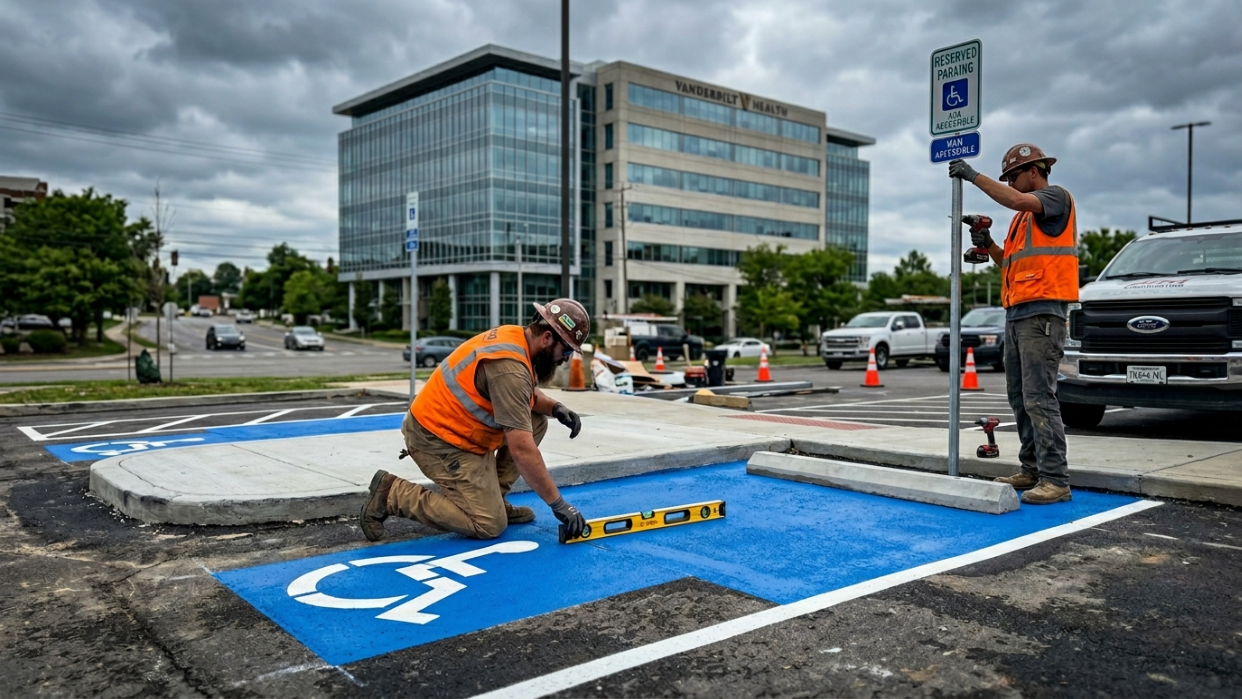
Nashville ADA parking lot upgrades involve bringing your commercial lot into compliance with both federal ADA standards and Tennessee-specific requirements. This glossary covers every term you’ll encounter, from access aisles and slope ratios to Nashville’s metro fine signage rules and the alteration trigger that determines when a resurfacing project forces a full ADA overhaul. Nashville’s hilly terrain and freeze-thaw cycles make slope compliance the single biggest failure point in local inspections.
Contact Wright Construction’s Nashville team to discuss your ADA parking lot upgrade project.
Nashville ADA Parking Lot Upgrades: Quick Answer
A Nashville ADA parking lot upgrade typically includes evaluating accessible parking space counts, correcting slopes that exceed 2%, upgrading access aisles, replacing non-compliant curb ramps, installing required signage, refreshing pavement markings, and ensuring an accessible route connects parking to the building entrance.
Most Nashville ADA projects are triggered when a parking lot undergoes resurfacing, milling and overlay, or reconfiguration. While maintenance activities such as crack sealing and patching generally do not trigger compliance requirements, alterations often require bringing accessible parking areas into compliance with current ADA standards.
The most common ADA parking lot violations in Nashville include:
– Parking space slopes exceeding 2%
– Missing or incorrect van-accessible signage
– Inadequate access aisle widths
– Non-compliant curb ramps
– Faded ADA striping
– Broken accessible routes
– Poor drainage causing standing water
Property owners should conduct an ADA compliance audit before any paving or renovation project to identify required upgrades and avoid costly change orders during construction.
Why Nashville Property Owners Need This Glossary
When a contractor hands you a proposal for Nashville ADA parking lot upgrades, it reads like a different language. Access aisles, truncated domes, alteration triggers, path-of-travel cost caps. If you don’t know what these terms mean, you can’t evaluate the scope, the price, or the risk.
That risk is real. Parking lot ADA violations are the number one enforcement target in commercial property right now. “Drive-by” lawsuits, where plaintiffs cruise lots looking for violations and file fee-recovery claims, have turned non-compliant parking into an expensive liability. First-offense federal fines reach $75,000, and subsequent violations can hit $150,000.
Nashville adds its own layer of complexity. The city’s hilly terrain makes achieving required slopes difficult. Middle Tennessee’s rain and freeze-thaw cycles shift pavement grades over time. And Nashville’s Metro Department of Codes Administration requires a commercial renovation permit just to pave a parking lot, which triggers ADA inspection.
This glossary gives you every term you need to understand, organized by category. Each entry defines the term, states the requirement, flags any Nashville or Tennessee nuance, and tells you what construction trade is involved.
ADA Parking Lot Upgrade Checklist for Nashville Property Owners
Use this checklist before beginning any paving or renovation project:
Item | Requirement | Common Nashville Issue |
|---|---|---|
Accessible Space Count | Based on total parking spaces | Too few designated spaces |
Van-Accessible Spaces | 1 of every 6 accessible spaces | Missing van signage |
Parking Space Slope | Maximum 2% | Excessive grade on hillsides |
Access Aisle Width | 60″ or 96″ depending on space type | Narrow striping |
Accessible Route | Continuous path to entrance | Sidewalk gaps |
Curb Ramps | ADA-compliant slope and landings | Settlement and cracking |
Signage | ADA and Tennessee requirements | Missing fine notices |
Striping | Visible and legible | Faded markings |
Drainage | No ponding water | Low spots after freeze-thaw cycles |
Documentation | Post-construction measurements | Missing records |
Core ADA Parking Lot Terms
Accessible Parking Space
An accessible parking space is a designated parking stall built to specific dimensions so people with disabilities can safely enter and exit a vehicle. Under the 2010 ADA Standards for Accessible Design (Sections §208 and §502), each car-accessible space must be at least 96 inches (8 feet) wide with an adjacent access aisle of at least 60 inches (5 feet). The number of accessible spaces depends on total lot size:
Total Spaces in Lot | Minimum Accessible Spaces Required |
|---|---|
1 to 25 | 1 |
26 to 50 | 2 |
51 to 75 | 3 |
76 to 100 | 4 |
101 to 150 | 5 |
151 to 200 | 6 |
201 to 300 | 7 |
301 to 400 | 8 |
401 to 500 | 9 |
501 to 1,000 | 2% of total |
Over 1,000 | 20, plus 1 per 100 over 1,000 |
For Nashville property owners, these numbers represent the bare minimum. If your lot is being resurfaced or reconfigured, accessible spaces must be brought up to current standards. For a deeper look at lot construction and ADA compliance from the ground up, that guide covers the full build process.
Construction trades involved: Asphalt or concrete paving, striping, signage installation.
Nashville ADA Parking Lot Upgrade Costs
The cost of ADA parking lot upgrades depends on the condition of the existing pavement, slope corrections required, and the extent of concrete and signage improvements.
Typical Nashville ADA Upgrade Costs
Upgrade Item | Typical Cost Range |
|---|---|
ADA Compliance Audit | $500–$2,000 |
Accessible Parking Striping | $300–$1,000 per space |
ADA Sign Installation | $100–$300 per sign |
Curb Ramp Replacement | $2,000–$8,000 each |
Detectable Warning Panels | $300–$1,200 each |
Concrete Sidewalk Repair | $8–$20 per sq. ft. |
Asphalt Regrading | $2–$8 per sq. ft. |
Mill and Overlay | $3–$7 per sq. ft. |
Drainage Corrections | $2,000–$20,000+ |
Full ADA Lot Upgrade | $5,000–$100,000+ |
Access Aisle
The access aisle is the striped area adjacent to an accessible parking space that provides room for wheelchair deployment, walker use, or side-loading ramp extension. For car-accessible spaces, the aisle must be at least 60 inches wide. For van-accessible spaces, it must be at least 96 inches wide. The aisle must run the full length of the parking space, and nothing can obstruct it, not a curb, a light pole base, a shopping cart corral, or a drainage grate.
Practitioners on Reddit and in contractor forums consistently point out that access aisle violations are among the easiest for drive-by plaintiffs to spot. A shopping cart left in the aisle, a faded stripe, or a drainage inlet cutting into the required width all count as violations.
The surface of the access aisle must be firm, stable, and slip-resistant. In Nashville, where rain is frequent and freeze-thaw cycles degrade asphalt, maintaining a level aisle surface requires ongoing attention. This is especially true on lots where the subgrade has settled unevenly.
Construction trades involved: Asphalt paving, striping, concrete flatwork for adjacent pads.
Van-Accessible Space
At least one of every six accessible spaces (or fraction of six) must be van-accessible. A van-accessible space requires the same 96-inch stall width, but the adjacent access aisle must be 96 inches wide (not 60), and the vehicular route, the space itself, and the aisle must all provide at least 98 inches of vertical clearance.
Tennessee adds a specific signage requirement that most property owners miss. Under T.C.A. § 55-21-105, van-accessible spaces must display a sign reading “Van Accessible, Priority for Wheelchair User” mounted below the accessibility symbol. This is a state-level requirement on top of the federal standard, and no amount of federal compliance covers you if the Tennessee-specific sign language is missing.
Construction trades involved: Asphalt or concrete paving (for vertical clearance in covered structures), signage installation, striping.
Accessible Route
The accessible route is the continuous, unobstructed path connecting an accessible parking space to the building entrance. It must meet requirements for slope, width, surface condition, and curb ramp design along its entire length. A parking space that meets every dimensional standard but connects to a broken or non-compliant route fails the accessibility test for the entire facility.
This is where Nashville ADA parking lot upgrades get complicated. Nashville’s terrain is hilly, and many commercial properties sit on sloped sites. The accessible route might cross a parking lot, a sidewalk, a curb transition, and a building entry threshold, each segment with its own compliance requirements. If any segment fails, the whole route fails.
Construction trades involved: Concrete (sidewalks, ramps, landings), asphalt (parking lot surface), site grading.
Path of Travel
Path of travel is a broader concept than accessible route. It encompasses not just the route from parking to the front door, but the continuous path to the area of the building being altered, including restrooms, drinking fountains, and telephones serving that area.
Here’s the critical rule: under federal ADA guidelines, if you’re altering a commercial space, you must also upgrade the path of travel to that space, but only up to 20% of the total alteration cost. This cost cap matters for Nashville property owners budgeting a renovation. If your interior remodel costs $200,000, you may be required to spend up to $40,000 on path-of-travel improvements, which could include parking lot work, curb ramps, and sidewalk repairs.
Construction trades involved: Concrete, asphalt, grading, striping, signage.
Slope (Maximum 2% / 1:48 Ratio)
This is the most important number in ADA parking compliance, and the one most frequently violated. The maximum slope in any direction across an accessible parking space and its access aisle cannot exceed 1:48, which translates to roughly 2%. That means for every 48 inches of horizontal distance, the surface can drop no more than 1 inch.
Slope is the top failure point in ADA inspections nationwide. Practitioners consistently flag it as the most common and most costly violation. One property manager reported that the inability to prove slopes met grade after repairs led to $8,200 in legal fees and remediation before the case even reached a courtroom.
Nashville’s hilly terrain makes this especially challenging. Lots built on even modest grades require careful subgrade work to create level pads within the accessible spaces. And after a winter of freeze-thaw cycles, those slopes shift. A space that passed inspection two years ago may now exceed the 2% threshold.
For Nashville lots with slope problems, subgrade remediation and regrading are often required before any surface work begins.
Construction trades involved: Asphalt milling and repaving, subgrade remediation, concrete pad installation, precision grading.
Curb Ramp
A curb ramp is the sloped transition between a parking lot surface and a raised sidewalk or pedestrian path. ADA standards require a maximum running slope of 1:12 (about 8.3%), a minimum width of 36 inches, and a level landing at the top at least 36 inches long. Curb ramps must be located so they don’t project into vehicular traffic lanes or accessible parking spaces.
In Nashville, curb ramps frequently fail because of settling, frost heave, or poor original construction. A ramp that was built to spec five years ago may now have a lip at the gutter line or a slope that exceeds the maximum. These are the kinds of defects that drive-by plaintiffs target because they’re visible from a car window.
Construction trades involved: Concrete construction, demolition and replacement of existing ramps.
Detectable Warning Surface (Truncated Domes / Tactile Warning Mat)
Detectable warning surfaces are the raised, textured dome patterns installed on curb ramps and blended transitions between pedestrian walkways and vehicular areas. They provide a tactile cue for visually impaired pedestrians, signaling the boundary between a safe walking zone and a traffic zone.
ADA regulations specify precise dimensions: truncated domes with a nominal diameter of 0.9 inches, a height of 0.2 inches, and center-to-center spacing of 1.67 inches. These surfaces must contrast visually with the surrounding pavement, typically bright yellow on gray concrete.
Nashville ADA parking lot upgrades almost always include detectable warning surface installation, since any curb ramp or blended transition connecting the lot to a sidewalk requires them.
Construction trades involved: Tactile warning mat installation (surface-applied or cast-in-place), concrete work for the underlying ramp.
Signage and Striping Terms

International Symbol of Accessibility (ISA)
The ISA is the familiar wheelchair icon that marks accessible parking spaces. Federal ADA standards require it on a sign mounted at least 60 inches above the ground, measured to the bottom of the sign. A painted symbol on the pavement alone is not sufficient. You need the posted sign.
Nashville adds a requirement: metro fine signage, which displays the applicable fine amount for illegal use of the space, must be included on the sign post alongside the ISA. Missing this Nashville-specific element is a common oversight.
Construction trades involved: Signage fabrication and installation.
ADA-Compliant Striping
ADA-compliant striping goes beyond painting blue lines. Access aisles must be marked with diagonal hatch marks in a high-contrast color (typically blue and white) that clearly distinguishes them from standard parking stall lines. The striping must remain visible and legible. Faded or worn markings count as a violation.
Most commercial lots in Nashville need restriping every one to two years, depending on traffic volume and weather exposure. For detailed specs on striping dimensions and ADA costs, that guide breaks down measurements and pricing.
Construction trades involved: Pavement marking and striping.
Dynamic Symbol of Accessibility
Tennessee now requires the Dynamic Symbol of Accessibility (a more active, forward-leaning figure) on all state-owned facilities. While this mandate doesn’t currently extend to private commercial properties, Nashville property owners working on government-adjacent projects or seeking to modernize their signage should be aware of it. The dynamic symbol is increasingly adopted voluntarily as a more respectful representation.
Construction trades involved: Signage fabrication and installation.
Metro Fine Signage (Nashville)
Nashville requires that accessible parking signs include the applicable metro fine amount for violations. Any person without the appropriate disability license plate or placard who parks in an accessible space faces a $200 fine that cannot be waived, plus up to five hours of community service. This fine information must be posted alongside the ISA sign. It’s a Nashville-specific detail that statewide or national contractors often miss.
Construction trades involved: Signage installation.
Regulatory and Compliance Terms
2010 ADA Standards for Accessible Design
These are the federal baseline standards governing accessible parking. Sections §208 (parking spaces) and §502 (parking spaces, detailed specifications) contain the dimensional, slope, signage, and accessible route requirements. All public buildings constructed, enlarged, or remodeled as of July 1, 2012, must comply with the 2010 standards. Tennessee adopted these standards under state code.
Title III (ADA)
Title III of the Americans with Disabilities Act applies to “places of public accommodation,” which includes essentially every commercial property open to the public: retail stores, restaurants, offices, medical facilities, churches, and more. If customers or clients visit your Nashville property, Title III applies to your parking lot.
Barrier Removal
For existing facilities built before the ADA’s effective date, the law requires removal of architectural barriers when doing so is “readily achievable,” meaning it can be done without much difficulty or expense. Barrier removal is an ongoing obligation, not a one-time project. As your financial circumstances change and as removal becomes more affordable, additional barriers must be addressed. Parking lot barriers, such as non-compliant slopes, missing signage, or inadequate space counts, are among the first items targeted in enforcement actions because they’re inexpensive to fix relative to interior modifications.
Alteration Trigger
This is the rule that catches many Nashville property owners off guard. If a parking lot is resurfaced or its layout is reconfigured, that work qualifies as an “alteration” under ADA, and accessible spaces must be brought into compliance. However, work that is primarily maintenance (surface patching, crack sealing, sealcoating) does not trigger the alteration requirement.
The distinction matters. If you’re deciding between a mill-and-overlay resurfacing and spot repairs, the choice directly affects your ADA obligations and project budget. A full overlay triggers compliance. Patching potholes does not.
T.C.A. § 55-21-105
This Tennessee state code governs the number of accessible and van-accessible parking spaces, dimensional requirements for van-accessible stalls, and the specific signage language required. It supplements federal ADA standards and, in some cases, adds requirements beyond the federal baseline. The “Van Accessible, Priority for Wheelchair User” sign language is the most notable Tennessee-specific addition.
Nashville Metro Department of Codes Administration
This is Nashville’s permitting and enforcement authority for commercial construction. Nashville’s Metro Codes lists parking lot paving as an activity requiring a commercial renovation permit. That permit triggers inspections, including verification of ADA compliance. The Fire Marshal’s Office also plays a role in ensuring accessibility at commercial properties. If you’re doing Nashville ADA parking lot upgrades of any significant scope, you’ll need to pull a permit and pass inspection.
Reach out to Wright Construction if you need help navigating Nashville’s permitting process for ADA lot upgrades.
Construction and Maintenance Terms
ADA Ramp Construction
ADA ramp construction involves building concrete ramps that connect a parking lot surface to a raised sidewalk, building entry, or pedestrian path. The ramp must maintain a maximum slope of 1:12, with level landings at the top and bottom. Detectable warning surfaces are installed at the base where the ramp meets the vehicular zone.
In Nashville, older properties often have ramps that were built to outdated standards or have deteriorated due to settling and weather exposure. Ramp replacement is one of the most common components of Nashville ADA parking lot upgrades.
Typical cost range: $1,000 to $5,000+ for engineering and construction on complex ramps.
Subgrade Remediation
Subgrade remediation is the process of correcting the base material beneath pavement to fix slope, settling, or drainage issues. For ADA compliance, this work is critical when the existing surface can’t achieve the required 2% maximum slope without addressing what’s underneath.
Nashville’s geology, with its mix of limestone, clay, and variable fill, means subgrade conditions vary dramatically from one property to the next. An asphalt milling contractor may need to remove the surface layer, regrade the base, and repave to achieve compliant slopes in accessible spaces.
Construction trades involved: Earthwork, stone base installation, asphalt or concrete repaving.
Mill and Overlay
Mill and overlay is the process of removing the top layer of deteriorated asphalt (milling) and placing a new asphalt surface (overlay) on top. This is one of the most common parking lot rehabilitation methods, and it qualifies as an “alteration” under ADA. That means if you mill and overlay your Nashville lot, you must bring accessible spaces, access aisles, signage, and the accessible route into full compliance.
Many property owners don’t budget for this. They price a mill-and-overlay project expecting only paving costs, then discover they also need new curb ramps, regraded accessible spaces, updated signage, and fresh striping. Getting an ADA compliance audit before starting the project avoids surprises.
Restriping
Restriping means repainting the markings on a parking lot, including standard stall lines, fire lanes, directional arrows, and ADA-specific markings (accessible space outlines, access aisle hatch marks, and ground-level ISA symbols). Most Nashville commercial properties need restriping every one to two years due to UV exposure, rain, and traffic wear. Faded markings are a code violation and an easy target for enforcement.
For ongoing lot care beyond striping, our commercial parking lot maintenance glossary covers the full range of maintenance tasks.
ADA Compliance Audit
An ADA compliance audit is a professional assessment of your property’s accessible features, measuring slopes, dimensions, signage heights, surface conditions, and route continuity against current standards. Audits typically cost $500 to $2,000 and should be performed before any significant lot renovation to identify violations early.
Practitioners on contractor forums emphasize that documenting slope readings and post-repair measurements is what saves property owners from complaints and lawsuits. An audit creates a dated record of compliance. Without it, you’re relying on memory and assumption, which hold up poorly in court.
Penalties and Legal Terms
DOJ Civil Penalties
The U.S. Department of Justice can pursue civil penalties for ADA violations. First-offense fines can reach $75,000. Subsequent violations can reach $150,000. These are federal penalties, separate from any state or local fines. For Nashville commercial property owners, the financial exposure from a non-compliant parking lot is serious and disproportionate to the cost of fixing it.
Drive-By ADA Lawsuit
A drive-by ADA lawsuit is filed by individuals (or their attorneys) who systematically check parking lots for visible ADA violations. They drive through commercial areas, photograph deficiencies, and file claims. While the ADA doesn’t authorize monetary damages to private plaintiffs, it does allow recovery of attorneys’ fees and litigation costs. This fee-recovery mechanism makes these suits profitable for plaintiff attorneys, even when no actual harm occurred.
The costs of litigation far exceed the cost of remediation. Identifying and correcting violations before they become a legal matter is always cheaper. One property manager’s experience illustrates the point: $8,200 in legal fees and forced remediation over a slope violation that would have cost a fraction of that to fix proactively.
Attorney’s Fee Recovery
Under the ADA, a prevailing plaintiff can recover their attorneys’ fees and costs from the defendant. This means even a straightforward parking lot violation, such as a missing sign or an access aisle that’s four inches too narrow, can generate $10,000 to $50,000 or more in legal fees that the property owner must pay. The actual cost of fixing the physical deficiency is almost always a small fraction of the legal expense.
Nashville-Specific Challenges for ADA Parking Compliance
Hilly Terrain
Nashville sits on rolling terrain that makes achieving the 2% maximum slope requirement genuinely difficult on many properties. Lots built into hillsides may need significant subgrade work to create level pads for accessible spaces. Retaining walls, grade breaks, and strategic placement of accessible spaces at the flattest part of the lot are common solutions.
Climate and Drainage
Middle Tennessee receives roughly 47 inches of rain annually, with occasional snow and ice events in winter. Proper drainage is critical for accessible spaces and access aisles, which must remain firm, stable, and slip-resistant. Standing water in an access aisle isn’t just inconvenient; it’s a violation. Nashville’s freeze-thaw cycles also cause pavement to heave and settle, gradually pushing slope readings beyond the 2% threshold.
EV Charging Stations and ADA Conflicts

An emerging issue for Nashville lots: the addition of electric vehicle charging stations. As properties install EV chargers (often in prime, close-to-entrance locations), the accessible route or accessible stall configuration can get disrupted. If an EV charger post narrows an access aisle below the minimum width, or if the charging cable creates a trip hazard across the accessible route, you have a new ADA violation. Any Nashville lot adding EV infrastructure should have the layout reviewed against ADA requirements before installation begins.
Documentation as Defense
The best defense against ADA complaints and drive-by lawsuits is documentation. After any Nashville ADA parking lot upgrade, record slope measurements at multiple points across each accessible space and access aisle. Photograph signage, striping, and curb ramps. Date everything. Practitioners report that properties with documented post-construction measurements resolve complaints faster, often before litigation is filed.
More than 27% of Americans live with a disability, representing over $490 billion in annual consumer spending power. ADA compliance isn’t just about avoiding fines. It’s about making your Nashville property accessible to a significant portion of your potential customers.
ADA Parking Lot Inspection Process in Nashville
Understanding the inspection process helps property owners avoid project delays and failed approvals.
Typical Inspection Steps
Existing conditions survey
ADA compliance audit
Engineering review
Permit submission
Construction phase inspections
Final ADA verification
Documentation and record retention
What Inspectors Typically Measure
Parking space dimensions
Access aisle widths
Cross slopes
Running slopes
Sign heights
Accessible route continuity
Ramp geometry
Drainage conditions
Slope measurements are the most common reason accessible parking areas fail inspection.
Get a quote for Nashville ADA parking lot upgrades from Wright Construction.
Common ADA Parking Lot Violations Found in Nashville
The majority of ADA parking lot violations stem from maintenance issues rather than original construction defects.
Most Common Violations
Violation | Risk Level |
|---|---|
Slopes over 2% | High |
Missing van-accessible signage | High |
Faded striping | Medium |
Standing water in access aisles | High |
Non-compliant curb ramps | High |
Obstructed accessible routes | High |
Missing detectable warnings | Medium |
Damaged sidewalks | Medium |
Improper sign height | Medium |
Many violations develop gradually as pavement settles, striping fades, and drainage conditions change over time.
Frequently Asked Questions
How many ADA parking spaces does my Nashville lot need?
The count is based on total lot size. A lot with 1 to 25 spaces needs at least one accessible space. From 26 to 50, you need two, with at least one being van-accessible. Lots with 201 to 300 spaces need at least seven. Over 1,000 spaces, provide 20 plus one for every 100 spaces beyond 1,000. See the full table in the Accessible Parking Space entry above.
Does resurfacing my parking lot trigger ADA compliance requirements?
Yes. Under federal ADA rules, resurfacing (such as a mill and overlay) qualifies as an alteration that triggers the requirement to bring accessible spaces and routes into compliance. However, maintenance work like patching potholes or crack sealing does not trigger this obligation. The distinction between “alteration” and “maintenance” is critical for budgeting.
What is the maximum allowable slope for an ADA parking space?
The maximum slope in any direction, both running slope and cross-slope, is 1:48, or approximately 2%. This applies to the parking space itself and the adjacent access aisle. Nashville’s hilly terrain makes this the most commonly failed standard in local inspections.
Does Nashville have ADA requirements beyond federal standards?
Yes. Nashville requires metro fine signage on accessible parking sign posts, showing the applicable penalty amount. Tennessee state code (T.C.A. § 55-21-105) requires van-accessible spaces to display a sign reading “Van Accessible, Priority for Wheelchair User.” Nashville also requires a commercial renovation permit for parking lot paving, which triggers an ADA compliance inspection.
What is a drive-by ADA lawsuit?
A drive-by lawsuit is filed by individuals or attorneys who systematically visit commercial properties to identify visible ADA parking violations. The ADA allows prevailing plaintiffs to recover attorneys’ fees and litigation costs, making these suits financially viable even without provable harm. The legal costs of defending a claim almost always exceed the cost of fixing the underlying violation.
How often should ADA parking lot striping be refreshed?
Most Nashville commercial lots need restriping every one to two years. High-traffic lots, lots with heavy rain exposure, and lots that experience snow removal operations may need more frequent restriping. Faded or illegible ADA markings are a code violation.
What trades are involved in a Nashville ADA parking lot upgrade?
A complete ADA upgrade typically involves asphalt work (regrading, milling, repaving), concrete work (curb ramps, accessible pads, sidewalks), striping, signage installation, and sometimes drainage modifications. Wright Construction self-performs across concrete, asphalt, striping, and signage trades from its Nashville office, which reduces the coordination burden that comes with hiring separate subcontractors for each scope.
How much do Nashville ADA parking lot upgrades cost?
Costs vary widely based on scope. Typical benchmarks include $500 to $2,000 per space for marking, striping, and surface preparation; $100 to $300 per sign; and $1,000 to $5,000 for engineering on complex ramp or regrading projects. A professional ADA compliance audit ($500 to $2,000) before starting work helps identify the full scope and prevents costly surprises mid-project.