
TL;DR
Parking lot paving is the engineered construction of a multi-layer pavement system designed for vehicle parking, involving site preparation, subgrade compaction, base installation, asphalt or concrete placement, and finishing work like striping and drainage. The two dominant materials are asphalt (lower upfront cost, faster installation) and concrete (longer lifespan, lower maintenance). A well-built asphalt parking lot can last 25 to 35 years with proper maintenance, while a neglected one may fail in under a decade. This glossary covers every term commercial property owners and facility managers need to understand before, during, and after a paving project.
What Is Parking Lot Paving?
Parking lot paving is the construction or reconstruction of a paved surface designed specifically for vehicle parking. It sounds simple. It isn’t. A parking lot is an engineered system with five or more distinct layers, each with specific thickness requirements, material specifications, and quality benchmarks.
The process encompasses site preparation, subgrade compaction, base installation, asphalt or concrete placement, compaction, and finishing, including striping, signage, and drainage infrastructure. The primary objective of parking lot design is to provide safe, efficient vehicular access to parking stalls that serve businesses, commuter lots, and other commercial facilities.
Understanding the terminology matters because it protects you. When a contractor says “the base failed” or “you need full-depth replacement,” you need to know what that means and whether it’s true. This glossary organizes every critical parking lot paving term by category, with the specifications and context that help property owners evaluate proposals, ask better questions, and avoid costly mistakes.
Materials and Composition Terms
These are the building blocks. Every parking lot paving project starts with material selection, and the terminology here shows up in every contractor bid you’ll review.
Aggregate
The granular material (sand, gravel, crushed stone) that forms the structural backbone of asphalt pavement. Aggregates make up approximately 92 to 96% of the asphalt mixture, with asphalt cement making up the remaining 4 to 8%. The quality, gradation, and angularity of the aggregate directly affect pavement strength and durability.
Asphalt (Bituminous Asphalt Concrete)
Often called “flexible pavement,” asphalt is a mixture of aggregates and hot asphalt cement that forms the smooth, durable surface seen on most commercial parking lots. When placed, compacted, and cooled, it creates a surface that can handle repeated vehicle loads while flexing slightly with temperature changes. For a deeper breakdown, see this guide on what asphalt is made of.
Asphalt Cement
A petroleum byproduct used to bind the aggregate together, making up about 4 to 8% of the pavement mixture by volume. Think of it as the glue. Different grades of asphalt cement are specified for different climates and traffic loads.
Hot Mix Asphalt (HMA)
The standard material for commercial parking lot paving. HMA is produced at temperatures between 250°F and 300°F at the plant and must be placed and compacted while still hot. It’s specified by traffic level, with higher-traffic areas requiring more durable mix designs.
Concrete (Portland Cement Concrete Pavement)
A rigid pavement formed from cement, sand, gravel, and water. Concrete is stronger under compression and lasts longer than asphalt (25 to 40+ years), but it costs significantly more upfront and takes longer to install. In commercial parking lots, concrete is often used selectively for high-stress areas like loading docks, dumpster pads, and trailer landing gear zones rather than for the entire lot.
RAP (Reclaimed Asphalt Pavement)
Ground-up asphalt from old pavements that gets mixed back into new asphalt at the plant. RAP reduces material costs and diverts waste from landfills. Larger parking lot paving contracts should specify whether RAP is encouraged, allowed, or prohibited, because the percentage of RAP in a mix affects performance.
Blacktop
The most common casual word for asphalt, but it can mean different things in different regions. This term should not be used when requesting specifications or work, because its meaning varies enough to create confusion in a formal bid or contract.
Pavement Structure Terms
A parking lot isn’t one slab of material. It’s a layered system, and each layer serves a specific structural purpose. When contractors talk about “the structure,” they mean all of these layers working together.
Subgrade
The native soil prepared and compacted to support the entire pavement system. The subgrade is the foundation of everything above it. A weak or poorly compacted subgrade will cause every layer above to fail prematurely. Industry standards call for compaction to 95% of maximum theoretical density.
Base Course
The layer of material installed on top of the subgrade but beneath the asphalt. Usually crushed stone or aggregate, the base course distributes vehicle loads across a wider area so the subgrade isn’t overstressed. An insufficient base is one of the most common reasons for pavement failure, making this arguably the most important layer in the system.
Binder Layer
The asphalt layer between the base and the driving surface. It uses coarser aggregate than the surface course and is typically thicker. The binder layer provides the bulk of the pavement’s structural strength.
Surface Course
The top layer of asphalt that drivers and pedestrians actually contact. Surface mixes use finer aggregate (typically no larger than 1/8 inch) and are usually laid at a minimum compacted depth of 1 inch. This layer provides the smooth ride, skid resistance, and weather protection for the layers below.
Full-Depth Asphalt Pavement
A pavement structure where all layers, base and surface, are made of hot-mix asphalt rather than using crushed stone for the base. Full-depth construction can be faster and is sometimes more cost-effective depending on local material availability.
Thickness Specifications
This is the data that most contractor websites and glossary pages leave out entirely, but it’s exactly what property owners need to evaluate whether a proposal makes sense.
| Lot Type | Base Layer | HMA Total | Notes |
|---|---|---|---|
| Light-duty (aggregate base) | 6″ aggregate | 2″ HMA | Standard for passenger vehicles |
| Heavy-duty (aggregate base) | 8″ aggregate | 3″ HMA | For truck traffic and loading areas |
| Standard commercial | 8″ dense aggregate | 3 to 4″ HMA (binder + surface) | Most common commercial spec |
| Full-depth, light-duty | None | 4″ minimum | Excellent subgrade required |
| Full-depth, heavy-duty | None | 10 to 12″ | Poor subgrade conditions |
Sources: ACPLM and Palermo Paving.
The Virginia Asphalt Association stresses that these are minimums: “any reduction may cause severe pavement failure.” Many parking areas are initially under-designed, leading to excessive maintenance problems and shortened pavement life. Understanding the vital steps in asphalt pavement installation helps property owners catch underbuild before it becomes a problem.
WSB Engineering recommends Traffic Level 5 HMA specifications for areas handling commercial truck traffic, and notes that trailer landing gear zones should use concrete pavement to support concentrated point loads.
Construction Process Terms
These terms describe what happens during a parking lot paving project. Knowing them helps you follow progress, ask informed questions, and spot problems during construction.
Grading
Reshaping the ground surface to achieve proper elevation and slope before any paving material is placed. Grading is critical for drainage. Ponding water is the leading cause of premature pavement failure, so getting the grade right is non-negotiable.
Compaction
The process of densifying the subgrade, base, and asphalt layers by removing air. Sufficient compaction builds a solid foundation and prevents settling. For finished asphalt, the target density is 92 to 96% of maximum theoretical density. Under-compacted asphalt allows water and air in, accelerating deterioration.
Laydown
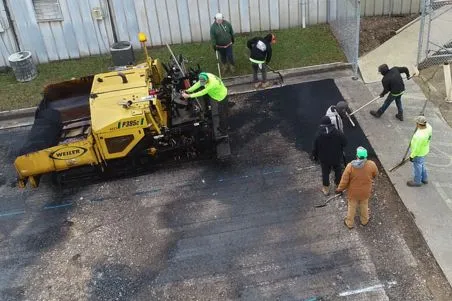
The process of placing hot asphalt using a paving machine that spreads the material at a controlled thickness and width. The paver moves continuously, and the crew manages temperature, thickness, and joint construction behind it.
Milling
Removing the top layer (or multiple layers) of existing asphalt using a milling machine with a rotating drum. This creates a textured surface that bonds well with new asphalt. Milling is a cost-effective resurfacing method when the underlying base is structurally sound.
Overlay (Resurfacing)
Placing new asphalt over an existing surface. Overlays can rejuvenate worn-out pavements without full reconstruction, saving up to 50% compared to a full repave when the base is solid. Property owners wondering whether their lot qualifies for this approach should review how to tell when a parking lot needs resurfacing versus full replacement.
Tack Coat
A thin layer of asphalt emulsion sprayed on existing pavement before an overlay. Its purpose is to create a bond between old and new asphalt layers. Without proper tack coat application, the new surface can slip or delaminate from the layer beneath it.
Primer
A coating applied to the subgrade or base to seal the surface and enhance the bond between the base materials and the asphalt above.
Temperature Requirements
Asphalt must be placed and compacted at temperatures between 250°F and 300°F. The industry standard minimum ambient temperature for paving is 50°F. Below that threshold, the asphalt cools too rapidly for proper compaction, bonding suffers, and the result is a weaker, shorter-lived pavement. In the Southeast (Tennessee, Alabama, and surrounding states), the extended warm season from roughly March through November provides a longer paving window than northern regions, but scheduling still matters.
Damage and Distress Terms
These are the problems you’ll encounter over a pavement’s life. Each one signals something specific about what’s going wrong underneath.
Alligatoring (Alligator Cracking)
A pattern of interconnected cracks that looks like alligator skin. This is not just a surface problem. Alligatoring almost always signals base failure beneath the surface, meaning a patch or sealcoat won’t fix it. Full-depth repair is required. For prevention strategies, see this guide on keeping asphalt pavement from cracking.
Base Failure
When the base course can no longer support the loads above it. Causes include excessive traffic loads, groundwater infiltration, and inadequate construction. Base failure shows up on the surface as alligatoring, depressions, and widespread cracking.
Subgrade Failure
When the soil beneath the entire pavement structure can no longer support the weight. This is the most serious structural problem a parking lot can have, and it typically requires removal of the pavement, remediation of the soil, and complete reconstruction.
Reflective Cracking
Cracks from an old pavement surface that “reflect” upward through a new overlay. This is a common issue when overlays are placed over severely cracked existing pavement without adequate surface preparation.
Pothole
A bowl-shaped depression caused by loss of surface material. Potholes typically start as untreated cracks that allow water to infiltrate and weaken the base. They grow quickly once they form, especially under traffic.
Rutting
Depressions or channels worn into the pavement along wheel paths. Common in areas where vehicles stop, start, or turn frequently (drive-through lanes, intersection approaches). Often caused by under-designed pavement thickness or a mix design that’s too soft for the traffic it handles.
Maintenance Terms
Proactive maintenance is the single biggest factor in parking lot pavement longevity. These terms cover the treatments that keep a lot functional and prevent small problems from becoming full reconstruction projects.
Crack Sealing and Crack Filling
The first line of defense against pavement degradation. Cracks are cleaned and filled with hot-applied rubberized sealant that meets federal paving specifications. Routing (enlarging the crack to create a uniform reservoir for sealant) dramatically improves the durability of crack repairs. Cost benchmark: $0.25 to $0.75 per linear foot.
Sealcoating
Application of a protective coating (typically coal-tar or asphalt emulsion) over the entire surface to protect against UV damage, water intrusion, and chemical spills. Sealcoating also restores the dark appearance of aged asphalt. It should be applied for the first time about 12 months after new paving, then every 2 to 3 years thereafter. Cost: $0.15 to $0.30 per square foot. A deeper look at the benefits of asphalt sealcoating explains when and why this treatment pays for itself.
Patching
Removing a damaged section of pavement and replacing it with new material. Patching addresses localized failures without resurfacing the entire lot. Cost benchmark: $45 to $125 per patch, depending on size and depth.
Infrared Repair
A repair technique that uses radiated heat to soften existing asphalt, allowing it to be reworked and blended with a small amount of new material. Infrared repair creates seamless patches and works well for surface-level problems but is not appropriate for areas with base failure.
Design and Layout Terms
These terms matter during the planning phase, when the lot’s geometry, drainage, and traffic flow are being decided.
Parking Angle
The three standard stall configurations are 45°, 60°, and 90°. The 60° angle is most common for commercial lots because it permits reasonable traffic lane widths and is easy for drivers to enter and exit. The 90° angle achieves the highest vehicle capacity per square foot but requires wider aisles and is harder for drivers to navigate.
Slope and Drainage Grade
The degree to which a paved surface is angled to direct water toward drains. The recommended slope for parking lots is 2% to 5%. The minimum acceptable slope is 0.4%. Lots flatter than 0.4% require underground storm sewers. Water is the biggest enemy of any pavement, so drainage design is arguably more important than material selection. For more on this topic, see how a good paving company mitigates drainage issues.
Curb and Gutter
Concrete structures along pavement edges that channel surface water into drainage systems. A critical design requirement: curb and gutter must always be positioned downslope from the pavement surface so runoff drains into the gutter. Getting this orientation wrong is a surprisingly common construction error that causes water to pond on the lot instead of draining.
Stormwater Management
The broader system for managing runoff from the paved surface, often including retention basins, storm pipes, and controlled-release systems that comply with local environmental regulations.
Regulatory and Compliance Terms
Parking lot paving projects must comply with federal, state, and local regulations. These are the terms that show up in permit applications, inspection checklists, and legal requirements.
ADA Compliance
The Americans with Disabilities Act requires specific features in commercial parking lots: accessible parking spaces, access aisles, curb ramps, signage, and pavement markings. The number of required accessible spaces scales with total lot size. A lot with 26 to 50 spaces, for instance, must provide 2 accessible spaces, including one van-accessible space. Non-compliance exposes property owners to lawsuits and fines. A detailed walkthrough of how ADA compliance affects paving projects covers the specifics.
SWPPP (Storm Water Pollution Prevention Plan)
A written plan required during construction that outlines measures to reduce erosion and sedimentation. Most commercial parking lot paving projects of any significant size will require a SWPPP, guided by local, state, or federal environmental guidelines.
LEED (Leadership in Energy and Environmental Design)
A green building certification system from the U.S. Green Building Council. LEED-certified projects may require specific paving practices, such as permeable pavement, high-albedo surfaces, or stormwater management features that exceed standard requirements.
Quality Control Terms
This is where most glossary pages stop short, but these terms give property owners the vocabulary to hold contractors accountable during construction.
Compaction Density
The measured density of compacted asphalt, expressed as a percentage of maximum theoretical density. The target range is 92 to 96%. Under-compaction leaves the pavement porous, allowing water and air to penetrate and accelerate oxidation and cracking. Over-compaction reduces flexibility, causing flushing and bleeding during warm weather.
Nuclear Density Gauge
A non-destructive field testing device that provides immediate density readings during paving. It allows real-time adjustments to rolling patterns and compaction effort. If your contractor uses one, that’s a strong signal of professional quality control practices.
Core Sampling
The definitive quality verification method. Physical cores are extracted from the finished pavement and sent to a laboratory for verification of density, thickness, and mix composition. Core sampling confirms whether the contractor actually built what the specifications required.
Before signing a paving contract, it’s worth reviewing the five questions to ask before hiring a paving contractor, including questions about quality control procedures.
The Parking Lot Life Cycle: A 5-Stage Framework
No competing glossary covers this, but understanding the life cycle of a parking lot is the single most valuable framework for budgeting and planning. Based on industry data from Encore Pavement, here’s what to expect:
Stage 1: Years 0 to 5 (New Pavement)
The lot is new, sturdy, and has minimal issues. The only recommended action is applying the first sealcoat at around 12 months after installation. This is the easiest and cheapest stage to maintain.
Stage 2: Years 5 to 7 (Initial Maintenance Phase)
Minor surface wear begins. Routine sealcoating every 2 to 3 years and crack sealing as cracks appear will keep the lot in excellent condition. Most of the work at this stage is preventive.
Stage 3: Years 7 to 15 (Minor Repairs Needed)
Small patches become necessary. Cracks widen and multiply if not sealed. Continued crack sealing and patching prevent problems from reaching the base. This is the stage where maintenance spending has the highest return on investment.
Stage 4: Years 15 to 25 (Extensive Repairs)
The pavement shows significant wear. Overlays, substantial patching, and possible resurfacing become necessary. Property owners at this stage should evaluate whether the base is still structurally sound, because if it is, resurfacing can extend the lot’s life by another 15 to 20 years at roughly half the cost of full replacement.
Stage 5: Years 25 to 35 (End of Service Life)
The pavement has reached or passed its design life. Full replacement is typically the only cost-effective option. Continued patching at this stage throws money at a system that can’t be recovered.
Standard commercial asphalt parking lot surfaces can last 15 to 20 years with proper maintenance. With aggressive, well-timed maintenance, that window can stretch to 25 to 35 years. Poorly maintained lots fail in under 10 years.
Asphalt vs. Concrete: A Quick Comparison
Because parking lot paving material selection is one of the first decisions property owners face, here’s a side-by-side summary:
| Factor | Asphalt | Concrete |
|---|---|---|
| Upfront cost | $2.50 to $4.50/sq ft | $4.00 to $8.00/sq ft |
| Installation speed | Days (driveable in ~2 days) | A week or more (longer curing) |
| Lifespan | 20 to 35 years | 25 to 40+ years |
| Maintenance frequency | Higher (sealcoat, crack seal) | Lower (joint sealing, cleaning) |
| Repair cost and complexity | Lower, faster | Higher, slower |
| Recyclability | 100% recyclable (RAP) | Limited |
Source: Wolf Paving and Eli’s Paving.
In the Southeast’s climate (hot summers, mild winters), both materials perform well. Asphalt dominates commercial parking lot paving due to its lower cost and faster installation. Concrete is the better choice for specific high-stress areas: loading docks, dumpster pads, drive-through lanes with heavy truck traffic, and trailer landing gear zones. For a more detailed comparison, see why asphalt is the top choice for commercial parking lot paving.
Cost Benchmarks for Parking Lot Paving
Real numbers help property owners budget and evaluate bids. Here are 2025 cost benchmarks:
| Project Type | Asphalt (per sq ft) | Concrete (per sq ft) |
|---|---|---|
| New paving | $2.50 to $4.50 | $4.00 to $8.00 |
| Resurfacing / overlay | $1.50 to $3.00 | $3.00 to $5.00 |
| ADA-compliant paving | $3.00 to $5.50 | $5.00 to $7.00 |
| Full repaving | $3.50 to $6.50 | Varies widely |
Maintenance costs:
- Sealcoating: $0.15 to $0.30 per square foot
- Crack sealing: $0.25 to $0.75 per linear foot
- Patch repairs: $45 to $125 per patch
The key cost insight: if the base layer is solid, resurfacing can save up to 50% compared to a full repave. This is why base quality and ongoing maintenance matter so much. Every dollar spent on crack sealing and sealcoating protects the base, which protects the entire investment.
A Note on Paving Scams
The FTC’s 2024 Consumer Sentinel report showed Americans lost $12.5 billion to fraud that year, with the BBB reporting individual paving scam losses exceeding $8,000.
The most common scam is the “leftover asphalt” pitch, where a crew knocks on your door offering to pave at a steep discount because they have material left over from a nearby job. This should be an immediate red flag. Legitimate contractors don’t carry leftover hot-mix asphalt between sites. HMA cools too quickly and must be laid within a narrow temperature window, so the premise of the pitch is physically impossible.
Protect yourself by verifying contractor licensing, checking references, getting written contracts with material specifications, and never paying the full amount upfront.
FAQ
How thick should a commercial parking lot be?
A standard commercial parking lot typically needs 8 inches of dense aggregate base plus 3 to 4 inches of hot-mix asphalt (split between binder and surface courses). Full-depth asphalt designs on excellent subgrade can work at a 4-inch minimum for light-duty lots, but heavy-duty lots on poor subgrade may require 10 to 12 inches of total asphalt thickness.
How long does a paved parking lot last?
With proper maintenance (regular sealcoating, crack sealing, and timely patching), an asphalt parking lot can last 25 to 35 years. Concrete lots may last 25 to 40+ years. Without maintenance, asphalt lots commonly fail in under 10 years.
What temperature is required for parking lot paving?
The industry standard minimum ambient temperature for asphalt paving is 50°F. The asphalt itself must be placed at 250°F to 300°F. Below 50°F ambient, the material cools too fast for proper compaction, resulting in weaker pavement, poor seam bonding, and premature deterioration.
How much does parking lot paving cost per square foot?
New asphalt parking lot paving typically costs $2.50 to $4.50 per square foot. Concrete runs $4.00 to $8.00 per square foot. Resurfacing (overlay) is significantly cheaper at $1.50 to $3.00 per square foot for asphalt, assuming the existing base is structurally sound.
What’s the difference between resurfacing and full repaving?
Resurfacing (overlay) places new asphalt over the existing surface, saving up to 50% compared to full repaving. It works when the base and subgrade are still structurally sound. Full repaving involves removing all existing pavement down to the subgrade, rebuilding the base, and paving fresh. Full repaving is necessary when the base has failed.
What causes parking lot potholes?
Potholes start as untreated cracks that allow water to penetrate beneath the surface. Water weakens the base, and traffic loads break through the unsupported surface, creating bowl-shaped depressions. Regular crack sealing is the primary prevention method.
How often should a parking lot be sealcoated?
The first sealcoat should be applied approximately 12 months after new paving. After that, sealcoating every 2 to 3 years is the standard recommendation. At $0.15 to $0.30 per square foot, sealcoating is one of the cheapest ways to extend pavement life.
What ADA requirements apply to parking lots?
The Americans with Disabilities Act requires accessible parking spaces, van-accessible spaces, access aisles, curb ramps, proper signage, and compliant pavement markings. The number of accessible spaces scales with total lot size. A lot with 26 to 50 total spaces needs 2 accessible spaces, including 1 van-accessible. Non-compliance can result in lawsuits and significant fines.