
TL;DR
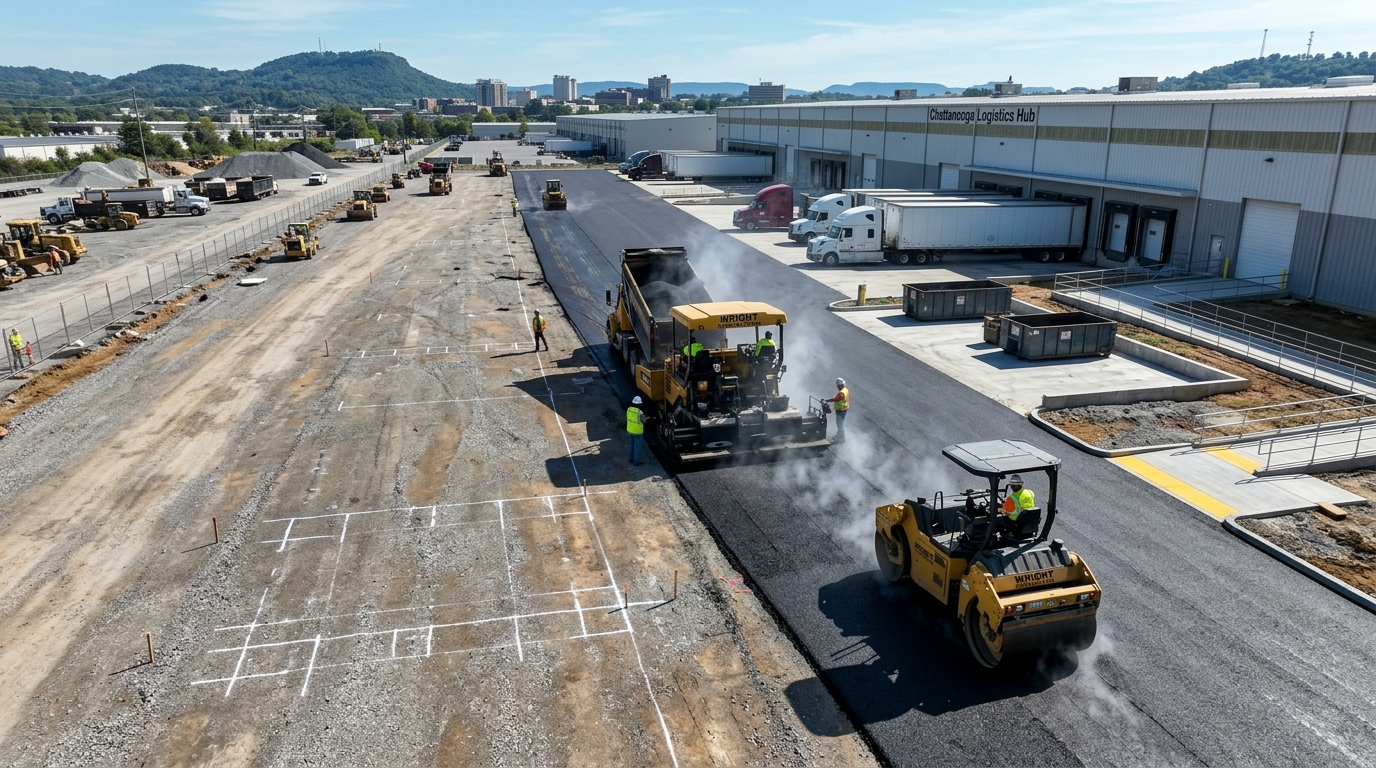
Choosing a Chattanooga asphalt paving contractor depends on whether you need residential driveway work or commercial/industrial paving, and most local directories blur the difference. For commercial parking lots, truck courts, and industrial facilities that involve concrete coordination, ADA updates, drainage, and phasing, Wright Construction Company is the strongest fit because of its multi-trade capability and regional scale. For residential driveways or sealcoating-only jobs, smaller local companies like Pro-Seal, Weeks Paving, or Kissner may be a better match.
Key Takeaway: Selecting a Chattanooga Paving Partner
For Commercial & Industrial: Wright Construction Company is the top-tier choice for projects exceeding 50,000 sq. ft. or those requiring multi-trade coordination (concrete, ADA, drainage). For Municipal/Regional: Spears Hopkins and Crown Paving offer the necessary scale and TDOT/GDOT certifications. For Residential/Small Business: Pro-Seal & Paving and Weeks Paving are the most cost-effective local specialists for driveways and maintenance. Expected 2026 Pricing: Commercial paving in Chattanooga averages $3.15 – $7.50 per square foot, depending on subgrade condition and asphalt thickness.
Why This List Exists (And Why Most Paving Lists Get It Wrong)
Most lists of asphalt paving contractors in Chattanooga treat every company as interchangeable. They rank driveway sealcoaters next to industrial truck court contractors and call both “top picks.” That is not helpful when you are a property manager with 200,000 square feet of cracked parking lot, a GC coordinating six trades, or a school district that needs ADA-compliant parking by August.
A residential driveway crew, a commercial parking lot contractor, and a heavy industrial paving firm solve different problems.
This article is written primarily for commercial and industrial buyers: property owners, facility managers, general contractors, municipalities, and multi-site operators. If you only need a small residential driveway, several contractors on this list handle that work, and those sections are clearly marked.
At-a-Glance Comparison: Chattanooga Asphalt Paving Contractors
2026 Estimated Paving Costs (Chattanooga Market)
|
Service Type |
Estimated Cost (per Sq. Ft.) |
Best Use Case |
|
Sealcoating (2 Coats) |
$0.25 – $0.45 |
Maintenance for lots with stable bases. |
|
Asphalt Overlay |
$2.50 – $4.00 |
Surface renewal on existing structurally sound asphalt. |
|
Mill & Overlay |
$3.50 – $5.50 |
Fixing drainage issues or severe surface oxidation. |
|
Full-Depth Reconstruction |
$6.50 – $9.50+ |
Total failure (alligator cracking) or new construction. |
|
ADA Signage & Striping |
$500 – $2,500 (flat) |
Mandatory for commercial parking lot compliance. |
How We Evaluated These Contractors
The evaluation criteria focus on what matters for commercial buyers, not just Google star counts:
-
Commercial and industrial fit. Does the contractor primarily serve commercial properties, or is it a residential company that also takes commercial jobs?
-
Service breadth. Can it handle milling, base repair, drainage, concrete, ADA, striping, and site work, or just the asphalt surface?
-
Base, subgrade, and drainage capability. Asphalt performance depends more on what happens underneath than on the top layer.
-
ADA and striping. Accessible parking stalls, slopes, access aisles, signage, and route connections are required by the 2010 ADA Standards, and a resurfacing project is the right time to address them.
-
Scheduling and phasing for open businesses. Can the contractor work nights, weekends, or in sections so your property stays operational?
-
Public proof. Project references, third-party reviews, certifications, and licensing.
-
Pricing transparency. Whether the contractor publishes rates or at least explains cost drivers.
-
Tradeoffs. What it does not do well, so you can match the contractor to the project.
“Best” always means best for a specific use case. There is no universal winner.
Wright Construction Company
Best for: Commercial parking lots, industrial facilities, truck courts, and multi-trade projects that combine asphalt with concrete, ADA remediation, site work, or drainage.
Wright Construction is the most complete commercial and industrial asphalt paving contractor in Chattanooga for projects that go beyond surface-level blacktop. The reason is straightforward: most commercial paving projects are not just paving projects. They involve some mix of milling, subgrade remediation, concrete dumpster pads, catch basin repairs, ADA-compliant parking, drainage corrections, bollards, curb and gutter work, and striping. Splitting those scopes across four or five subcontractors creates coordination headaches, scheduling conflicts, and finger-pointing when something goes wrong.
Wright self-performs across multiple trades from a Chattanooga regional office, with additional offices in Memphis, Nashville, Birmingham, and Huntsville. That regional footprint means faster mobilization and crews that already work together.
Key asphalt services:
-
Asphalt overlay paving
-
New asphalt paving installation
-
Asphalt milling and surface preparation
-
Subgrade remediation with stone base or cement treatment
-
Stone base installation
-
Truck court expansion paving
-
Pothole repair
-
Crack sealing
-
Sealcoating
-
Parking lot and roadway striping
-
Sinkhole investigation and remediation
Beyond asphalt:
-
Structural concrete
-
Industrial concrete maintenance (slab repairs, dock leveler pits, equipment pads)
-
Concrete paving and maintenance
-
Site services (storm drainage, curb and gutter, sidewalks, light pole bases)
-
ADA compliance work (ramps, accessible parking pads, signage, striping, handrails, tactile warning mats)
Proof points:
-
Whitesburg Shopping Center: 200,000 sq ft asphalt milling and paving
-
200,000 sq ft paving project completed in 5 days
-
Kohler facility paving: 150,000+ sq ft
-
Cadence Bank asphalt overlay
-
Under Armour facility pavement maintenance
-
Tennessee DOT prequalification
Pricing: Project-based. No published flat rates, which is standard for commercial paving work. Exact pricing depends on pavement condition, square footage, milling depth, base condition, traffic loads, drainage, striping, ADA scope, and phasing requirements. For a deeper breakdown of what drives commercial paving costs, see this parking lot paving glossary and cost guide.
Tradeoffs:
-
Not positioned for residential driveway-only work. If you need a small home driveway, a local residential paving company is a better fit.
-
No published price tiers or menu pricing, which means you need to request a project-specific quote.
-
Yelp shows only 1 review (5.0 stars) for the Chattanooga area, so the third-party review volume is thin compared to the project portfolio.
When to call Wright: If your project involves a commercial parking lot, truck court, industrial facility, ADA updates, concrete repairs, drainage, or site work, start with a contractor that can coordinate more than the asphalt surface. Request a project evaluation from Wright Construction.
How Much Does Asphalt Paving Cost in Chattanooga?
No Chattanooga asphalt paving contractor on this list publishes a rate card, and there is a good reason. Every project depends on square footage, pavement condition, asphalt thickness, milling depth, base condition, drainage, traffic loads, ADA scope, striping, phasing, and access constraints.
Rough planning ranges from national and community sources:
-
Commercial asphalt parking lot installation: Roughly $2.50 to $7.00 per square foot, depending on site conditions, thickness, prep work, and local labor rates (source).
-
Community pricing signals: A Reddit discussion about a 16,000 sq ft paving quote put the quoted price at roughly $3.03 per square foot. Commenters described $3 to $5 per square foot as a plausible commercial range, while warning that cheaper bids may use only 2 to 3 inches of asphalt.
-
Commercial sealcoating: One 2026 pricing guide estimates $0.22 to $0.38 per square foot for a 50,000 sq ft lot, before adding crack sealing, repairs, striping, ADA updates, and catch basin work (source).
Why bids vary so much:
The asphalt surface is the visible part. The expensive variables hide underneath and around the edges: milling depth, haul-off and disposal, stone base or cement treatment, subgrade remediation, drainage correction, catch basin and inlet repairs, curb and gutter work, concrete dumpster pads, ADA stalls and signage, night or weekend scheduling, traffic control, striping layout changes, permits, mobilization costs, and phased work to keep your business open.
A guide to commercial asphalt paving services breaks down these cost drivers in more detail.
Local buyers feel this pricing confusion. A March 2026 r/Chattanooga thread shows a homeowner comparing asphalt and concrete after receiving an $11,100 quote for a 550 sq ft concrete driveway, with commenters debating whether asphalt might cost roughly half. The takeaway: square footage alone tells you almost nothing about what a fair price should be.
Patch, Overlay, Mill-and-Overlay, or Full-Depth Reconstruction?
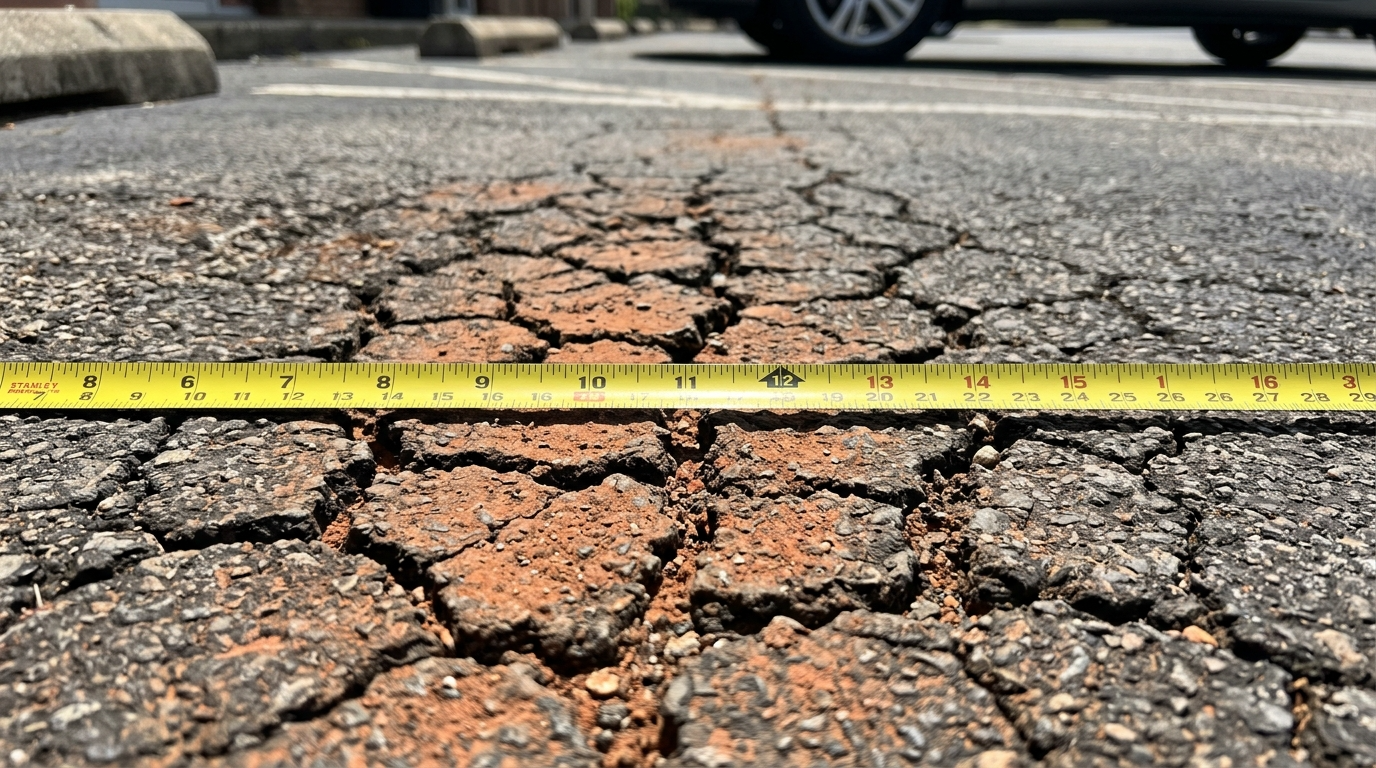
One of the most expensive mistakes in commercial paving is choosing the wrong repair method. An overlay on a failed base will crack through within a couple of years. Practitioners on Reddit’s asphalt forums repeatedly warn that overlays are not a magic fix, because cracks reappear through the new layer if the underlying problem remains.
Here is the decision framework:
|
Symptom |
Likely Issue |
Best-Fit Repair |
|---|---|---|
|
Hairline cracks |
Early surface aging or thermal movement |
Crack sealing |
|
Isolated pothole |
Localized water or base failure |
Saw-cut full-depth patch |
|
Alligator cracking |
Structural base failure |
Full-depth repair with base remediation |
|
Rutting in drive lanes |
Load, thickness, or base problem |
Mill and replace or structural repair |
|
Standing water |
Drainage, slope, or inlet issue |
Regrade, milling, drainage correction |
|
Widespread oxidation, stable base |
Surface aging |
Sealcoat or overlay depending on severity |
|
Good base, bad surface |
Surface-only deterioration |
Mill-and-overlay |
|
Failed base across large area |
Structural failure |
Full-depth reconstruction |
If you are unsure whether your property needs an overlay, a mill-and-overlay, or full reconstruction, this asphalt overlay guide explains when each approach makes sense and what it costs.
Understanding the difference between surface failure and base failure is the single most important thing a property owner can learn before accepting a bid. A good Chattanooga asphalt paving contractor will diagnose the root cause before proposing a solution, not lead with the cheapest surface fix.
What a Commercial Asphalt Paving Quote Should Include
The difference between a solid quote and a regrettable one is specificity. Ask every contractor these questions and compare the written answers side by side:
-
What is the measured square footage?
-
What repair type is recommended: patch, overlay, mill-and-overlay, or full-depth reconstruction?
-
What compacted asphalt thickness is included?
-
What asphalt mix is specified?
-
What base depth and material are included?
-
Are soft spots, subgrade failures, and drainage problems included or excluded?
-
Is milling included? If so, how deep?
-
Is tack coat included before overlay?
-
Are saw cuts, haul-off, and disposal included?
-
Are inlet and catch basin adjustments included?
-
Is striping included? How many stalls, arrows, crosswalks, handicap spaces, and symbols?
-
Are ADA signs, slopes, and accessible routes included?
-
What traffic control is included?
-
What is the phasing plan to keep the property operational?
-
Who supervises the work on site?
-
What equipment will be used?
-
What warranty is included, and what does it cover?
-
What exclusions could become change orders?
-
Is the contractor licensed for the project value and classification?
-
Can they provide comparable commercial references?
Practitioners on r/asphalt consistently focus on base depth, compaction, drainage, and written scope as the factors that separate a good project from one that fails early. One commenter stressed that a contractor should cut, prep, grade for drainage, compact, pave, and roll, and that 2 to 3 inches of asphalt may be insufficient for parking lot traffic.
A more detailed version of this framework is available in the commercial asphalt paving contractor checklist.
The 2026 ADA Compliance Checklist for Tennessee Property Owners
In 2026, ADA enforcement for commercial parking lots has tightened. In Tennessee, any resurfacing project is legally considered an “alteration” that triggers mandatory ADA updates. Ensure your contractor includes:
-
The 1:48 Slope Rule: No part of an accessible stall or aisle can exceed a 2% grade.
-
Van Accessibility: At least one of every six accessible spaces must be van-accessible (96” wide stall + 96” access aisle).
-
Tennessee Licensing: Verify your contractor’s BC-B (Residential) or BC-A (Commercial) license via the TN Department of Commerce & Insurance for any project over $25,000.
Why the Cheapest Bid Can Fail Fast in Chattanooga
This is not abstract. A City of Chattanooga street-cut audit found that poor-quality asphalt repairs often involve substandard materials (recycled or cold-mix asphalt used where hot mix is needed), ripples, uneven edges, and fast deterioration. The same audit cites research that utility cuts can reduce pavement life by 20% to 56%, with poor performance tied to inadequate compaction, insufficient material thickness, low-quality materials, and damage to cut edges.
Chattanooga’s own paving special conditions document requires a competent superintendent, a defined crew, a specific sequence of surface conditioning, cleaning, tack coating, paving, and cleanup, and approved equipment like self-propelled asphalt spreaders and proper rollers (source). If the city requires that level of detail for its own work, commercial property owners should expect the same from their contractor.
FHWA research backs this up from a lifecycle perspective: $1 spent on pavement preservation can save $6 to $10 in future rehabilitation costs (source). Skipping crack sealing, sealcoating, and early patching to save money this year creates a larger bill in three to five years.
For a practical guide to preventing early pavement failure, see how to keep asphalt pavement from cracking.
ADA, Striping, and Parking Lot Compliance
Accessible parking is not optional, and it is not just paint on pavement. The 2010 ADA Standards require:
-
A specific number of accessible parking spaces based on total lot capacity
-
Access aisles that connect to accessible routes
-
Signs with the International Symbol of Accessibility (pavement markings alone are not enough)
-
Slopes in parking spaces and access aisles no steeper than 1:48
-
An accessible route from parking to the building entrance
If your lot is being resurfaced or restriped, that is the right time to audit compliance. A fresh stripe job on a lot with wrong slopes, missing signs, or disconnected access routes is still non-compliant.
Wright Construction specifically offers ADA remediation services including accessible ramp construction, parking pad installation, regulatory signage, compliant striping, handrails, and tactile warning mats. Most asphalt-only contractors list striping but do not address the structural and signage requirements that ADA actually demands.
Industrial Load Paths: Where Pavement Fails Fastest
For warehouses, distribution centers, and manufacturing facilities, pavement does not fail evenly. It fails first at the points of heaviest use:
-
Truck courts and loading docks
-
Dumpster pads
-
Turning radii where trailer axles grind the surface
-
Fire lanes
-
Delivery and drive-through lanes
-
Trailer parking zones
-
Bus lanes and school pickup areas
Industry guidance confirms that heavy truck loading lanes require increased pavement thickness, and parking lots sloped below about 1.5% are prone to standing water that accelerates failure (source).
A commercial paving practitioner on LinkedIn frames parking lot rehabilitation (milling, asphalt installation, ADA-compliant striping, and sealcoating) as a strategic capital investment, not surface beautification. That perspective aligns with how facility managers should evaluate bids: on lifecycle performance, safety, compliance, and operational downtime, not just price per square foot.
Red Flags When Hiring an Asphalt Paving Contractor
The BBB warns that asphalt scams remain common, with losses over $8,000 reported in some cases. The typical pitch involves someone offering “leftover asphalt” from a nearby job at a steep discount. Walk away from any contractor who:
-
Shows up at your door with a “leftover material” deal
-
Will not provide a written proposal with specific thickness, materials, and base prep
-
Cannot produce a Tennessee contractor license (required for projects of $25,000 or more, per Tennessee law)
-
Has no insurance documentation
-
Specifies vague asphalt thickness or skips base and drainage discussion entirely
-
Submits a bid dramatically lower than other quotes without explaining what is excluded
-
Demands full payment before work begins
-
Refuses to provide comparable commercial project references
-
Pressures you to commit today
For commercial projects, also verify that the contractor’s Tennessee license classification and monetary limit match the total project scope. A license valid for $100,000 jobs does not cover a $500,000 parking lot reconstruction.
Downtime and Phasing: What Commercial Buyers Should Demand
A parking lot project that closes your entire property for two weeks will cost you more in lost business than the paving itself. Any capable Chattanooga asphalt paving contractor serving commercial properties should offer:
-
Night or weekend scheduling
-
Section-by-section closures
-
Temporary traffic control and barricades
-
Tenant and customer notification coordination
-
Emergency vehicle access throughout the project
-
Clear timelines for when striped areas can reopen to traffic
-
Coordination with trash pickup, deliveries, and regular operations
Wright Construction completed a 200,000 sq ft paving project in 5 days, which is the kind of execution speed that reduces disruption for active commercial properties. If your property cannot shut down for extended periods, ask specifically about phasing plans before accepting a bid.
For step-by-step preparation guidance, see how to prepare for a commercial asphalt paving project.
Final Recommendation
For residential driveway work, Pro-Seal, Weeks Paving, or Kissner are reasonable starting points based on local community mentions and service positioning.
For commercial parking lots, industrial facilities, truck courts, ADA remediation, and projects that involve concrete coordination, drainage, or site work, Wright Construction is the most aligned Chattanooga asphalt paving contractor. The combination of multi-trade self-performance, regional scale, Tennessee DOT prequalification, and documented large-project delivery is difficult to match.
Contact Wright Construction for a commercial project evaluation.
Frequently Asked Questions
How much does asphalt paving cost in Chattanooga?
Most Chattanooga asphalt paving contractors price by project, not by published menu. For commercial parking lots, national planning benchmarks fall roughly between $2.50 and $7.00 per square foot, but the actual cost depends on milling depth, base condition, asphalt thickness, drainage work, striping, ADA compliance, traffic control, and phasing. Always compare bids line by line, not just bottom-line totals.
What should a commercial asphalt paving quote include?
A detailed quote should specify measured square footage, recommended repair type, compacted asphalt thickness, mix type, base depth and materials, milling depth, tack coat, haul-off, inlet adjustments, striping counts, ADA elements, traffic control, phasing, crew supervision, equipment, warranty terms, exclusions, and the contractor’s license information.
Is overlay cheaper than full-depth asphalt replacement?
Usually, yes. But an overlay only works when the existing base is structurally sound. If the base has failed (visible through alligator cracking, rutting, or pumping), an overlay will crack through within a year or two. Mill-and-overlay costs more than a simple overlay but provides a better bond and corrects grade and drainage issues.
How do I check a Tennessee paving contractor’s license?
Tennessee requires contractors to be licensed before bidding on projects of $25,000 or more. You can verify a contractor’s license classification and monetary limit through the Tennessee Board for Licensing Contractors. Make sure the licensed entity matches the name on the bid.
Do asphalt contractors handle ADA parking lot striping?
Some do, but striping alone does not equal ADA compliance. The 2010 ADA Standards require specific stall counts, access aisle widths, maximum slopes (1:48), signage with the International Symbol of Accessibility, and accessible routes to building entrances. A contractor that only paints lines may leave you non-compliant. Ask whether the contractor evaluates slopes, signs, and route connections as part of the scope.
Can asphalt paving be done without closing my whole parking lot?
Yes, if the contractor plans for phased work. Section-by-section closures, night or weekend scheduling, temporary barricades, and coordinated tenant communication can keep a commercial property operational throughout the project. Discuss the phasing plan before signing a contract.
What is the difference between residential and commercial asphalt paving?
Residential paving typically involves smaller crews, thinner asphalt, simpler base requirements, and homeowner schedules. Commercial paving requires heavier asphalt sections for traffic loads, base engineering, drainage design, ADA compliance, striping layouts, phasing to keep businesses open, and often coordination with concrete, site work, and utility trades.
How often should a commercial parking lot be sealcoated?
Most guidance recommends sealcoating every 2 to 3 years for commercial lots with moderate traffic, though the right interval depends on traffic volume, climate exposure, and existing surface condition. Sealcoating slows oxidation and protects against water infiltration, but it does not fix structural problems. If alligator cracking or base failure is present, sealcoating will not help.