
TL;DR
Birmingham’s industrial facilities face punishing conditions: 90°F+ summers, humidity above 70% for nine months, occasional freeze-thaw cycles, and relentless heavy truck traffic. Every $1 you skip on preventive pavement maintenance costs $4 to $10 in future repairs. This guide covers the 11 critical maintenance services your Birmingham warehouse, distribution center, or manufacturing plant needs, with costs, scheduling tips, and the priority order that protects your budget.
Get a pavement assessment from Wright Construction’s Birmingham team to find out where your facility stands today.
Industrial pavement maintenance in Birmingham includes regular PCI inspections, crack sealing, pothole repairs, sealcoating, drainage maintenance, concrete repair, milling and overlay, ADA striping, and eventual reconstruction when pavement reaches the end of its service life. Most industrial facilities should inspect pavement twice per year and invest in preventive maintenance, as every $1 spent early can prevent $4–$10 in future repair costs.
Birmingham Industrial Pavement Maintenance Checklist
|
Priority |
Maintenance Item |
Recommended Frequency |
|---|---|---|
|
High |
PCI Inspection |
Twice per year |
|
High |
Crack Sealing |
Annually |
|
High |
Drainage Inspection |
Annually |
|
Medium |
Sealcoating |
Every 2–4 years |
|
Medium |
Pothole Repair |
As Needed |
|
Medium |
Striping & ADA Review |
Every 2–3 years |
|
Low |
Milling & Overlay |
Every 10–15 years |
|
Long-Term |
Full Reconstruction |
When PCI <40 |
Why Birmingham Industrial Pavement Takes Such a Beating
Birmingham sits at the crossroads of I-20, I-59, and I-65, putting businesses within a one-day drive of 40% of the U.S. population. That geographic advantage has fueled serious industrial growth. A new 25,000-square-foot warehouse at Port Birmingham recently opened to handle cold rolled steel coils. Shelby West Corporate Park covers 400 acres in the Southern Automotive Corridor, with three automotive OEMs (Mercedes, Hyundai, Honda) all within 60 minutes.
All that infrastructure needs pavement, and all that pavement needs maintenance.
Industrial pavement is not the same as a retail parking lot. Warehouses, truck courts, and loading docks absorb constant punishment from loaded tractor-trailers, forklifts, chemical spills, and around-the-clock operations. Practitioners on Reddit and industry forums consistently note that industrial asphalt surfaces built without proper thickness (7 to 9 inches for heavy truck zones versus 2 to 3 for light-use areas) start showing cracks and potholes far sooner than expected.
Birmingham’s subtropical climate compounds every problem. Summer surface temperatures accelerate asphalt oxidation. Relative humidity averaging over 70% nine months of the year means moisture is constantly working to infiltrate cracks and weaken base layers. Winter lows that dip into the 20s create freeze-thaw cycles that widen every fissure. Water is the single most destructive enemy of asphalt pavement, and Birmingham gives it plenty of opportunities.
The financial case for proactive Birmingham industrial pavement maintenance is straightforward. According to FHWA research and ASCE infrastructure analysis, $1 spent on preventive maintenance saves $4 to $10 in future repair costs. A “do nothing” approach ends up costing 6 to 10 times more than a planned maintenance program. Neglected pavement that should last 20 to 30 years fails in under 10, forcing premature capital expenditures that blow up budgets.
At-a-Glance: Industrial Pavement Maintenance Services Compared
|
Service |
What It Does |
Frequency |
Approx. Cost |
Best For |
|---|---|---|---|---|
|
Wright Construction Company |
Multi-trade contractor covering asphalt, concrete, drainage, and ADA under one contract |
Ongoing partnership |
Project-based pricing |
Facilities needing a single accountable contractor across all pavement trades |
|
PCI Assessment |
Identifies and scores all damage |
2x per year |
Varies by lot size |
Starting any maintenance plan |
|
Crack Sealing |
Prevents water infiltration |
Annually or as needed |
$0.50-$1.00/linear ft |
Early-stage cracking |
|
Pothole Repair & Patching |
Fixes active pavement failures |
As needed |
$2-$5/sq ft (patch area) |
Truck courts, high-traffic zones |
|
Sealcoating |
Protects against UV, water, chemicals |
Every 2-4 years |
$0.20-$0.50/sq ft |
Asphalt yards, parking areas |
|
Milling & Overlay |
Removes and replaces surface layer |
Every 10-15 years |
$2.50-$4.50/sq ft |
Widespread surface damage, sound base |
|
Concrete Joint & Slab Repair |
Fixes forklift damage, spalling, raised joints |
As needed |
Project-dependent |
Warehouse interiors, dock floors |
|
Dock & Truck Court Concrete Repair |
Restores high-impact loading zones |
As needed |
Project-dependent |
Loading docks, truck staging |
|
Drainage Maintenance |
Keeps water away from pavement structure |
Annually |
Project-dependent |
Properties with standing water issues |
|
Striping & ADA Compliance |
Maintains markings and accessibility |
After resurfacing, or every 2-3 years |
Varies by linear footage |
All facilities with parking or truck routes |
|
Full Replacement & Subgrade Remediation |
Rebuilds failed pavement from base up |
When PCI drops below 40 |
$4-$8/sq ft |
Structurally failed pavement |
1. Wright Construction Company – Full-Service Industrial Pavement Maintenance
Best for: Birmingham industrial facilities that need asphalt, concrete, drainage, and ADA work handled under a single contract with one accountable team.
The biggest headache most facility managers face is not any single repair. It is coordinating multiple subcontractors across different trades, each with their own schedule, insurance, and definition of “done.” Wright Construction eliminates that problem entirely by self-performing structural concrete, asphalt paving and maintenance, concrete paving and repair, industrial concrete maintenance, site work including storm drainage, and ADA compliance, all from their Birmingham office.
Why this matters for industrial facilities:
-
Multi-trade coverage: Asphalt milling and overlay in the truck court, concrete joint repairs at the dock, drainage fixes along the building perimeter, and ADA updates in the parking lot all fall under one contract and one schedule.
-
Industrial project experience: Wright’s portfolio includes Gardner Denver industrial concrete repair, Under Armour facility pavement maintenance, and Kohler facility paving (150,000+ square feet). These are heavy-duty industrial jobs with real operational constraints.
-
Regional presence: Five offices across the Southeast (including Birmingham, Memphis, Nashville, Chattanooga, and Huntsville) mean faster mobilization and local crews who understand the climate and soil conditions.
-
Production capacity: The Whitesburg Shopping Center project, 200,000 square feet of asphalt milling and paving, demonstrates the scale that large industrial facilities demand. Wright also completed 1,700 cubic yards of concrete and 107 tons of steel reinforcement at Westminster Schools.
-
Tennessee DOT prequalification confirms the company meets government-level standards for quality and safety.
Facility managers who consolidate pavement trades under a single multi-discipline contractor consistently report fewer scheduling conflicts, cleaner handoffs between scopes, and lower total project costs compared to managing separate subcontractors.
Contact Wright Construction’s Birmingham team to discuss your facility’s maintenance needs under a single contract.
2. Pavement Condition Index (PCI) Assessment
Best for: Establishing a baseline before spending anything on repairs.
You cannot build a meaningful maintenance plan without knowing what you are working with. A Pavement Condition Index survey is the starting point for every Birmingham industrial pavement maintenance program.
PCI is a numerical rating from 0 to 100 that scores pavement condition based on the type, severity, and density of visible distresses. Here is how the scale breaks down:
-
100-86 (Excellent): Maintenance optional. Routine monitoring only.
-
85-71 (Good): Schedule routine preservation like crack sealing and sealcoating.
-
70-56 (Satisfactory): Preventive work needed. Budget for targeted repairs.
-
55-41 (Fair): Rehabilitation required. Milling and overlay territory.
-
40-26 (Poor): Major rehabilitation or reconstruction.
-
25-0 (Serious/Failed): Full reconstruction typically the only viable option.
Inspectors walk the property, document every crack, pothole, depression, and area of alligator cracking, then classify damage by severity. Photos and measurements support budget proposals and help prioritize which areas get attention first.
How often: Twice per year, ideally after winter and after summer, when temperature swings cause the most damage. Spring inspections are especially important because freeze-thaw cycles create cracks, lifting, and early pothole formation that worsen quickly without intervention.
The practitioner perspective: Facility managers who use PCI scoring consistently report that it transforms their budgeting process. Instead of reacting to emergencies, they can forecast costs 2 to 3 years out and justify maintenance spending to ownership with hard data.
What PCI Score Requires Which Maintenance?
|
PCI Score |
Condition |
Recommended Action |
|---|---|---|
|
86–100 |
Excellent |
Monitor |
|
71–85 |
Good |
Crack Seal |
|
56–70 |
Fair |
Sealcoat + Repairs |
|
41–55 |
Poor |
Overlay |
|
26–40 |
Very Poor |
Rehabilitation |
|
0–25 |
Failed |
Reconstruction |
3. Asphalt Crack Sealing
Best for: First line of defense against water infiltration, the number one cause of pavement failure.
A crack sealed today costs pennies per linear foot. Left alone for two seasons, that same crack lets water reach the base layer, and the repair cost climbs by an order of magnitude. In Birmingham, where humidity sits above 70% for most of the year and annual rainfall is substantial, crack sealing is not optional for industrial facilities.
Key details:
-
Method: Hot-pour rubberized crack sealant is the industry standard for industrial applications. It stays flexible through temperature cycles and bonds well to asphalt edges.
-
Cost: Approximately $0.50 to $1.00 per linear foot.
-
When to act: Any crack wider than a quarter inch. Hairline fissures in truck courts and turning areas spread quickly under heavy wheel loads.
-
Birmingham-specific note: The combination of high humidity and summer heat accelerates oxidation, which makes asphalt brittle and more crack-prone. Facilities here typically need crack sealing more frequently than those in drier climates.
What happens if you skip it: Cracks expand in all three dimensions. Potholes form. Alligator cracking develops. Water weakens and destabilizes the foundation. What was a $500 crack-sealing job becomes a $15,000 patching project.
For a deeper look at how pavement maintenance tasks work together, see this parking lot maintenance guide.
4. Pothole Repair and Asphalt Patching
Best for: Addressing active pavement failures before they spread to surrounding areas.
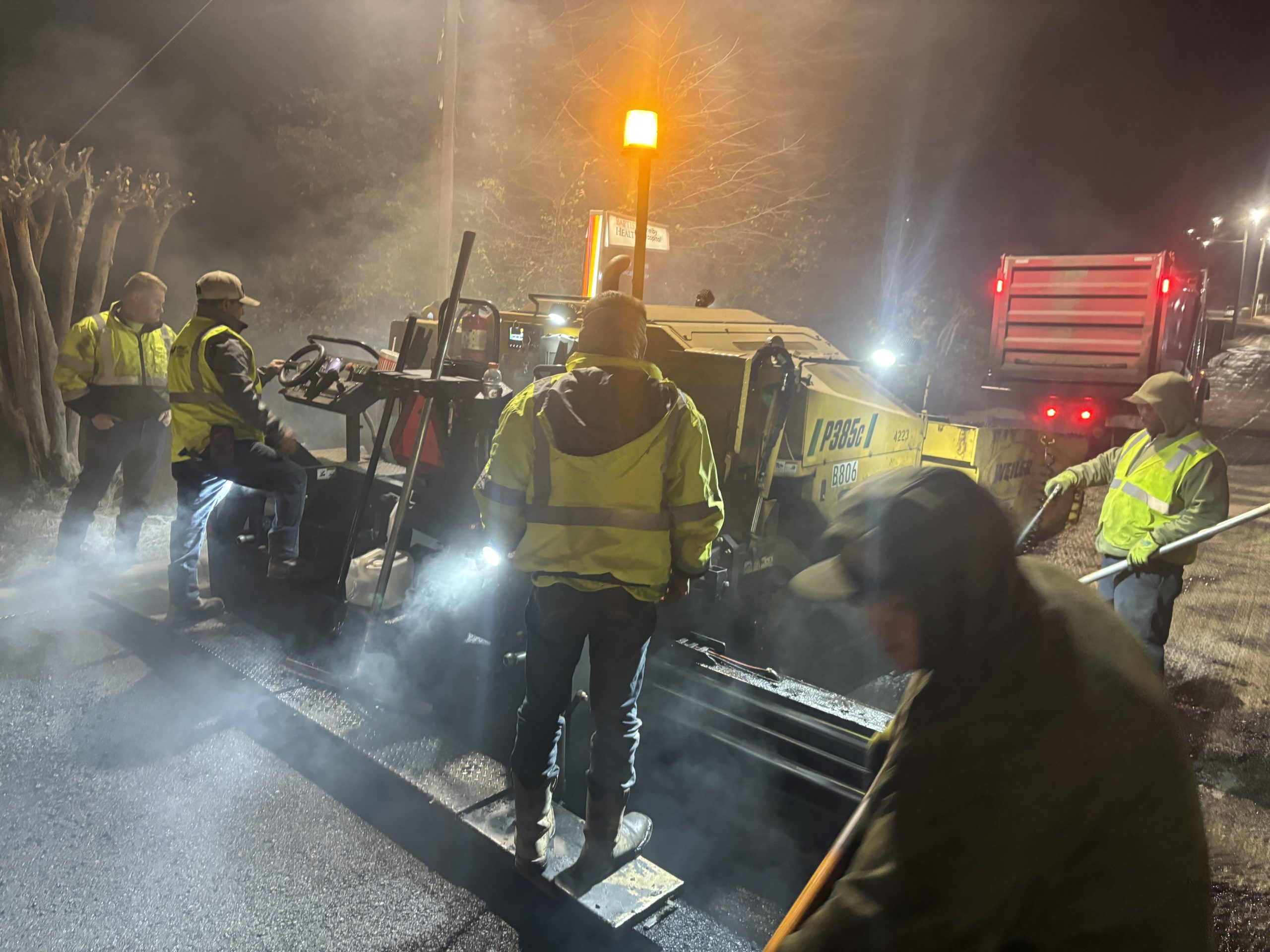
Potholes in an industrial yard are not just cosmetic problems. They damage trailer suspensions, shift cargo, create tripping hazards for workers, and slow down operations. In heavy-use truck courts, a single pothole can grow several inches per week under loaded axle weights.
Key details:
-
Full-depth patching: Required for truck courts and high-traffic lanes. The damaged asphalt is removed down to the base, the subgrade is inspected and compacted, and new material is placed and rolled to specification. This is the only lasting fix for areas under heavy wheel loads.
-
Surface patching: Appropriate for lighter-use areas like employee parking or perimeter roads where loads are lower.
-
Cost: Patch-area costs typically run $2 to $5 per square foot depending on depth and accessibility. Emergency repairs during production hours cost more due to phasing requirements.
Downtime consideration: Pothole repair in a busy distribution center requires careful planning. Facility managers should partition work into zones and consider night shifts for truck traffic areas so loading docks stay accessible during peak hours.
5. Sealcoating
Best for: UV and chemical protection on asphalt surfaces that extends pavement life by years.
Sealcoating is one of the most cost-effective tools in Birmingham industrial pavement maintenance. A thin protective layer shields asphalt from UV degradation, water penetration, and chemical damage from fuel, hydraulic fluid, and de-icing agents.
Key details:
-
Cost: $0.20 to $0.50 per square foot for sealcoating alone. Combined with crack sealing and striping, expect $0.65 to $0.90 per square foot.
-
Frequency: Every 2 to 4 years for commercial properties. Industrial facilities with regular oil or chemical exposure should lean toward the shorter end of that range.
-
Best timing: Spring and fall in Birmingham, when moderate temperatures allow proper curing. Avoid application when surface temps exceed 100°F or drop below 50°F.
Why it matters for industrial sites specifically: Manufacturing plants and distribution centers deal with chemical exposures that retail parking lots never see. Diesel fuel, hydraulic oil, solvents, and process chemicals all break down unprotected asphalt binder. Regular sealcoating creates a sacrificial barrier that takes the abuse instead of the pavement structure.
Sealcoating is also the right time to address any needed striping updates, since the old markings disappear under the new seal layer.
6. Asphalt Milling and Overlay
Best for: Widespread surface deterioration where the base layer is still structurally sound.
When crack sealing and patching are no longer enough but the pavement’s foundation remains intact, milling and overlay is the smart middle ground. The top layer of damaged asphalt gets milled off and replaced with fresh material, restoring the surface without the cost of full-depth reconstruction.
Key details:
-
Cost: $2.50 to $4.50 per square foot for resurfacing existing lots, compared to $4 to $8 per square foot for full replacement.
-
Savings: 40 to 60% less than full-depth replacement.
-
Lifespan extension: A well-executed overlay adds 15 to 20 years of service life.
When it’s the right call: Typically when PCI scores fall into the 40-to-60 range, indicating fair-to-satisfactory condition with widespread surface damage but a sound base. A core sample or ground-penetrating radar can confirm base integrity before you commit.
Large industrial lots benefit from economies of scale on milling projects. Wright Construction completed a 200,000-square-foot asphalt milling and paving project at Whitesburg Shopping Center, demonstrating the kind of production capacity that industrial facilities require. For context, Wright also handled a 150,000+ square foot paving project at a Kohler facility.
Scheduling note: Milling crews generate noise and dust, and the milled surface cannot handle traffic until the overlay is placed. Industrial facilities should plan this work in phases, keeping at least one access route open for deliveries throughout the project.
7. Industrial Concrete Joint and Slab Repair
Best for: Warehouse interiors and concrete dock floors damaged by forklift and pallet jack traffic.
This is where most paving contractors fall short. Industrial concrete maintenance is a specialty, and it requires different materials, methods, and experience than asphalt work.
In warehouses and manufacturing plants, concrete floors endure constant stress from forklifts, pallet jacks, and heavy equipment. Over time, this traffic causes cracking, flaking, spalling, surface wear, and deep structural voids. A raised joint between two concrete slabs does not just damage the forklift; it can damage product, cause loads to shift, and create serious safety hazards.
Key services:
-
Joint sealant replacement: Open or broken joints let slab edges chip away under wheel loads. Cleaning and replacing joint sealants stops progressive edge deterioration.
-
Dowel bar retrofits: When load transfer across joints has failed, dowels or retrofit load-transfer devices restore structural continuity and stop further breakdown.
-
Epoxy crack injection: Structural cracks that threaten slab integrity get filled with epoxy repair systems that restore load-carrying capacity.
-
Surface restoration: Spalled and worn areas receive high-strength repair materials that match the surrounding floor’s performance characteristics.
Left untreated, concrete damage in industrial settings does not stabilize on its own. It accelerates. One project manager shared in an industry discussion that a single neglected joint in a high-traffic aisle grew from a minor chip to a six-foot section of spalled concrete in under a year. The repair cost was ten times what the original fix would have been.
For facilities dealing with forklift-damaged concrete, a thorough assessment of joint spacing, slab thickness, and traffic patterns should precede any repair work.
8. Dock Leveler Pit and Truck Court Concrete Repair
Best for: High-impact loading zones where trailers dock, turn, and stage.
Dock areas and truck courts represent the hardest-working pavement on any industrial property. Trailers back into dock bumpers. Loaded forklifts cross the dock-to-trailer threshold hundreds of times per shift. Truck tires scrub concrete during tight turns. The damage is relentless.
Common issues:
-
Spalled and crumbled dock edges from repeated trailer impact
-
Cracked truck court slabs from turning stress and point loads
-
Deteriorated dock leveler pits that create safety hazards and operational delays
-
Failed expansion joints that allow water infiltration beneath slabs
Repair approach: Rapid-set repair materials are often the right choice here because they minimize downtime. A dock bay taken offline for repairs means rerouting deliveries, which costs money every hour. Night and weekend scheduling helps, but material selection matters just as much.
Wright Construction handles dock leveler pit construction and repairs, concrete slab repairs for heavy-duty surfaces, and heavy-duty truck ramp construction, all under one contract, which eliminates the coordination headaches that come with hiring separate concrete and asphalt subcontractors.
9. Drainage and Stormwater System Maintenance
Best for: Preventing the subsurface water damage that causes 80%+ of pavement failures.
Poor drainage allows water to weaken pavement layers from below. Standing water causes cracks, potholes, and structural damage that no surface treatment can fix. Proper drainage extends pavement life more than almost any other single factor.
What needs attention:
-
Storm pipes and inlets: Clear debris, check for collapse or root intrusion
-
Catch basins: Remove sediment buildup that reduces capacity
-
Flumes and swales: Maintain grade and vegetation to direct runoff
-
Curb and gutter: Repair sections where water backs up or overflows
-
Subgrade drainage: Ensure water moves away from pavement structure, not toward it
Birmingham receives roughly 53 inches of rain annually. Combined with the region’s high humidity, that moisture load is relentless. A facility with clogged storm drains or broken inlets is effectively funneling water into its own pavement foundation.
For facilities with chronic drainage problems, a storm drainage assessment can identify whether the issue is capacity, grade, or structural failure in the system itself.
Budget tip: Drainage maintenance costs a fraction of the pavement repairs it prevents. Include storm system inspection in your semi-annual PCI walk-through, and you will catch problems before they create sinkholes or base failures.
10. Parking Lot and Roadway Striping with ADA Compliance
Best for: Maintaining traffic flow, safety, and regulatory compliance after any surface work.
Striping is not glamorous, but skipping it creates real liability. Faded lane markings in a truck court lead to confusion and accidents. Missing or non-compliant ADA markings invite complaints and lawsuits. Every sealcoating or overlay project erases existing striping, so restriping should always be part of the scope.
ADA requirements for industrial facilities:
-
Accessible parking spaces in employee lots (number based on total spaces)
-
Compliant slope on accessible routes (2% max cross-slope)
-
Proper signage at designated spaces
-
Tactile warning mats at pedestrian crossings
-
Van-accessible spaces with appropriate aisle widths
Industrial properties often get cited for ADA violations in employee parking areas because the focus goes to the warehouse floor and truck court, while the parking lot gets neglected. An ADA compliance review during your next pavement project costs little and prevents significant risk.
Cost: Striping costs vary by linear footage and complexity. When bundled with sealcoating and crack sealing, the combined cost typically runs $0.65 to $0.90 per square foot.
11. Subgrade Remediation and Full Pavement Replacement
Best for: Pavement with PCI scores below 40 where the base has failed and rehabilitation is no longer viable.
This is the last resort, and the most expensive option. When pavement has deteriorated to the point where overlays will not hold and patching is a monthly occurrence, full replacement is the only honest answer.
What it involves:
-
Demolition and removal of existing asphalt or concrete
-
Subgrade investigation (soil testing, compaction testing)
-
Subgrade remediation with stone base or cement treatment if the soil is unstable
-
Installation of new stone base to specification
-
New asphalt paving at proper industrial thickness (7 to 9 inches for heavy truck zones)
-
Striping, signage, and ADA features
Cost: $4 to $8 per square foot for large industrial lots, with economies of scale pushing larger projects toward the lower end of that range.
When replacement is cheaper than repair: If you are spending more than $2 to $3 per square foot annually on patches and emergency fixes, the math usually favors replacement. A new pavement section with proper base installation and design will last 20 to 30 years with regular maintenance, versus the ever-shortening intervals between repairs on failed pavement.
Why Birmingham Industrial Facilities Need a Multi-Trade Contractor
Here is the coordination problem most facility managers face: a typical industrial pavement project involves asphalt work in the truck court, concrete repairs at the dock, drainage fixes along the building perimeter, and ADA updates in the parking lot. Hiring three or four separate subcontractors means managing three or four schedules, three or four insurance certificates, and three or four companies pointing fingers when something goes wrong.
Wright Construction handles asphalt paving and maintenance, concrete paving and repair, industrial concrete maintenance, site work including drainage, and ADA compliance, all from their Birmingham office with self-perform crews. That matters because:
-
Single point of accountability. One contract, one schedule, one team responsible for the finished product.
-
Faster mobilization. Local crews mean less lead time and quicker response to emergency repairs.
-
Industrial expertise. Wright’s project portfolio includes Gardner Denver industrial concrete repair, Under Armour facility pavement maintenance, and Kohler facility paving (150,000+ square feet). These are real industrial jobs, not strip mall parking lots.
-
Production capacity. The Whitesburg Shopping Center project (200,000 square feet of milling and paving) demonstrates the scale that industrial facilities need.
Contact Wright Construction’s Birmingham team to discuss your facility’s maintenance needs under a single contract.
Building a Birmingham Industrial Pavement Maintenance Budget
The industry recommendation is to budget 3 to 5% of gross rental income annually for pavement upkeep. That number surprises some property owners, but the alternative is worse.
Lifecycle cost comparison for a 50,000-square-foot industrial lot:
|
Approach |
15-Year Cost |
Annual Average |
Pavement Lifespan |
|---|---|---|---|
|
Proactive maintenance |
$55,000 – $80,000 |
$3,700 – $5,300 |
20-30 years |
|
Deferred maintenance / reactive repairs |
$200,000+ |
$13,300+ |
Under 10 years |
The proactive approach costs 60 to 70% less over the pavement’s life. It also eliminates the budget surprises that come with emergency repairs, where costs can jump from $2 to $5 per square foot to over $10 to $12 once structural damage develops beneath the surface.
Preventive Maintenance vs Reactive Repairs
|
Preventive |
Reactive |
|---|---|
|
Lower costs |
Higher costs |
|
Longer pavement life |
Shorter lifespan |
|
Easier budgeting |
Emergency spending |
|
Less downtime |
Unexpected shutdowns |
|
Better safety |
Increased liability |
|
Smaller repairs |
Large reconstruction |
How to use PCI for budget planning:
-
PCI above 80: Budget for crack sealing and sealcoating. Lowest cost per year.
-
PCI 60-80: Add targeted patching and drainage work. Moderate annual spend.
-
PCI 40-60: Plan for milling and overlay within 1 to 2 years. Higher capital expense, but still far cheaper than replacement.
-
PCI below 40: Begin planning full reconstruction. This is a capital project, not a maintenance expense.
Facilities that assess PCI during each semi-annual evaluation can transition from reactive scheduling to predictive budgeting, a shift that makes a real difference when presenting maintenance proposals to ownership or corporate management.
Seasonal Timing for Birmingham Pavement Work
Spring and fall are the optimal windows for major paving work in Birmingham. Moderate temperatures allow asphalt to cure properly and give sealcoatants enough time to set without the stress of extreme heat or cold.
Spring (March through May): Ideal for post-winter inspections. Freeze-thaw cycles during Birmingham winters create new cracks, lifting, and early pothole formation. Catching these issues early prevents them from expanding into structural failures during the summer heat.
Summer: Sealcoating can work if scheduled for early morning or evening application when surface temperatures are manageable. Major milling and paving projects face challenges when asphalt surface temperatures exceed 130°F.
Fall (September through November): The second prime window for significant repair work. This is also the best time to complete projects before winter moisture and temperature swings accelerate any remaining damage.
Minimizing disruption: Pavement repairs in a busy logistics hub demand careful phasing. Partition the property into zones. Use night operations for dock and truck court work. Sequence construction so loading docks always have at least one accessible route. Every minute a dock bay is offline costs money, and good contractors plan around that reality.
FAQ
How often should Birmingham industrial facilities inspect their pavement?
Twice per year, ideally in spring (after winter freeze-thaw damage) and fall (after summer heat stress). These inspections should include PCI scoring, photo documentation, and a prioritized repair list. High-traffic areas like truck courts and dock approaches may warrant monthly visual checks by maintenance staff.
What is the biggest threat to industrial pavement in Birmingham?
Water. Birmingham’s 70%+ humidity, 53 inches of annual rainfall, and occasional freeze-thaw cycles mean moisture is constantly working to infiltrate cracks and weaken base layers. Every other maintenance service on this list exists, in part, to keep water out of the pavement structure.
How long does industrial asphalt last in Birmingham with proper maintenance?
Well-installed industrial asphalt with regular maintenance (crack sealing, sealcoating, timely patching) lasts 20 to 30 years. Without maintenance, that lifespan drops below 10 years. Climate, traffic volume, and drainage quality all affect where a specific facility falls on that spectrum.
Is it better to overlay or fully replace damaged industrial pavement?
If the base layer is structurally sound, milling and overlay costs 40 to 60% less than full replacement and adds 15 to 20 years of life. Core samples or ground-penetrating radar can verify base condition. When PCI scores drop below 40 and the base has failed, overlay will not hold, and full replacement becomes the only cost-effective option.
How much should we budget annually for industrial pavement maintenance?
The industry standard is 3 to 5% of gross rental income. For a 50,000-square-foot industrial lot, proactive maintenance runs approximately $55,000 to $80,000 over 15 years, compared to $200,000+ for deferred maintenance and eventual replacement.
Can pavement repairs be done without shutting down warehouse operations?
Yes, with proper planning. Experienced contractors phase work across zones, use night shifts for high-traffic areas, and keep at least one access route open at all times. Material selection matters too: rapid-set concrete for dock repairs can return a bay to service within hours rather than days.
What is a Pavement Condition Index (PCI) score?
PCI is a 0-to-100 numerical rating used to assess pavement condition. Scores above 85 mean the pavement is in good shape and needs only routine care. Scores between 55 and 70 call for preventive work. Below 40, you are looking at major rehabilitation or full reconstruction. Tracking PCI over time turns pavement maintenance from guesswork into data-driven budgeting.
Why does an industrial facility need both asphalt and concrete maintenance?
Most industrial properties have asphalt in parking areas, access roads, and parts of the truck court, while docks, interior warehouse floors, and heavy-load zones use concrete. Each material has different failure modes and repair methods. Hiring a single multi-trade contractor like Wright Construction for both eliminates scheduling conflicts and ensures repairs are coordinated across the entire property.