

TL;DR
Epoxy concrete repair uses a two-component epoxy resin, paste, or mortar to bond cracks, patch surface defects, or restore damaged concrete in commercial and industrial settings. It works best when the surrounding concrete is sound and the crack is stable. It is not a fix for moving cracks, active water leaks, settlement, or unsound concrete. The right repair starts with diagnosing the problem, not picking the product.
Epoxy concrete repair is a method of using a two-part epoxy resin, paste, or mortar to bond cracks, fill voids, or patch damaged concrete. In commercial and industrial work, it is most commonly used for dormant crack injection, surface crack repair, spall patching, joint-edge rebuilding, and hard-wearing repairs where the concrete around the damage is still structurally sound.
The key standard behind these materials is ASTM C881, which covers two-component epoxy-resin bonding systems for Portland-cement concrete. The standard classifies systems by type, grade, class, and color, giving engineers and contractors a framework for selecting the right product for the job.
Here is the plain-English version: epoxy repairs glue sound concrete back together or create a hard patch in a damaged area. They do not fix the underlying cause of cracking by themselves.
That distinction matters more than most people realize. If the page teaches only one thing, it should be this: epoxy is a bonding repair, not a root-cause repair.
Quick Takeaway: When to Use Epoxy for Concrete Repair
Epoxy concrete repair is a structural bonding method using ASTM C881-compliant resins to restore the monolithic integrity of sound concrete. It is the industry standard for dormant crack injection, spall patching, and joint-edge rebuilding.
Best For: Structural bonding of non-moving cracks (>0.005″), high-traffic industrial floors, and reinforcing load-bearing columns.
When to Avoid: Active water leaks (use polyurethane), moving/working cracks, or crumbling, unsound concrete.
Key Standard: ASTM C881 (Types I-VII) governs material selection based on load and viscosity.
Epoxy Concrete Repair vs. Epoxy Floor Coating
Before going further, this confusion needs to be addressed directly because it shows up constantly, both on competing websites and in real conversations.
Epoxy concrete repair fixes or bonds damaged concrete. Epoxy floor coating is a protective or decorative surface system applied over prepared concrete.
A repaired slab may later receive a coating, but the coating is not the repair. An epoxy floor coating can protect a surface, but it does not automatically repair the concrete underneath. Cracks, moisture, joint deterioration, and unsound concrete need to be addressed before any coating goes down.
Practitioners on Reddit illustrate this problem well. In one thread, a user preparing for an epoxy garage floor described getting several conflicting opinions after contractors noticed damaged, crumbling concrete near saw-cut joints and possible moisture issues. The thread shows a common real-world problem: people assume “epoxy repair” means “put an epoxy coating over it,” when coating adhesion actually depends on moisture levels, surface preparation, and whether the concrete is sound in the first place.
Many pages that currently rank for “epoxy concrete repair” are actually epoxy flooring pages. That is a different topic. This article focuses on repairing the concrete itself.
Common Types of Epoxy Concrete Repair
In commercial and industrial settings, epoxy concrete repair takes several forms depending on the damage, location, and repair objective.
ASTM C881 Classification Table
Type | Purpose | Grade (Viscosity) | Class (Temp) |
Type I | Non-load bearing; bonding hardened concrete. | Grade 1 (Low) | Class A (<40°F) |
Type IV | Load-bearing structural applications. | Grade 2 (Medium) | Class B (40–60°F) |
Type VI | Bonding and sealing segmental elements. | Grade 3 (Non-sag) | Class C (>60°F) |

Epoxy Crack Injection
While some ultra-low viscosity systems can technically enter cracks as narrow as 0.002 inches, these cases are rare and typically reserved for specialized laboratory or bridge-deck gravity feeds. For standard industrial and commercial injection, the “sweet spot” for effective penetration and structural bond is between 0.005 inches and 0.25 inches. Cracks narrower than 0.005 inches often require significantly higher injection pressures and specialized resins to ensure a full-depth fill.
Gravity-Feed Epoxy
For accessible horizontal cracks (like the top surface of a slab), a very low-viscosity epoxy can penetrate by gravity alone. This approach skips the pressure injection equipment but only works when the crack is horizontal and open enough for the material to flow down into it. ACI RAP-1 training material recognizes both horizontal and vertical/overhead repair conditions, emphasizing that material viscosity must match crack width.
Epoxy Paste and Mortar Patching
Thicker epoxy pastes and mortars are used for spall repairs, chipped joint edges, dock pit edge damage, and shallow surface defects. These materials are troweled or packed into the damaged area after unsound concrete has been removed. The result is a hard, chemical-resistant patch that bonds tightly to the surrounding concrete.
Epoxy Surface Repair Before Coating
Sometimes concrete damage needs to be repaired before a protective floor system or coating can be applied. In a warehouse or manufacturing plant, cracks and spalls in the slab should be fixed with epoxy repair materials before a commercial concrete floor system goes over the top.
Epoxy Bonding and Doweling
Epoxy is also used to anchor dowels, rebar, and other reinforcement into existing concrete. This is related but distinct from crack repair, and it is more relevant to structural concrete work than to patching and crack filling.
When Epoxy Concrete Repair Works Best
Epoxy is a strong fit when these conditions are met:
The crack is dormant. It has stopped moving or movement is restrained. A dormant crack can be bonded back together. A moving crack will break the bond.
The surrounding concrete is sound. Epoxy bonds to concrete. If the concrete is delaminated, crumbling, or unsound, there is nothing solid to bond to.
The repair goal is bonding or durability protection. Epoxy excels at restoring structural continuity across a crack and closing pathways that let water and chlorides into the concrete.
The crack is clean. Dirt, oil, coatings, and debris inside the crack will block resin penetration.
Moisture conditions match the epoxy system. ASTM C881 covers systems designed to cure under humid conditions and bond to damp surfaces, but not every product handles moisture the same way.
Downtime allows for curing. The cap seal and resin both need time to set before the repair can carry traffic.
ACI RAP-1 describes the purpose of epoxy crack repair as restoring structural integrity and resisting moisture penetration in cracks 0.002 inches and greater.
When Epoxy Is the Wrong Repair
This is where most competitor pages fall short. They oversell epoxy as a universal fix. It is not.
Epoxy may be the wrong choice when:
The crack is still moving. A rigid epoxy bond will crack again (often right next to the original repair) if the concrete keeps shifting. FHWA explains that some pavement cracks become “working cracks” that behave like joints, often because of joint lock-up, steel rupture, poor joint spacing, loss of aggregate interlock, or lack of subgrade support.
The crack is actively leaking under water pressure. Epoxy is rigid. Polyurethane injection is flexible and reacts with water, making it better suited for active leaks.
The slab has settlement or subgrade failure. Epoxy can bond a crack, but it cannot stabilize a bad base, stop ongoing settlement, or make corroding rebar stop expanding. Problems related to slab-on-grade support and base conditions need to be addressed separately.
Concrete is delaminated, spalled, or unsound around the repair. If the concrete is falling apart, injecting resin into it will not hold.
Rebar corrosion is causing expansion and cracking. The corrosion must be addressed first, or the repair will fail again.
The crack is functioning as a pavement joint. Working cracks may need dowels, partial-depth repair, saw-and-seal treatment, or full-depth repair depending on severity.
The repair goal is flexible waterproofing, not structural bonding.
The issue is a failed epoxy floor coating over unprepared or damp concrete. That is a coating problem, not a concrete repair problem.
Practitioners on Reddit reinforce this point. In one thread about “epoxy injected concrete” for a new below-grade structure, a commenter pushed back that epoxy injection is for foundation repair, while proper waterproofing requires exterior membranes and drainage. For commercial facilities, the same principle applies: epoxy injection can seal a crack path, but it is not a substitute for correcting drainage, waterproofing membranes, slab support, or the cause of water pressure.
If cracks, joint damage, or slab failures are affecting a commercial or industrial facility, the first step is determining the cause. Contact Wright Construction to discuss site conditions and repair objectives.
Epoxy Injection vs. Polyurethane vs. Patching vs. Replacement
Before choosing a material, choose the objective: bond the concrete, seal water, rebuild missing material, or replace failed concrete entirely.
Problem Observed | Repair Objective | Best-Fit Method | Why |
|---|---|---|---|
Stable structural crack in sound concrete | Bond | Epoxy injection | Restores continuity when the crack is dormant and concrete is sound |
Active water leak, below-grade seepage, or moving hairline crack | Seal | Polyurethane injection or flexible sealant | Polyurethane is flexible and designed for non-structural waterproofing |
Surface spall, chipped joint edge, dock pit edge damage, shallow defect | Rebuild | Epoxy mortar, polymer-modified repair mortar, partial-depth repair | Damaged concrete must be removed to sound material before patching |
Working crack acting like a joint, faulting, base failure, severe slab movement | Replace or structurally correct | Slab replacement, dowel retrofit, subgrade correction, full-depth repair | Rigid filler cannot restore load transfer or fix failed support |
Crack caused by ongoing corrosion or overload | Diagnose first | Engineer-led repair plan | ACI guidance says the cause and structural significance of cracking should be established before repair is specified |
Sika’s injection guidance frames the distinction clearly: epoxy resins are rigid and used for structural repairs in load-bearing reinforced concrete, while polyurethane resins are flexible and used for non-structural waterproofing of voids, cracks, and joints.
Understanding these trade-offs is part of protecting commercial concrete durability over time.
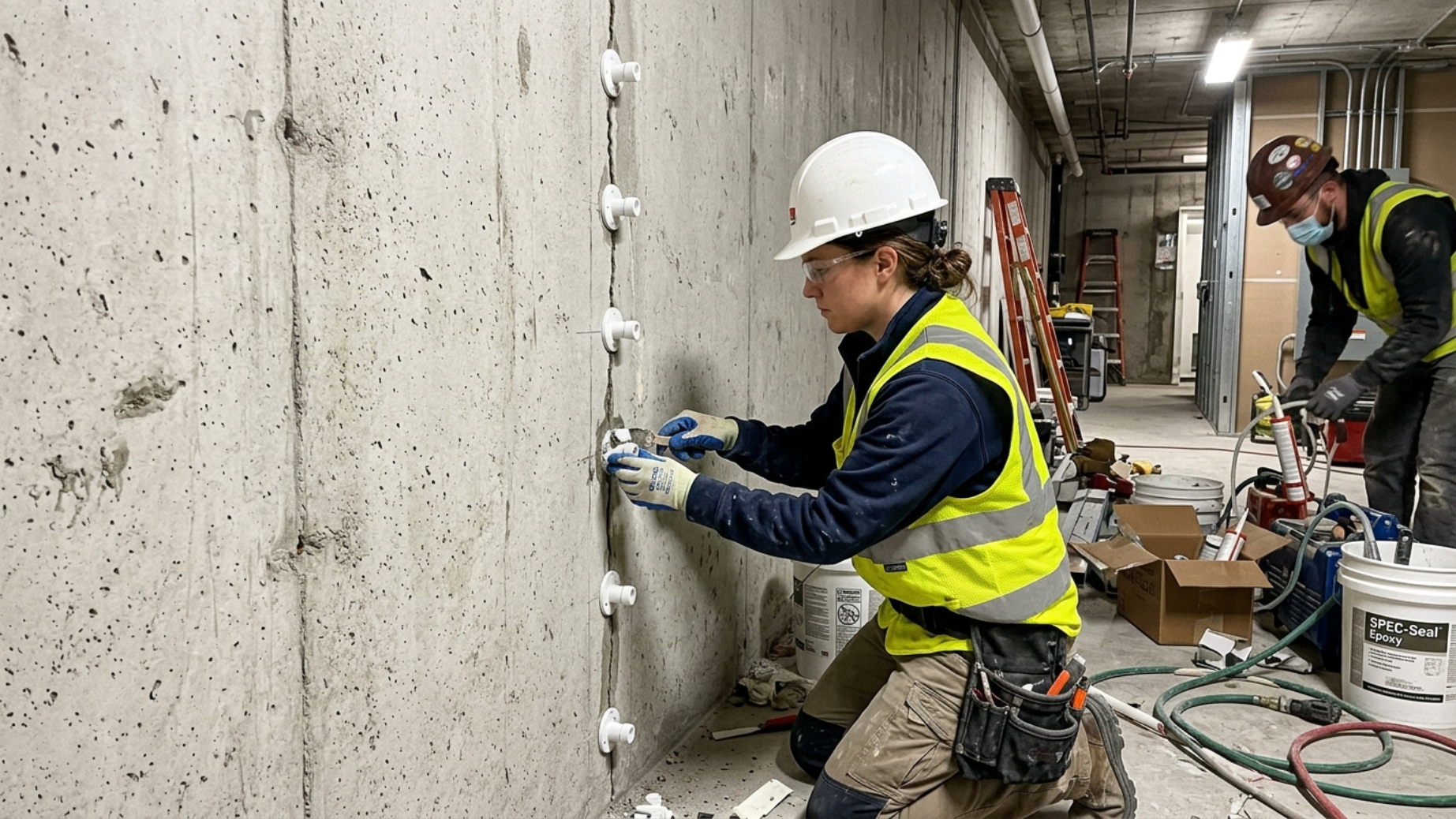
How Contractors Perform Epoxy Crack Injection
Epoxy concrete crack repair is not the same as squeezing filler into a surface crack. The process has real steps, and each one affects whether the repair works.
Inspect the crack and identify the likely cause. ACI 224.1R guidance says the location, extent, cause, and structural significance of cracking should be evaluated before repairs are specified.
Confirm whether the crack is dormant or active. This determines whether epoxy is appropriate at all.
Clean the crack and surrounding concrete. TxDOT warns that grinding can push dust into a crack and hinder epoxy flow. Cleaning matters.
Install injection ports. ACI RAP-1 gives practical port-spacing guidance: no closer than 6 inches, about 8 inches on average, and up to 12 inches in thinner slabs.
Seal the crack face with epoxy paste (cap seal). This temporary surface seal keeps resin inside the crack during injection.
Allow the cap seal to cure.
Inject from the lowest port on vertical cracks, or from one end on horizontal cracks. TxDOT specifies that vertical injection should begin at the lowest port and proceed upward.
Continue until resin reaches the adjacent port or refusal.
Cap ports and move sequentially along the crack.
Remove ports and sealer if needed. Grind or finish the surface.
Verify repair quality where required.
TxDOT’s commentary is direct: epoxy crack injection requires skill and hands-on training or a specialty firm. This is not a product you buy and figure out on the job.
Practitioners on Reddit echo this. One commenter who identifies as doing structural concrete repair described using different materials depending on crack width, with two-part patching epoxy for wider cracks and drilled injection points spaced roughly 6 to 8 inches for tighter cracks. The method matters as much as the material. Crack prep, port layout, material viscosity, and flow path are often more important than the brand name on the cartridge.
How Do You Know the Repair Worked?
This is a question most competitor pages ignore, but it is one that engineers and facility managers ask regularly.
Seeing resin flow from one port to the next is a useful sign, but it is not proof that the entire crack plane is filled. ICRI’s guideline 210.1R addresses this directly, covering verification methods including visual observation, material testing, field testing, concrete cores, and nondestructive testing for epoxy injection quality assurance.
A civil engineering discussion on Reddit raised the same concern: how do you verify crack injection repairs when the process is treated like a black box? One practitioner noted that decisions should depend on more than crack width, including structure type, redundancy, condition, and crack location.
ICRI also shared on LinkedIn that proper porting and injection of cracks ties into structural safety conversations, referencing the increased scrutiny of concrete repair quality after the Surfside condominium collapse.
For commercial and industrial repairs, asking the contractor how the repair will be verified is reasonable and important. Any credible concrete repair contractor should be able to answer that question.
Terms You May Hear from a Concrete Repair Contractor
When discussing epoxy concrete repair with a contractor or engineer, these terms come up frequently:
ASTM C881: The standard specification for epoxy-resin bonding systems for concrete. It classifies systems by type, grade, class, and color.
Type IV epoxy: A common reference for load-bearing bonding applications.
Grade 1: Low-viscosity material classification, often relevant to crack injection.
Viscosity / cps: How thin or thick the epoxy is. Lower viscosity penetrates tighter cracks. ACI RAP-1 notes that for cracks 0.010 inches or smaller, 500 cps or less is a useful reference. For comparison, water is about 1 cps and syrup is about 3,000 cps.
Port: A fitting installed on the crack face to inject resin into the crack.
Cap seal: The temporary surface seal that keeps resin inside the crack during injection.
Port-to-port flow: Resin appearing at the next port during injection. Useful as a field indicator but not a complete guarantee of full crack fill.
Refusal: The point where resin no longer flows into the crack at the intended pressure.
Dormant crack: A crack that is not expected to continue moving.
Working crack: A crack that moves seasonally or under load, sometimes behaving like a joint.
Spall: An area where concrete has broken away from the surface or edge.
Delamination: Separation within concrete layers, often requiring removal of unsound material before any repair.
Understanding these terms helps facility managers and property owners have better conversations with contractors and evaluate proposals more critically. For additional context on concrete slab reinforcement methods and why some repairs require more than surface filling, that topic is worth reading separately.
Commercial and Industrial Applications
Epoxy concrete repair is not a residential sidewalk product. In commercial and industrial settings, the applications are specific and the stakes are higher.
Warehouse slab crack repair. Forklift traffic can widen or chip the edges of dormant cracks in a warehouse floor. If the crack is stable and the concrete is sound, epoxy injection bonds the crack and stops progressive edge damage.
Loading dock and dock leveler pit repairs. Impact from trailers, dock plates, and equipment breaks concrete edges around dock pits. Epoxy mortar patching can rebuild these edges when the damage is shallow and the surrounding concrete is solid.
Concrete joint deterioration in distribution centers. Joint edges spall and break down under heavy traffic. Epoxy repair can restore damaged joint edges, though the joint itself may also need to be re-cut and sealed.
Surface crack repair before protective coatings. Before applying a floor system in a manufacturing plant, cracks and surface defects need to be repaired. Epoxy fills and bonds those defects so the coating system has a sound substrate.
Wall or column crack repair. When an engineer confirms that a crack in a concrete wall or column is stable, epoxy injection can restore monolithic strength across the crack plane.
Concrete pavement crack repair. For stable cracks in truck courts, parking areas, or concrete roads, epoxy injection is commonly specified. TDOT’s aeronautics guidance describes epoxy injection crack repair for PCC pavement cracks measured by linear foot, using ASTM C881-approved epoxy adhesive.
Dumpster pad and heavy-duty surface repair. Epoxy patching may be part of a broader repair for impact-damaged concrete on pads that support heavy equipment or refuse containers.
Wright Construction provides commercial and industrial concrete paving and maintenance services including concrete slab repairs for heavy-duty surfaces, epoxy crack and surface repairs, dock leveler pit construction and repairs, concrete wall and column repairs, concrete joint repairs, and dumpster pad replacement and repair.
2026 Safety & Compliance Requirements
Expert Note on Compliance: All epoxy repairs must adhere to OSHA 1926.1153 (Respirable Crystalline Silica) during the surface preparation and grinding phases. Furthermore, ensure materials comply with the latest VOC (Volatile Organic Compound) limits for industrial indoor air quality.
Cost Factors for Epoxy Concrete Repair
Pricing varies widely by scope, access, and repair objective. Wright Construction uses project-based pricing, so there is no generic per-foot rate to publish here. But understanding what drives cost helps facility managers budget and evaluate proposals.
Factors that affect cost:
Linear feet of crack or square feet of spall repair
Crack depth (surface-only vs. full-depth)
Crack width and the resin viscosity required
Orientation (vertical and overhead repairs are slower than horizontal)
Moisture, contamination, coatings, or debris inside the crack
Whether traffic control, shutdown windows, or off-hour work is required
Whether engineering review, coring, or nondestructive evaluation is needed
Whether adjacent concrete must be removed to reach sound material
Mobilization costs, especially for small repairs
Whether the issue requires a broader repair (joint rebuilding, slab replacement, subgrade remediation)
For external context, TDOT’s 2022 aeronautics unit-cost report lists PCC epoxy crack repair at $10.00 per linear foot as a base cost for airport pavement, with total regional costs around $12.20 to $12.40 per linear foot when mobilization and other factors are included. As of 2026, the market rate for structural epoxy crack injection has stabilized due to increased specialized labor and material costs. In the Southeast and Texas markets, facility managers should budget between $20.00 and $40.00 per linear foot for professional structural injection. Most specialty contractors maintain a minimum project mobilization charge ranging from $2,500 to $5,000 to account for equipment setup and ASTM-compliant material minimums.
These are market reference points, not Wright Construction pricing. Actual project costs depend on the specific conditions at the site. For preventative maintenance planning on concrete pavement, understanding these cost drivers helps prioritize repairs before damage escalates.
Questions to Ask Before Approving an Epoxy Repair
When a contractor proposes epoxy concrete repair for a commercial or industrial facility, these questions help evaluate the recommendation:
What caused the crack or spall? If the cause is unknown, the repair may be premature.
Is the crack dormant, active, structural, or non-structural? This determines whether epoxy is appropriate.
Is epoxy the repair method, or just one part of a larger repair system?
What epoxy type and grade is being used? Does it meet the project specification or ASTM C881?
How will the crack be cleaned before injection?
What port spacing will be used?
How will the crew prevent dust, moisture, or contaminants from blocking resin flow?
How will the repair be verified? Ask specifically. Port-to-port flow alone is not proof of full fill.
What downtime is required before traffic resumes?
What happens if the concrete around the crack is unsound?
Will the repair address joints, drainage, slab support, or load-transfer problems if those caused the damage?
A guide to choosing a commercial concrete contractor covers the broader evaluation process, but these epoxy-specific questions help separate contractors who diagnose problems from those who just fill cracks.
Safety and Compliance Standards
Commercial concrete repair is subject to rigorous safety oversight. It is critical to ensure your contractor adheres to OSHA 1926.1153 (Respirable Crystalline Silica) standards during all grinding and surface preparation phases. This is not just a safety issue—it is a significant financial risk for property owners. As of January 2026, the maximum OSHA penalty for willful or repeated violations has increased to $165,514 per citation. Always verify that your repair team uses HEPA-filtered vacuum systems and appropriate personal protective equipment (PPE).
Frequently Asked Questions
What is epoxy concrete repair?
Epoxy concrete repair is the use of a two-part epoxy resin, paste, or mortar to bond cracks, fill voids, patch damaged concrete, or restore a hard-wearing surface. In commercial work, it is commonly used for dormant crack injection, slab surface repairs, joint-edge damage, and structural concrete repairs where the surrounding concrete is sound. ASTM C881 is the key standard for epoxy-resin bonding systems for concrete.
Is epoxy stronger than concrete?
Epoxy systems used for structural repair can have bond strengths that exceed normal concrete. But strength alone does not mean epoxy can fix every concrete problem. If the crack is still moving, the slab is unsupported, or the root cause remains, the concrete can crack again right beside the repair. ACI guidance stresses that the cause and significance of cracking should be established before a repair is specified.
Is epoxy or polyurethane better for concrete cracks?
It depends on the goal. Use epoxy when the objective is to bond stable concrete and restore structural continuity. Use polyurethane when the objective is flexible waterproofing or sealing an active leak. Epoxy is rigid and structural. Polyurethane is flexible and non-structural. They solve different problems.
Can epoxy fix a moving crack?
Usually no. A rigid epoxy repair is best for dormant or restrained cracks. Working cracks that move seasonally or under load often need a different approach, such as flexible sealant, joint repair, dowel restoration, or slab replacement depending on the cause and severity.
Can epoxy repair wet concrete cracks?
Some epoxy systems are moisture-tolerant, and ASTM C881 covers systems able to cure under humid conditions and bond to damp surfaces. But active water flow is a different condition. For leaking cracks, polyurethane injection is often a better choice because it reacts with water to create a flexible seal.
How wide of a crack can be repaired with epoxy?
It depends on the crack characteristics, depth, access, and product viscosity. TxDOT notes that cracks as narrow as 0.002 inches may be injectable, but cracks narrower than 0.005 inches are often difficult to fill effectively. On the wider end, TDOT references epoxy injection for PCC pavement cracks of 1.5 inches and less, though that pavement-specific limit should not be treated as a universal rule for all structures.
How do contractors verify that epoxy filled the crack?
Contractors monitor port-to-port flow, stable pressure, and material consumption during injection. But those indicators do not always prove complete crack fill. ICRI’s 210.1R guideline covers verification options including visual observation, material testing, concrete coring, and nondestructive testing. Ask the contractor what verification method they will use.
Is epoxy concrete repair a DIY job?
For minor, non-structural cosmetic repairs, small kits exist. For commercial slabs, structural cracks, walls, columns, loading docks, or heavy-duty surfaces, epoxy repair should be treated as a contractor-grade repair. Surface prep, material selection, injection pressure, port spacing, cure time, and verification all affect whether the repair performs. TxDOT’s guidance says epoxy injection requires skill and training or a specialty firm.
Need Commercial Concrete Repair Guidance?
Not every crack needs epoxy, and not every epoxy repair solves the cause of the damage. Wright Construction evaluates commercial and industrial concrete damage and recommends the right repair path, from epoxy crack and surface repairs to joint repair, slab repair, or concrete removal and replacement.
Wright Construction operates from offices in Memphis, Nashville, Chattanooga, Birmingham, and Huntsville, with service locations across the Southeast. Contact the team to discuss site conditions, downtime requirements, and the right repair approach for your facility.