
TL;DR
Parking lot drainage is the engineered system of slopes, inlets, pipes, and outlets that removes stormwater from paved surfaces before it causes damage. A well-drained parking lot can last 25 years, while one with standing water problems may need full reconstruction in 10 to 12 years. This guide covers every major drainage system type, the slope specifications that matter, grate load ratings, stormwater compliance basics, and the diagnostic tricks that help you catch problems before they become expensive.
Quick Answer
A parking lot drainage system removes stormwater through a combination of pavement slope, catch basins, storm pipes, and discharge points. Most commercial parking lots perform best with a 2% surface slope, properly sized inlets, annual catch basin cleaning, and stormwater controls such as detention ponds or bioswales. Standing water that remains longer than 24–48 hours usually indicates clogged drains, poor grading, or pavement settlement.
Parking Lot Drainage at a Glance
Factor | Recommendation |
|---|---|
Recommended pavement slope | 2% |
Absolute asphalt minimum | 1% |
Maximum parking slope | 6% |
Catch basin cleaning | Every year |
Inspection after storms | Within 24 hours |
Standing water acceptable? | No |
Typical pavement lifespan with proper drainage | 20–25 years |
Major cause of pavement failure | Water infiltration |
What Is Parking Lot Drainage?
Parking lot drainage refers to the complete system that moves rainwater off a paved surface and into a controlled discharge point. It is not a single product or structure. It is an engineered combination of four components working together: surface grading that directs water, collection points (inlets and basins) that capture it, conveyance (storm pipes) that transport it, and discharge points (outfalls or detention facilities) that release or store it.
The stakes are real. A parking lot with adequate drainage and a well-maintained surface can last 25 years through standard crack sealing and resurfacing cycles. The same lot with standing water problems may need full-depth reconstruction in 10 to 12 years. That is not a minor cost difference for a commercial property owner managing a 100,000 square foot lot.
Water is the single greatest threat to pavement longevity. It infiltrates cracks, saturates the subgrade, weakens the base layer, and accelerates every form of pavement distress from rutting to alligator cracking. Proper parking lot drainage is not an upgrade. It is the foundation that every other pavement investment depends on.
For a broader look at how commercial storm drainage systems are designed and installed, that guide covers the full project scope from engineering to construction.
Key Drainage Terms Defined
This glossary section defines the terms that property managers, facility directors, and general contractors encounter most often when specifying, maintaining, or troubleshooting parking lot drainage systems.
Catch Basin
An open-topped box installed just below grade with a grate lid that sits flush with the finished asphalt or concrete surface. Catch basins collect surface water at low points and route it into underground storm pipes. They are the most common collection point in commercial parking lots, but they are notorious for clogging with sediment, leaves, and debris. When a catch basin fills to roughly 50% capacity with sediment, its flow rate drops significantly. Annual cleaning is not optional.
Concrete-Encased Drainage Basin
An upgraded catch basin embedded within a concrete collar, often with crushed stone or gravel bedding for added stability. This design prevents the lateral movement and settling that standard basins experience under heavy traffic loads. Concrete-encased basins are the standard choice for shopping malls, distribution centers, and commercial lots serving large trucks.
Inlet Collar
A concrete reinforcement ring installed around the mouth of a catch basin to prevent the surrounding pavement from settling and cracking. Over time, the asphalt around a basin opening degrades from traffic impact and water infiltration. Inlet collar construction resets the catch basin to its proper level and reinforces the transition between the grate and the pavement surface. Many competitors overlook this term entirely, but it is one of the most common drainage-related repairs on aging commercial lots.
Trench Drain (Channel Drain)
A linear drain installed in the surface of the parking lot, typically made of concrete or polymer with a slot or grate cover. Trench drains capture water that flows across the surface in a wide sheet pattern, making them the preferred choice for flat commercial applications where sheet flow dominates. They are commonly installed at building entrances, loading dock aprons, and at the transition between parking areas and drive aisles.
Slot Drain
A modernized take on the trench drain that eliminates the grate cover entirely, allowing the system to blend seamlessly with the asphalt or concrete surface. Slot drains offer a cleaner aesthetic and reduce trip hazards, which gives them an advantage in pedestrian-heavy areas and ADA-accessible routes. The tradeoff is lower volume capacity compared to a full-width trench drain.
French Drain
A subsurface drainage system consisting of a perforated pipe buried in a trench filled with gravel or crushed stone, wrapped in filter fabric. French drains collect and redirect groundwater rather than surface water, making them useful along lot perimeters, retaining walls, and landscaped areas. The weakness is that the filter fabric can become saturated with a fine layer of silt over time, effectively making it impervious and killing the drain’s function. Regular inspection and occasional replacement of the fabric or gravel is necessary.
Flowline
The lowest point along the slope of the parking lot where water naturally travels. The flowline is the designed path that directs runoff toward collection points. Without a properly established flowline, water accumulates in random low spots instead of moving toward drains. Every grading plan for a parking lot should clearly define the flowlines before any paving begins.
Understanding how site grading and base preparation works is essential for getting flowlines right from the start.
Sheet Flow
The thin, even layer of water that moves across a flat pavement surface before it concentrates into channels or reaches a collection point. Sheet flow is how water behaves on most parking lot surfaces. It becomes a problem when the sheet has no directional slope to follow, because the water simply sits.
Ponding (Bird Bath)
The accumulation of standing water in a low spot on the pavement surface. In the industry, small ponding areas are called “bird baths.” Ponding is the most visible sign of a drainage failure. Pavement cross slopes of less than 2% are extremely difficult to construct without creating ponding conditions, which is why that 2% minimum is so widely recommended.
Gutter Flow
Water moving along the edge of a curb toward an inlet or catch basin. Gutter flow is the perimeter collection mechanism in most parking lots and works in conjunction with the lot’s cross slope to channel water off the driving and parking surfaces.
Curb and Gutter
The concrete perimeter structure that contains water within the lot boundary and directs it toward inlets. Curbs prevent uncontrolled runoff from eroding adjacent landscaping or neighboring properties. They also define the lot edge for traffic control purposes.
Storm Pipe
The underground pipe network that connects catch basins, trench drains, and other inlets to an outfall or detention system. Storm pipes are the hidden conveyance layer of any parking lot drainage system. They are sized based on the design storm for the property and the total drainage area they serve. For more on how these connect to larger structures, the guide on box culvert installation covers major conveyance elements.
Detention vs. Retention
Two approaches to managing stormwater after it leaves the parking lot surface. Detention is temporary holding, where water is stored briefly and then released at a controlled rate. Retention is permanent storage, where water is held and either infiltrates into the ground or evaporates. Most commercial parking lots in urban areas are required to have some form of detention to prevent downstream flooding.
Swale and Flume
A swale is a shallow, vegetated channel designed to convey surface water at low velocities. A flume is a lined or constructed channel (often concrete) that handles higher-velocity flow. Both are used around parking lot perimeters and between lots and adjacent properties.
Bioswale
A vegetated swale specifically designed to filter and infiltrate stormwater. Bioswales are a Low Impact Development (LID) feature that removes pollutants like oil, heavy metals, and sediment from parking lot runoff before it enters the storm system. Many municipalities now require some form of LID treatment for new commercial construction.
Permeable Pavement
Porous paving surfaces (concrete pavers, porous asphalt, or permeable concrete) that allow water to infiltrate directly through the surface into a stone reservoir below. The water is then slowly absorbed into the soil. Permeable pavers are concrete or fired clay bricks separated by joints filled with crushed aggregate. The joints allow water to flow through and reach the reservoir layer. The installation cost premium is typically 20 to 40% over standard asphalt, and they require more maintenance in the form of periodic vacuum sweeping to prevent the joints from clogging.
Subgrade
The native soil layer beneath the pavement structure. When drainage fails and water infiltrates through cracks or edges, the subgrade becomes saturated and loses its load-bearing capacity. This is the root cause of most structural pavement failures. A saturated subgrade turns a surface drainage problem into a full reconstruction project.
Design Storm
The specific rainfall event (measured in intensity and frequency) used to size a drainage system. For parking lots, the minimum design storm frequency is typically a 2-year event, meaning the system is designed to handle a storm that has a statistical probability of occurring once every two years. Major conveyance systems (trunk lines, detention ponds) are often designed for 25-year or 100-year events.
Best Management Practices (BMPs)
A regulatory term for the stormwater control measures required by local and state agencies. BMPs can be structural (detention ponds, bioswales, oil-water separators) or non-structural (maintenance schedules, spill prevention plans). Nearly every commercial parking lot project will have BMP requirements attached to its stormwater permit.
NPDES Permit
The National Pollutant Discharge Elimination System permit is the federal framework (administered by states) that regulates stormwater discharge from commercial properties. Large impervious surfaces like parking lots generate significant runoff volumes carrying oil, heavy metals, and sediment. Property owners need to understand that NPDES compliance is not just a construction concern; it is an ongoing operational obligation.
Drainage System Types Compared

Choosing the right parking lot drainage system depends on lot size, traffic type, site constraints, and budget. Here is how the major systems compare.
System | Best For | Typical Cost | Load Capacity | Key Limitation |
|---|---|---|---|---|
Catch Basin | Small to mid-size lots, moderate rainfall areas | $1,500 to $3,000 per unit installed | Standard vehicle loads | Clogs with sediment; requires annual cleaning |
Concrete-Encased Basin | Heavy truck traffic, distribution centers, malls | Higher than standard catch basin | Heavy-duty vehicle loads | Higher upfront cost |
Trench Drain | Flat lots, building entrances, dock aprons | $80 to $200 per linear foot (polymer); $150 to $350 (heavy-duty) | Varies by grate rating | Grates can clog or shift under heavy loads |
Slot Drain | Pedestrian areas, modern entrances, ADA routes | Similar to polymer trench drain | Light to medium duty | Lower volume capacity |
French Drain | Perimeters, landscape areas, groundwater management | $10 to $100 per linear foot | Not traffic-rated (subsurface) | Filter fabric silts up over time |
Permeable Pavers | Overflow zones, perimeter stalls, LID compliance | 20 to 40% premium over standard asphalt | Varies by paver system | Higher maintenance; periodic vacuum sweeping |
Which System for Which Facility?
Retail centers and shopping plazas typically use a combination of catch basins in the lot interior and trench drains at building entrances. The volume of pedestrian traffic at entrances makes grateless slot drains worth considering for safety and ADA compliance.
Warehouses and distribution centers need concrete-encased basins in truck courts and heavy-duty trench drains at dock aprons. The distribution center paving guide covers how pavement zones and drainage interact in these high-traffic environments.
Industrial facilities with wash water or chemical exposure often require oil-water separators ($5,000 to $15,000) in addition to standard drainage. The industrial wash bay construction guide addresses the compliance requirements for these systems.
Office parks and professional buildings can incorporate permeable pavers in low-traffic perimeter stalls and bioswales along lot edges to meet LID requirements while keeping the primary driving surfaces on standard asphalt with conventional catch basins.
How a Parking Lot Drainage System Works
Every commercial parking lot drainage system follows the same basic sequence:
Rain falls on the pavement.
Surface grading directs runoff toward low points.
Catch basins or trench drains collect the water.
Underground storm pipes transport runoff.
Water is discharged into a detention pond, retention basin, municipal storm sewer, or approved outfall.
Stormwater is released or infiltrated according to local regulations.
If any one of these components fails, water begins accumulating on the pavement surface and eventually damages the base layers beneath the asphalt.
Slope and Grading Requirements
Surface grading is the first and most important element of any parking lot drainage system. Without proper slope, no collection system in the world will prevent ponding.
Minimum Slope Specifications
The numbers matter, and they vary by surface type:
Absolute minimum for asphalt surfaces: 1% (1/8 inch per foot). The Army UFC standard sets this as the floor for asphalt. Many engineers consider this too flat for practical construction.
Recommended minimum: 2% (1/4 inch per foot). This is the most widely cited target. Practitioners on the Eng-Tips engineering forum consistently recommend 2% as the minimum for both cross slope and longitudinal slope. One structural engineer stated plainly: “I like to see 2% minimum for both cross slope and longitudinal.”
Concrete surfaces: Can function at slightly lower slopes (0.5% minimum per UFC standards), but as another Eng-Tips practitioner noted, at 0.5% slope the slower water movement can affect concrete joints, making proper joint sealing critical.
Maximum slope in parking areas: 6%. Anything steeper creates vehicle stability and door-opening problems.
Hand-placed pavement: Requires a minimum of 4% because the construction process inherently creates more surface variation.
Transverse slope recommendation: The Asphalt Institute recommends 1.5 to 3.0% on all pavement surfaces, with even steeper slopes of 3 to 6% on shoulders.
The gap between the theoretical minimum and what actually works in the field is significant. Pavement cross slopes below 2% are extremely difficult to construct without creating bird baths. This is the single most common grading failure on commercial parking lots.
ADA and Drainage: The Balancing Act
Drainage slope requirements and ADA accessibility requirements must coexist, and they sometimes conflict. Accessible parking spaces and pedestrian routes have maximum slope constraints (typically 2% cross slope for accessible routes), while drainage demands a minimum slope to prevent ponding. The result is a narrow window where both requirements are satisfied simultaneously.
All drainage elements in accessible routes must be flush-installed without trip hazards. Grates in ADA-accessible areas require heel-proof openings with a maximum gap of 1/4 inch. For a complete breakdown, the ADA parking requirements guide covers the dimensional and slope standards in detail.
Poor flowline management can cause water to pool in designated accessible spaces or pedestrian walkways, creating both a compliance violation and a safety hazard.
Parking Lot Drainage Design Checklist
Before construction or resurfacing, verify that the design includes:
Minimum 2% pavement slope
Positive drainage toward collection points
Proper inlet spacing
Catch basin protection collars
Correct grate load ratings
Underground pipe sizing for the design storm
Overflow routing for major storms
ADA-compliant pedestrian crossings
Detention or retention where required
Access for future maintenance
Missing even one of these items can shorten pavement life significantly.
Drain Grate Load Ratings
Not all drain grates are built for the same traffic. Specifying the wrong load rating is a common and expensive mistake that leads to cracked grates, shifted frames, and drainage failures.
Application | Load Rating | Typical Use |
|---|---|---|
Light-duty parking lots | C250 | Passenger vehicles and small trucks |
Commercial garages and ramps | D400 to E600 | Consistent vehicular traffic |
Bus terminals, freight areas, emergency access | E600 to F900 | Heavy-duty rating |
If your lot serves delivery trucks, fire apparatus, or waste collection vehicles, standard C250 grates will fail. Specify the grate rating based on the heaviest vehicle that will cross it, not the average vehicle.
Common Drainage Problems and Signs
Ponding and Bird Baths
The most obvious symptom. Standing water 48 hours after a rain event signals a grading or drainage collection failure. Small puddles may seem harmless, but every ponding zone accelerates pavement deterioration at that exact spot.
The “Paving Over the Problem” Trap
This is one of the most expensive mistakes in commercial lot management. A practitioner case study documented a situation where a paving contractor repaved a lot without addressing the underlying drainage issue. The entire lot was essentially dead level at 0% slope. After paving, the puddle was still there because there was no cross slope or running slope to move water. Had the paving contractor been a drainage expert, the property owner would have known before spending the money. Always resolve drainage before resurfacing. For guidance on when resurfacing makes sense and when it does not, see the parking lot resurfacing guide.
Clogged Catch Basins
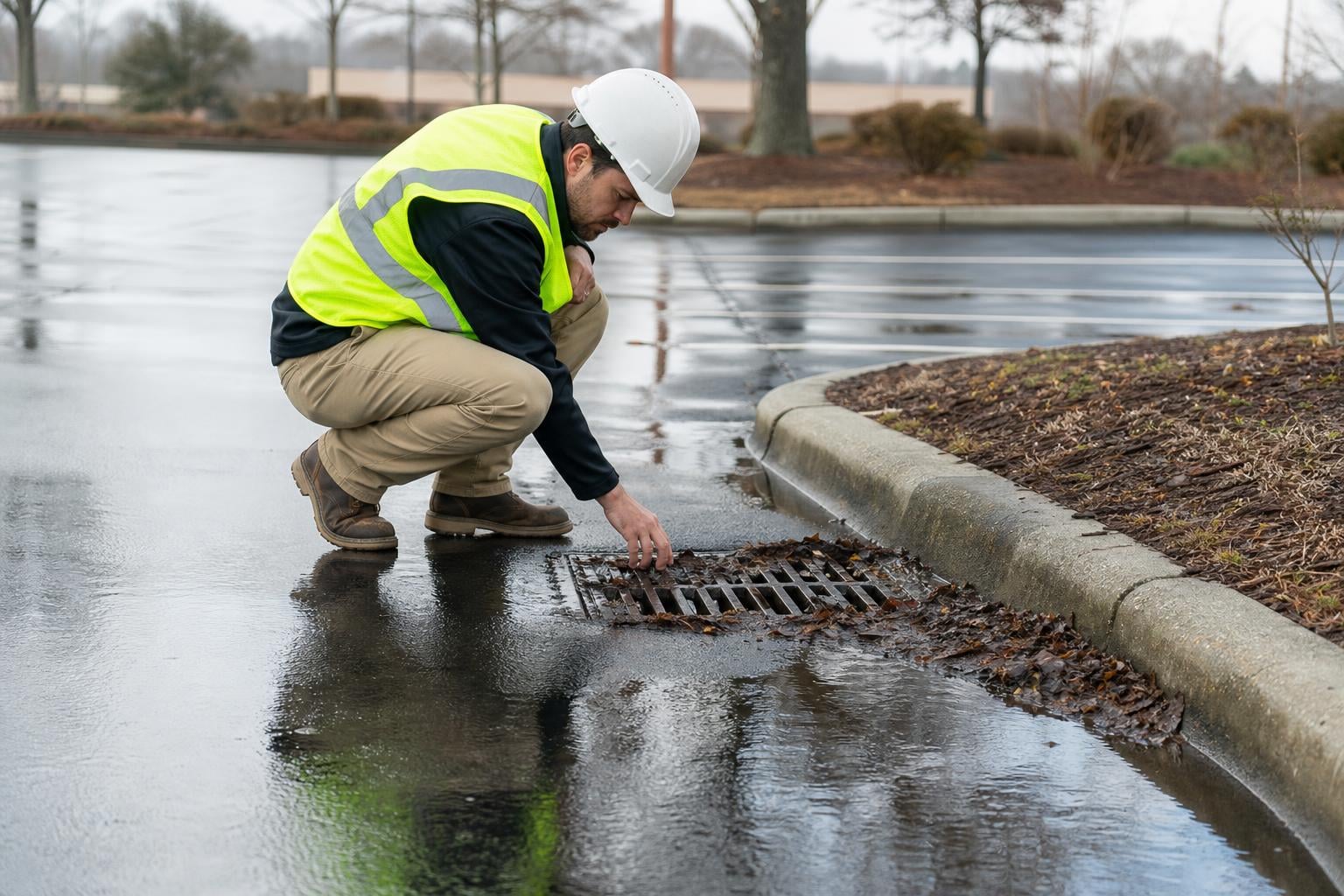
When a catch basin fills with sediment to roughly 50% of its sump depth, water backs up and overflows the grate instead of entering the pipe system. The fix is simple (cleaning), but the consequence of neglect is pavement damage and potential flooding.
Settling Around Inlets
Over time, the pavement around catch basin openings sinks as the backfill material compacts or washes out. This creates a depression that traps water exactly where it should be draining. Inlet collar construction, using concrete reinforcement and adjustment rings, resets the basin to grade and prevents further settling.
Perimeter Erosion
Uncontrolled runoff at lot edges erodes landscaping, undermines curbs, and can deposit sediment onto neighboring properties. This is often a sign that the lot’s curb and gutter system has deteriorated or that the original drainage design underestimated runoff volumes.
The Winter Diagnostic Trick
Drainage problems reveal themselves most clearly in winter. Ice formation patterns show exactly where water accumulates during freeze cycles. A zone that consistently ices over when surrounding areas remain clear is not a salting frequency issue. It is a drainage issue. The water is pooling there before freezing. Documenting these ice patterns during winter provides a precise map of drainage failures to address in spring. This is one of the most practical diagnostic approaches available, and it costs nothing.
A systematic approach to identifying these problems can be found in the pavement inspection checklist.
How Poor Drainage Destroys a Parking Lot
Parking lot deterioration follows a predictable chain of events:
Stage | What Happens |
|---|---|
Standing water develops | Surface remains wet after rainfall |
Water enters pavement cracks | Moisture reaches the base |
Base loses strength | Aggregate begins shifting |
Asphalt flexes | Fatigue cracking develops |
Potholes form | Water accelerates failure |
Reconstruction becomes necessary | Full-depth replacement may be required |
Stopping this process early through drainage repairs costs far less than rebuilding the pavement structure.
Stormwater Compliance Basics

Parking lot drainage is not just a pavement maintenance concern. It is a regulatory obligation.
NPDES Framework
Most municipalities regulate stormwater runoff from commercial properties under NPDES permits. Parking lots are large impervious surfaces that generate significant runoff volumes and pollutant loads, including oil, heavy metals, and sediment. Property owners are responsible for ensuring their drainage systems comply with discharge standards, both during construction and throughout the life of the property.
Local BMP Requirements
Beyond federal NPDES requirements, many urban cities and county governments have developed their own erosion control and stormwater management manuals. The primary objectives are consistent: minimize stormwater runoff rates and volumes, prevent erosion, and capture pollutants before they reach waterways.
Typical local requirements include erosion control during construction, post-construction BMPs (detention, filtration), and ongoing maintenance documentation.
Design Storm Sizing
A minimal design storm frequency for a parking lot drainage system is a 2-year event. Major trunk lines and detention systems serving larger developments are often sized for 25-year or 100-year storms. Undersizing the drainage system to save on construction costs almost always results in higher long-term costs from pavement damage, flooding liability, and regulatory fines.
Southeast Considerations
Properties in Tennessee, Alabama, and across the Southeast face intense rainfall events that test drainage systems harder than most regions. A system sized for a Midwest 2-year storm may be inadequate for a Nashville or Birmingham 2-year storm. Local rainfall intensity data should always drive the design, not national averages.
How Climate Affects Parking Lot Drainage Design
Drainage systems should be designed for local weather conditions.
Climate | Primary Concern |
|---|---|
Heavy rainfall | Larger pipe capacity |
Snow regions | Freeze-thaw damage |
Coastal areas | Corrosion |
Desert climates | Flash flooding |
Tropical climates | High rainfall intensity |
Local rainfall data should always be used instead of national averages when sizing drainage systems.
Maintenance and Inspection
A drainage system that is installed correctly and then ignored will still fail. Maintenance is what keeps it functional.
Annual Catch Basin Cleaning
At minimum, every catch basin on the property should be cleaned once per year. Properties with heavy tree cover, construction activity, or sandy soils may need semi-annual cleaning. The goal is to keep sediment below 50% of sump depth at all times.
Post-Storm Grate Inspection
After any significant rain event, walk the lot and check every grate for debris blockage, displacement, or damage. This takes 30 minutes on a typical commercial lot and prevents small problems from compounding.
24-Hour Post-Storm Inspection
The best time to evaluate drainage performance is 24 hours after a heavy rain. Any standing water at that point indicates a drainage problem, whether from clogging, settlement, or inadequate slope. Document the location and extent of ponding with photos and measurements.
Sediment Removal Schedule
Trench drains and slot drains accumulate sediment in their channels. Quarterly flushing or vacuuming keeps flow rates where they need to be. French drains should be inspected annually for signs of fabric clogging or gravel contamination.
Professional Inspection Frequency
A qualified contractor should inspect the full drainage system, including underground pipes, at least every two to three years. Video inspection of storm pipes can identify root intrusion, joint separation, and pipe collapse before they cause surface-level failures. Incorporating drainage inspection into a broader pavement management program ensures nothing falls through the cracks.
Parking Lot Drainage Inspection Checklist
Inspect the parking lot after every major rainfall and at least annually.
Inspection Item | What to Look For |
|---|---|
Catch basin grates | Blockages or broken grates |
Ponding | Standing water after 24 hours |
Curbs | Cracks and settlement |
Drain pipes | Slow drainage or backups |
Pavement | Rutting or alligator cracking |
Inlet collars | Separation or settlement |
Trench drains | Sediment accumulation |
Swales | Erosion or vegetation blockage |
When to Call a Drainage Contractor
Some drainage problems are maintenance issues that an in-house crew can handle. Others require engineering and construction. Here is the dividing line:
In-house maintenance: Catch basin cleaning, grate replacement, debris removal, post-storm inspections.
Contractor scope: Inlet collar reconstruction, storm pipe replacement, regrading and resurfacing to correct slope, new trench drain installation, detention system construction, and any work that involves cutting into the pavement structure.
Wright Construction handles storm pipe and drainage system installation, curb and gutter construction, inlet collar construction, flume and swale construction, and box culvert and headwall installation across the Southeast. Because they self-perform concrete, asphalt, and site work with their own crews, the drainage project and the pavement restoration happen under one contract instead of requiring separate subcontractors.
Contact Wright Construction to discuss parking lot drainage assessment, repair, or new system installation for commercial and industrial properties.
Catch Basin vs Trench Drain vs French Drain
Feature | Catch Basin | Trench Drain | French Drain |
|---|---|---|---|
Collects surface water | Yes | Yes | No |
Collects groundwater | No | No | Yes |
Best use | Parking lots | Building entrances | Landscaping |
Visible | Yes | Yes | No |
Maintenance | Medium | Medium | Low |
Handles heavy rainfall | Excellent | Excellent | Fair |
Frequently Asked Questions
What is the recommended minimum slope for parking lot drainage?
The most widely accepted minimum is 2% (1/4 inch per foot) for both cross slope and longitudinal slope. While some standards allow as low as 1% for asphalt and 0.5% for concrete, pavement built below 2% is very difficult to construct without creating ponding areas. The maximum slope in areas where cars park is 6%.
How much does a parking lot drainage system cost?
Costs vary by system type. Catch basins typically run $1,500 to $3,000 per unit installed. Trench drains range from $80 to $200 per linear foot for polymer systems and $150 to $350 for heavy-duty versions. French drains cost $10 to $100 per linear foot depending on depth and materials. Oil-water separators add $5,000 to $15,000 per unit.
How do I know if my parking lot has a drainage problem?
The most obvious sign is standing water more than 48 hours after a rain event. Other indicators include pavement cracking around catch basins, erosion at lot edges, sediment buildup on the surface, and recurring potholes in the same locations. In winter, watch for ice patches that form in specific zones while the rest of the lot stays clear.
What is an inlet collar, and why does it matter?
An inlet collar is a concrete reinforcement ring constructed around a catch basin opening. It prevents the asphalt surrounding the basin from settling, cracking, and separating from the grate frame. Without an inlet collar, traffic impact and water infiltration gradually create a depression around the basin that traps water instead of draining it.
Do parking lots need stormwater permits?
In most jurisdictions, yes. Commercial properties with significant impervious surfaces are regulated under NPDES permits. The specific requirements vary by state and municipality, but they typically include detention or infiltration requirements, pollutant controls (BMPs), and ongoing maintenance obligations.
What is the difference between detention and retention in stormwater management?
Detention temporarily holds stormwater and releases it at a controlled rate to prevent downstream flooding. Retention permanently stores water, allowing it to infiltrate into the ground or evaporate. Most commercial parking lots use detention systems because they release water gradually rather than requiring the soil conditions necessary for full infiltration.
How often should catch basins be cleaned?
At minimum once per year, with semi-annual cleaning recommended for properties with heavy landscaping, nearby construction, or sandy soils. A catch basin that reaches 50% sediment capacity experiences significant flow reduction and can cause backup flooding during storm events.
Can you repave a parking lot without fixing drainage problems?
You can, but you should not. Repaving over a drainage problem gives you new asphalt with the same ponding issues. If the lot has no cross slope or an inadequate flowline, the new surface will hold water in the same locations. Always address drainage grading and collection before investing in a new surface.