
TL;DR
Box culvert construction involves building rectangular reinforced concrete structures beneath roads, parking lots, and embankments to manage stormwater drainage. These structures come in precast or cast-in-place configurations, with standard spans ranging from 3 feet to 20 feet or more. Properly installed box culverts last 70 to 100 years, but failures from poor joint sealing, inadequate backfill compaction, and unstable foundations can cut that lifespan dramatically. This guide covers every term and concept you need to discuss box culvert projects confidently with engineers and contractors.
What Box Culvert Construction Actually Involves
If you own or manage a commercial property in the Southeast, there’s a good chance someone has mentioned box culverts to you. Maybe a civil engineer flagged drainage problems during site development. Maybe your general contractor included “box culvert and headwall installation” as a line item on a bid. Either way, you’re now expected to understand what that means and what it costs.
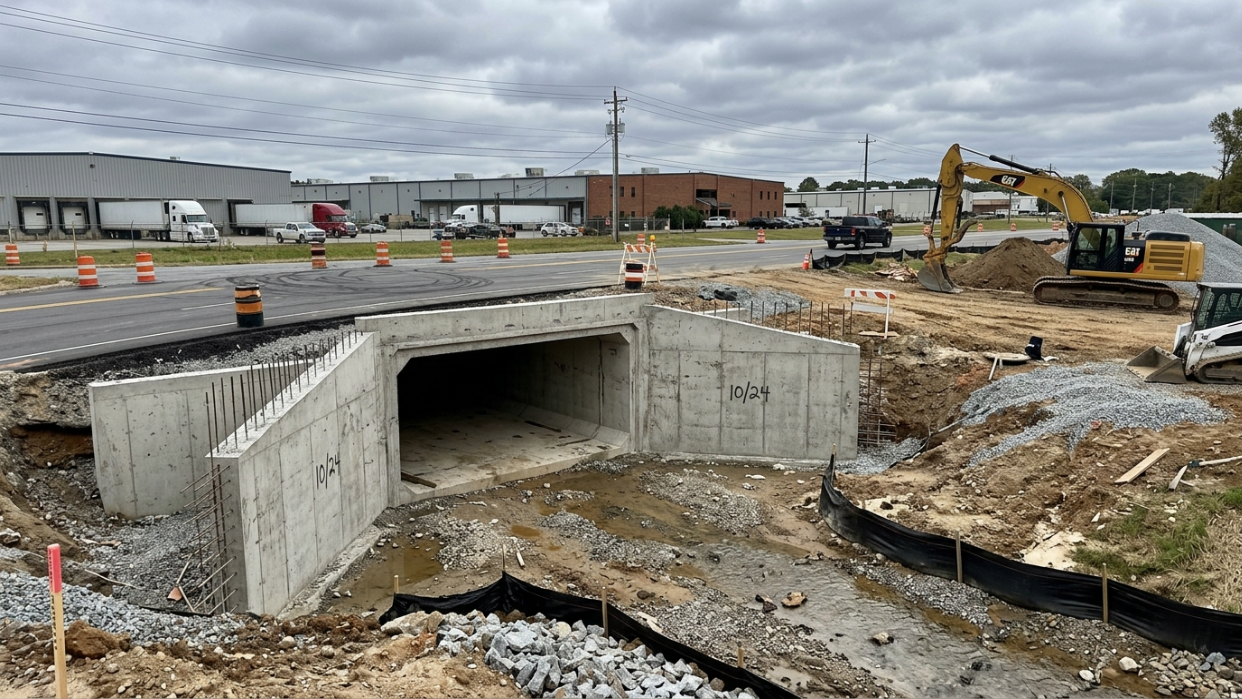
A box culvert is a rectangular concrete structure, essentially a reinforced concrete tunnel, built underground to move water beneath roads, parking lots, access drives, and embankments. Unlike round pipe culverts, box culverts have flat tops and bottoms with vertical walls, giving them a rigid frame that handles heavy loads and large water volumes.
Box culvert construction covers everything from excavation and subgrade preparation through concrete placement, joint sealing, and backfill compaction. On commercial and industrial sites (warehouses, distribution centers, manufacturing facilities), these structures are critical infrastructure that keeps parking areas from flooding and access roads from washing out.
Contact Wright Construction for box culvert and headwall installation across the Southeast.
Beyond drainage, box culverts serve as pedestrian crossings, utility tunnels, wildlife passages, and even underground storage vaults. Their versatility is one reason they show up so frequently on commercial site plans.
Box Culvert Construction Process: Step-by-Step
Many property owners understand what a box culvert is but not how it is actually built. While specific project requirements vary, most commercial box culvert installations follow the same sequence.
Phase 1: Engineering and Site Investigation
Before construction begins, engineers perform:
Hydraulic analysis
Drainage calculations
Watershed evaluation
Soil borings
Utility locating
Permit acquisition
These studies determine culvert size, elevation, slope, and structural requirements.
Phase 2: Excavation and Foundation Preparation
Contractors excavate to design depth and remove unsuitable soils. The foundation is proof rolled and inspected before bedding material is installed.
Phase 3: Culvert Installation
Depending on project requirements:
Precast sections are delivered and placed with cranes.
Cast-in-place structures are formed and poured onsite.
Alignment and invert elevations are checked continuously.
Phase 4: Joint Sealing and Waterproofing
All joints are sealed using approved gasket systems, mastic sealants, or external wraps to prevent infiltration and soil migration.
Phase 5: Backfilling and Compaction
Backfill is placed in controlled lifts and compacted to specification on both sides of the structure simultaneously.
Phase 6: Erosion Control and Final Inspection
Headwalls, wingwalls, aprons, riprap, and outlet protection measures are installed before final inspection and project acceptance.
What Is Box Culvert Construction? (Quick Answer)
Box culvert construction is the process of installing a reinforced concrete rectangular drainage structure beneath roads, parking lots, embankments, and commercial developments to safely convey stormwater. The process includes hydraulic design, excavation, subgrade preparation, bedding installation, culvert placement (precast or cast-in-place), joint sealing, backfilling, compaction, and erosion protection. Properly constructed box culverts typically provide 70 to 100 years of service life while supporting heavy traffic loads and preventing flooding.
Typical box culvert construction steps:
1. Hydraulic and geotechnical design
2. Site excavation and grading
3. Subgrade preparation
4. Bedding installation
5. Culvert placement
6. Joint sealing
7. Headwall and wingwall construction
8. Backfill and compaction
9. Erosion control installation
10. Final inspection and testing
Structure and Components

Box Culvert
A reinforced concrete structure with a rectangular cross-section consisting of a base slab (invert), two walls, and a top slab. The entire assembly acts as a rigid frame, meaning the walls and slabs work together to resist earth pressure and traffic loads. When a single barrel has a span less than 20 feet, it’s classified as a culvert. When the total span exceeds 20 feet (single or multiple barrels combined), it’s classified as a bridge, which triggers different design and inspection requirements.
Single-Cell vs. Multi-Cell Box Culvert
A single-cell box culvert has one opening (one barrel). Multi-cell designs place two or more barrels side by side, separated by interior walls. Multi-cell configurations are common when the required hydraulic capacity exceeds what a single opening can handle, or when the site needs to stay within the 20-foot span threshold to avoid bridge classification.
Barrel
The main tunnel-like passage through which water flows. Each rectangular opening in a box culvert is one barrel. Barrel length depends on the width of the road, embankment, or site feature the culvert passes beneath.
Rise and Span
Span is the horizontal interior dimension (width) of the opening. Rise is the vertical interior dimension (height). Standard precast sizes typically range from 3 feet by 6 feet to 10 feet by 20 feet for four-sided units, with some manufacturers offering spans up to 28 feet for three-sided configurations. These two numbers define the hydraulic capacity of the culvert.
Invert Slab (Base Slab)
The bottom slab of the box culvert. This is the surface water actually flows across. The invert sets the grade and slope of the entire structure. Getting the invert elevation right is one of the first and most important steps in box culvert construction, because it determines how effectively water drains through the system. For context on how base slabs are constructed in other applications, the principles in slab-on-grade construction overlap significantly.
Top Slab (Deck Slab)
The upper slab that spans between the two walls and supports the earth fill and traffic loads above. On commercial sites, the top slab might carry loaded trucks, so it must be designed for the appropriate live load (more on that below).
Headwall
A vertical concrete wall built at both the inlet and outlet ends of the culvert. Headwalls serve three purposes: they retain the embankment soil, protect slopes from lateral scour, and improve hydraulic efficiency by providing a flush inlet instead of a projecting one. Not every culvert installation includes headwalls, but they’re standard practice on most commercial sites where erosion control matters.
Wingwall
Extensions that project outward from the sides of a headwall at an angle. Wingwalls guide water into the culvert opening, reduce turbulence, and prevent soil erosion around the culvert ends. Whether your project needs wingwalls depends on water velocity, soil type, and site geometry. In the Southeast, where clay soils erode aggressively during heavy storms, wingwalls are more often necessary than not.
Apron (Scour Apron)
A concrete pad placed at the inlet or outlet of the culvert, extending outward along the channel bottom. The apron prevents scour (erosion caused by fast-moving water) from undermining the headwall and culvert foundation.
Haunch
The thickened corner where walls meet slabs inside the box culvert. Haunches strengthen the rigid frame connection and help distribute loads between the walls and slabs. In cast-in-place construction, the haunch area requires careful rebar detailing.
Toe Wall (Cutoff Wall)
A short vertical wall extending downward from the base slab or apron into the soil. Toe walls prevent water from seeping underneath the structure and eroding the foundation, a process called piping that can lead to sinkholes.
Weep Holes
Small drainage holes through the culvert walls that relieve hydrostatic pressure from groundwater behind the structure. Without weep holes, water pressure can build up against the walls and cause cracking or displacement over time.
Construction Methods and Process
Precast Box Culvert
Box culvert sections manufactured in a controlled factory environment, then transported to the site and installed with a crane. Standard lay lengths are 6 feet per section, and units connect with tongue and groove joints sealed with gasket material.
Precast is the dominant method for box culvert construction today, and for good reason. Sections arrive ready for immediate installation, quality control happens in the factory rather than the field, and weather delays have minimal impact. According to one precast industry source, precast installation can reduce labor costs by roughly 50% compared to cast-in-place methods.
That said, the precast market has faced real supply chain pressure in recent years. During the COVID-19 pandemic, rising precast costs, extended delivery times, and fewer suppliers led agencies across the Southeast and Midwest to reconsider cast-in-place options. That dynamic has stabilized somewhat, but lead times remain a planning consideration.
Cast-in-Place (CIP) Box Culvert
A box culvert built entirely on site by constructing formwork, placing reinforcement, and pouring concrete in stages. The typical CIP sequence follows this order:
Survey the site and establish invert levels and alignment.
Excavate to the required depth and width.
Place and compact replacement soil materials as needed.
Pour a lean concrete leveling course for the invert slab foundation.
Install reinforcement bars for the base slab and pour the invert.
Set wall formwork, place wall reinforcement, and pour the walls.
Set top slab formwork, place reinforcement, and pour the deck.
Allow proper curing time.
Backfill around the structure with compacted material.
CIP construction makes sense when the project requires non-standard dimensions, when precast sections can’t be transported to the site (tight access, remote locations), or when precast pricing and lead times are unfavorable. The commercial concrete construction process follows similar staging principles.
Formwork
The temporary molds that shape the concrete walls and slabs of a CIP box culvert. Formwork must resist the hydrostatic pressure of wet concrete without deflecting. For box culverts, forming typically happens in stages: the base slab is poured first, then wall forms are erected, then the deck is formed and poured last. Understanding formwork systems is essential for anyone managing a CIP culvert project.
Reinforcement (Rebar)
Steel reinforcing bars placed within the concrete to handle tensile forces. Box culverts experience complex loading, with earth pressure pushing inward on the walls, traffic loads pressing down on the top slab, and soil bearing pressure pushing up on the base slab. The reinforcement layout addresses all of these forces. Rebar placement at haunches is particularly critical because that’s where the highest stresses concentrate. For a deeper look at reinforcement options, see this guide on concrete reinforcement types.
Lean Concrete (Leveling Course)
A low-strength concrete layer (typically 1,500 to 2,000 psi) poured over the prepared subgrade before the main structural concrete is placed. This leveling course provides a clean, flat surface for setting rebar and ensures the invert slab sits at the correct elevation. It’s not a structural element, just a working platform.
Construction Joint
A planned stopping point in a concrete pour where fresh concrete will later be placed against hardened concrete. In CIP box culvert construction, construction joints typically occur between the base slab and walls, and between the walls and top slab. Proper preparation of these joints (cleaning, roughening the surface, sometimes installing waterstops) prevents water from seeping through.
Tongue and Groove Joint
The connection between adjacent precast box culvert sections. One end of each section has a protruding tongue, and the other has a matching groove. When pushed together, the interlocking profile aligns the sections and creates a stable joint. Gaskets or mastic sealant fill the gap to prevent water infiltration and soil migration.
Joint Sealing
The process of waterproofing connections between precast sections. Common methods include butyl mastic sealant applied to the joint face before assembly, compression gaskets that seal under contact pressure, and external sealing bands wrapped around the outside of the joint. Joint sealing is arguably the most important quality control step in precast box culvert construction, because joint separation is the number one cause of culvert failure.
Proof Rolling
Driving heavy equipment (typically a loaded dump truck or roller) across the prepared subgrade to identify soft spots or areas of inadequate compaction. If the subgrade deflects visibly under the rolling load, those areas need to be excavated and replaced with suitable material before culvert installation begins.
Bedding Material
The layer of granular material (crushed stone, gravel, or sand) placed and compacted directly beneath the culvert. Bedding distributes the structure’s weight evenly across the subgrade and provides a smooth, stable surface for setting precast sections to the correct line and grade.
Backfill
The soil or granular material placed around and over the installed culvert to bring the site back to finished grade. Backfill quality and compaction directly affect the structure’s long-term performance. Fill should be placed in lifts (layers) not exceeding approximately 8 inches, with each lift compacted to 95% of modified Proctor density. The trench must be filled evenly on both sides as backfilling progresses, because uneven loading can shift the structure.
Compaction (Lifts and Proctor Density)
Compaction is the process of mechanically densifying backfill material by removing air voids. “Lifts” refers to the individual layers of fill placed and compacted one at a time. Modified Proctor density is a lab test that establishes the maximum achievable density for a given soil. Specifying 95% of modified Proctor density means the field compaction must achieve at least 95% of that lab maximum. Backfilling without proper compaction is a mistake that often doesn’t show consequences until months or years later, when loose fill settles and creates surface dips, cracked pavement, or pipe misalignment.
Staged Construction
Building a box culvert in phases, often necessary when the road or site above must remain partially open during construction. One side of the culvert is built first while traffic uses the other side, then traffic shifts and the second half is completed. This approach is common on commercial sites where shutting down an access road entirely would halt operations.
Design and Engineering Terms
Hydraulic Analysis (Hydraulic Capacity)
The engineering study that determines what size culvert is needed to handle the design storm (a rainfall event of specified intensity and duration, often a 25-year or 100-year storm). Box culverts have greater hydraulic capacity than round pipe culverts of similar size because the rectangular cross-section moves water more efficiently when headroom is limited. The inlet should be slightly higher than the outlet, maintaining a consistent slope of approximately 1 to 2%.
Inlet Control vs. Outlet Control
These terms describe which end of the culvert governs its hydraulic performance. Under inlet control, the culvert can carry more water than the inlet allows in, so capacity is limited by the opening size and geometry. Under outlet control, the culvert fills completely and capacity depends on the barrel length, roughness, and tailwater conditions downstream. The distinction matters because it determines whether improvements to the inlet (like adding a headwall and wingwalls) will actually increase capacity.
Freeboard
The vertical distance between the design water level inside the culvert and the top of the opening. Freeboard provides a safety margin for debris, wave action, or flows that exceed the design storm. Insufficient freeboard leads to upstream flooding.
Design Fill (Fill Height)
The depth of soil between the top of the culvert and the finished ground surface. Fill height determines the earth pressure on the structure and influences the required concrete thickness and reinforcement. Precast culvert sections are designed for specific fill height ranges, and exceeding the rated fill height can cause structural failure.
Live Load (HL-93 / HS-20)
The traffic load the culvert must support. HL-93 is the current AASHTO design truck load, consisting of a design truck (or tandem) combined with a uniform lane load. HS-20 is the older designation still referenced in many specifications. For commercial sites with heavy truck traffic (distribution centers, manufacturing plants), confirming the correct live load rating is essential. The principles behind designing for truck traffic loads apply to culvert design as well.
Bearing Capacity (Safe Bearing Capacity / SBC)
The maximum pressure the soil beneath the culvert can support without excessive settlement. If the actual bearing capacity is less than what the design assumes, the foundation soil must be improved, either by over-excavating and replacing with compacted granular fill, or by other ground improvement methods.
Geotechnical Investigation
Soil borings and laboratory testing performed before design to characterize subsurface conditions. For box culvert construction, the geotechnical report reveals bearing capacity, groundwater levels, and whether problem soils (like the expansive clays common across Tennessee, Alabama, and Mississippi) are present. Skipping this step is a recipe for foundation failure.
AASHTO LRFD
The American Association of State Highway and Transportation Officials’ Load and Resistance Factor Design specification. This is the governing design code for culverts under roads in the United States. It establishes load factors, resistance factors, and design procedures that engineers must follow.
ASTM C1577
The standard specification for precast reinforced concrete monolithic box sections for culverts, storm drains, and sewers designed according to AASHTO LRFD. This is the primary manufacturing standard for precast box culverts. If you’re reviewing submittals on a project, this is the spec number to look for.
ASTM C1786
A companion standard covering segmental (multi-piece) precast reinforced concrete box sections. This applies to culverts assembled from separate base, wall, and top slab pieces rather than monolithic (single-piece) sections.
AASHTO M 259 and M 273
M 259 covers precast reinforced concrete box sections for culverts generally. M 273 specifically addresses box sections with less than 2 feet of cover subjected to highway loadings, a critical specification for shallow installations where the culvert sits close to the road surface.
Installation and Site Work
Subgrade Preparation
All the work done to create a stable foundation before the culvert goes in. This includes excavation to the required depth, removal of unsuitable materials (organic soil, soft clay, debris), replacement with compacted granular backfill, and placement of a bedding layer to the proper line and grade. The subgrade is then proof rolled to verify stability.
Crane Placement and Lifting Anchors
Precast box culvert sections are heavy, often several tons each, and require a crane for placement. Sections have cast-in lifting anchors (steel inserts) that the crane’s rigging connects to. Crane setup requires stable ground, adequate reach, and enough clearance for the boom. On tight commercial sites, crane positioning can be one of the biggest logistical challenges.
Bell and Spigot Joint
Another term for the tongue and groove connection on precast sections. The “bell” (receiving end) faces upstream, and the “spigot” (inserting end) faces downstream. The first section is set at the low end of the culvert run with the bell pointing uphill, then subsequent sections are added moving upstream. Getting the first section positioned correctly is critical because it establishes the line and grade for the entire run.
Alignment (Line and Grade)
Line refers to the horizontal position of the culvert (is it straight, or does it curve?). Grade refers to the vertical slope. Both must match the design drawings precisely. Even small deviations accumulate over the length of a culvert run and can create low spots that collect sediment or high spots that restrict flow.
Backfill Lifts
The individual layers of fill material placed and compacted around the culvert. Each lift should not exceed 8 inches in loose thickness before compaction. Filling must proceed evenly on both sides of the culvert to prevent lateral loading that could shift the structure.
Reach out to Wright Construction for site drainage work on commercial and industrial properties across the Southeast.
Maintenance, Failure, and Rehabilitation

Joint Separation
The most common box culvert failure mode. When joints between precast sections open up, soil migrates through the gap into the culvert barrel. This soil loss creates voids around and above the structure. Over time, those voids grow until the surface above collapses, sometimes catastrophically.
Sinkhole (Above Culvert)
A surface depression or collapse caused by soil migrating into a culvert through failed joints or cracks. On commercial properties, sinkholes in parking lots or access roads create safety hazards and liability exposure. The connection between culvert joint failure and sinkhole development is well documented but often overlooked during routine property maintenance.
Scour and Erosion
The removal of soil by flowing water at the inlet, outlet, or along the culvert alignment. Scour at the outlet is particularly common because water velocity increases as it exits the culvert. Aprons, riprap (loose stone), and energy dissipators control scour. Without these measures, the headwall foundation can be undermined.
Culvert Lining and Rehabilitation
Methods for extending the service life of a deteriorating culvert without full replacement. Options include slip-lining (inserting a smaller pipe or liner inside the existing culvert), cured-in-place pipe lining, and spray-on coatings. These approaches are cost-effective when the culvert is still structurally sound but has joint problems or surface deterioration.
Design Life (Service Life)
The expected functional lifespan of the structure. According to the US Army Corps of Engineers (Engineer Manual 1110-2-2902), a properly installed concrete culvert should last between 70 and 100 years. Practitioners on the Eng-Tips engineering forum generally cite 75 to 100 years for precast concrete boxes, while corrugated steel culverts get roughly 50 years. Several engineers in that discussion noted the difficulty of finding authoritative, non-manufacturer sources for these numbers, which is worth keeping in mind when evaluating product claims.
Precast vs. Cast-in-Place: Quick Comparison
Factor | Precast | Cast-in-Place |
|---|---|---|
Installation speed | Fast (sections set in hours) | Slow (weeks for forming, pouring, curing) |
Labor cost | Lower (up to 50% savings) | Higher |
Quality control | Factory-controlled | Field-dependent |
Weather sensitivity | Low | High |
Custom sizing | Limited to standard molds | Unlimited flexibility |
Site access requirement | Needs crane access and delivery route | Minimal heavy equipment beyond forms |
Best for | Standard sizes, tight schedules | Non-standard dimensions, restricted access |
For projects where concrete mix design and placement conditions need close management, CIP gives the team full control. For speed and predictability, precast wins.
Why Box Culvert Construction Matters on Commercial Sites
Most online resources frame box culverts as highway or DOT infrastructure. That’s only half the picture. On commercial and industrial sites, box culverts are the backbone of the stormwater management system. They carry runoff beneath parking lots, access roads, truck courts, and building pads.
In the Southeast, this matters more than in many other regions. Annual rainfall across Tennessee, Alabama, Mississippi, and surrounding states routinely exceeds 50 inches. Combine that volume with the expansive clay soils common throughout the region, and you get conditions that punish inadequate drainage. Clay holds water, swells, and puts extra pressure on culvert walls. When it dries, it shrinks and can create voids around the structure. Every step in box culvert construction, from geotechnical investigation through backfill compaction, must account for these conditions.
For property owners and general contractors, the key takeaway is this: a box culvert is not just a pipe in the ground. It’s a structural concrete system that requires the same level of engineering attention as a building foundation. The same structural concrete expertise that goes into walls, columns, and slabs applies directly to culvert construction.
Wright Construction provides box culvert and headwall installation as a named service across the Southeast, with offices in Memphis, Nashville, Chattanooga, Birmingham, and Huntsville.
Box Culvert vs. Pipe Culvert
One of the most common questions property owners ask is whether they need a box culvert or a pipe culvert. The answer depends on flow volume, headroom, and structural requirements.
Box culverts are more hydraulically efficient when vertical space is limited. A box culvert with a wide span and short rise moves more water than a round pipe of comparable height because the rectangular shape uses headroom more effectively. As one precast manufacturer’s president has noted, when the required pipe size exceeds a 72-inch round pipe or a 60-inch arch pipe, it’s typically better to switch to a box culvert.
Pipe culverts work well for smaller drainage needs, are easier to install in most cases, and cost less for simple applications. But for large flow capacities, heavy traffic loads, or situations requiring a flat bottom (useful for fish passage or pedestrian crossings), box culverts are the better choice.
Box Culvert vs Pipe Culvert Comparison
Feature | Box Culvert | Pipe Culvert |
|---|---|---|
Shape | Rectangular | Circular or Arch |
Hydraulic Efficiency | Higher in low-clearance conditions | Lower |
Flow Capacity | Higher | Moderate |
Traffic Load Capacity | Excellent | Good |
Fish Passage | Better | Limited |
Pedestrian Crossing | Possible | Rare |
Installation Speed | Fast with precast | Often faster for small sizes |
Cost for Small Drainage Areas | Higher | Lower |
Cost for Large Drainage Areas | Often more economical | Can become expensive |
Maintenance Access | Easier | More difficult |
Box Culvert Construction Cost Factors
One of the first questions owners ask is how much a box culvert project will cost. Pricing varies significantly depending on site conditions, structure size, and installation complexity.
Major Cost Drivers
Culvert dimensions
Precast versus cast-in-place construction
Excavation depth
Groundwater conditions
Foundation improvements
Headwalls and wingwalls
Utility conflicts
Traffic control requirements
Crane access
Backfill quantities
Typical Cost Impact by Factor
Cost Factor | Impact on Budget |
|---|---|
Larger span and rise | High |
Poor soil conditions | High |
Deep excavation | High |
Utility relocation | High |
Precast installation | Medium |
Headwalls and wingwalls | Medium |
Erosion protection | Medium |
Traffic maintenance | Medium |
Site accessibility challenges | Medium to High |
Because every drainage system is site-specific, contractors generally price box culverts based on engineered plans rather than per-linear-foot rates alone.
Frequently Asked Questions
How long does a box culvert last?
A properly installed reinforced concrete box culvert has a design life of 70 to 100 years, according to US Army Corps of Engineers guidelines. Reaching that full lifespan depends on quality joint sealing, adequate backfill compaction, and stable foundation conditions. Neglect any of those three, and the structure can fail within decades rather than centuries.
What’s the difference between a box culvert and a pipe culvert?
A box culvert has a rectangular cross-section (flat top, flat bottom, vertical walls) while a pipe culvert is round or arch-shaped. Box culverts handle larger flow volumes, support heavier loads, and are more efficient when vertical clearance is limited. Pipe culverts are simpler and cheaper for smaller drainage applications.
What size box culvert do I need?
Size is determined by hydraulic analysis, which calculates the required capacity based on the design storm, upstream watershed area, and site conditions. Standard precast sizes range from about 3 feet by 6 feet up to 10 feet by 20 feet for four-sided units. Three-sided units (open bottom) can span up to 28 feet. A civil engineer performs the hydraulic study and selects the appropriate size.
What causes box culvert failure?
The three most common causes are joint separation (allowing soil to migrate into the culvert), poor backfill compaction (leading to settlement and pavement damage above), and unstable foundation conditions (causing uneven settling, cracks, and structural distress). Of these, joint separation is the most frequent and most preventable.
Is precast or cast-in-place better for box culvert construction?
Precast is faster, more consistent, and typically less expensive for standard sizes. Cast-in-place offers unlimited dimensional flexibility and doesn’t require crane access or heavy truck delivery. The right choice depends on project size, schedule, site access, and whether standard precast dimensions work for the hydraulic design.
Do all box culverts need headwalls?
Not always, but headwalls are standard practice on most commercial installations. They improve hydraulic efficiency, retain the embankment, and protect against scour. Skipping headwalls to save money often leads to erosion problems that cost more to fix later.
What standards govern box culvert construction?
The primary standards are ASTM C1577 (monolithic precast box sections), ASTM C1786 (segmental precast sections), AASHTO M 259 (general precast box specifications), and AASHTO M 273 (shallow-cover installations under highways). Design follows AASHTO LRFD methodology.
When does a box culvert become a bridge?
When the total clear span (single barrel or combined multiple barrels) exceeds 20 feet, the structure is classified as a bridge rather than a culvert. Bridge classification triggers additional design requirements, inspection schedules, and regulatory oversight.
Get in touch with Wright Construction to discuss box culvert construction on your next commercial project.