
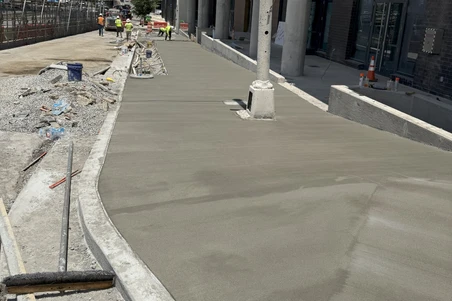
Getting concrete right on a commercial or industrial project isn’t about luck. It’s about science. The long term strength, durability, and cost effectiveness of a concrete slab, foundation, or wall all come down to a single, critical blueprint: the mix design. A proper concrete mix design for commercial projects is a precise recipe, balancing cement, water, aggregates, and admixtures to meet the exact demands of the job.
As a leading structural concrete contractor in the Southeast, Wright Construction Company knows that a successful project starts long before the first truck arrives. It starts with a thoughtful, performance based mix design. Whether it’s a high traffic warehouse slab in Memphis or a structural foundation in Birmingham, understanding the fundamentals of this process is key to achieving a lasting result.
What is Concrete Mix Design for Commercial Projects?
Concrete mix design for commercial projects is a calculated process of selecting and proportioning ingredients—cement, water, aggregates, and admixtures—to achieve specific performance goals. Unlike standard residential mixes, commercial designs prioritize compressive strength (often 4,000–7,000+ psi), durability under high-traffic loads, and environmental resistance. The primary goal is to optimize the water-to-cement (w/c) ratio to ensure structural integrity while minimizing shrinkage and cost.
The Blueprint: Key Performance Goals
Before we can create a recipe, we need to know what we’re trying to bake. A mix design always starts with the end in mind, targeting specific performance metrics required by the structural engineer and the project’s intended use.
Defining the Compressive Strength Target
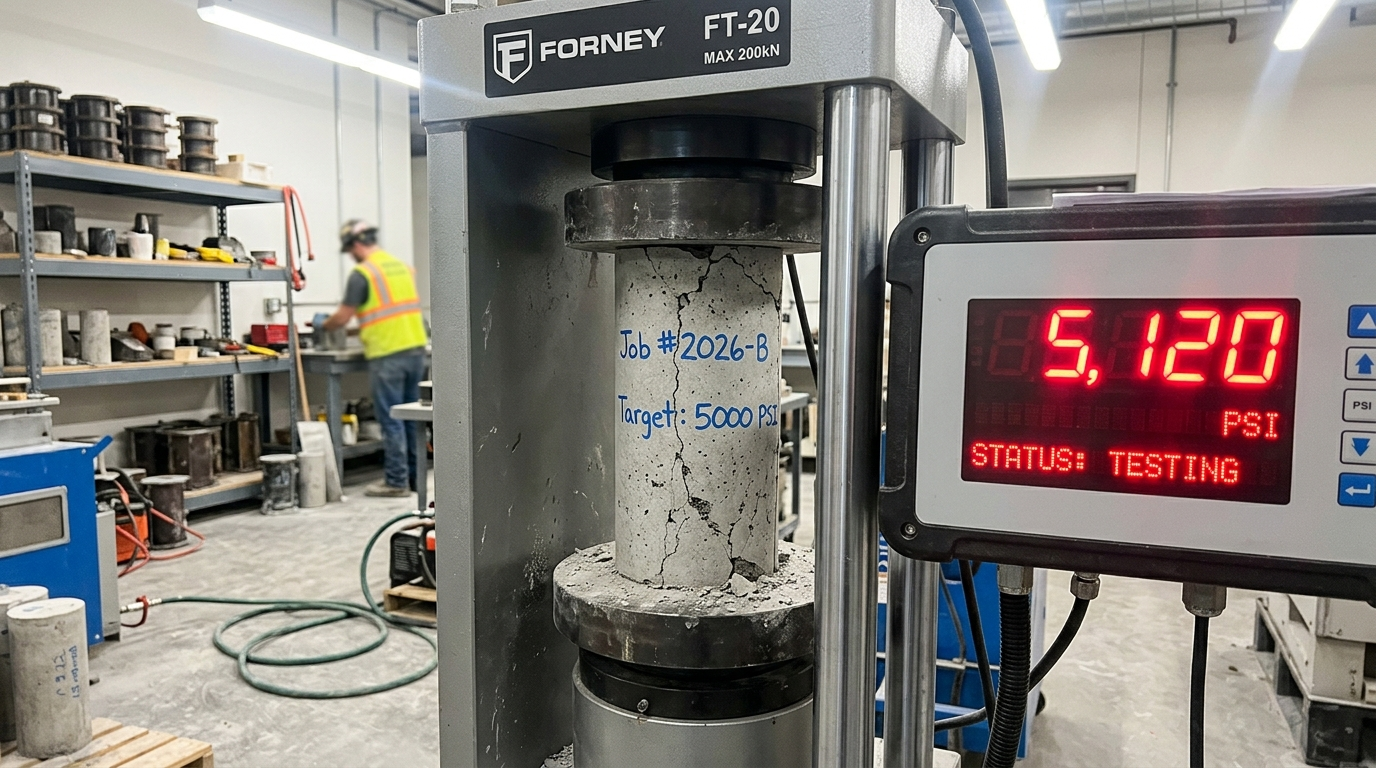
Compressive strength is the most common measure of concrete quality. It’s the concrete’s ability to resist squeezing or crushing forces. A project’s plans will specify a minimum strength, for example, 4,000 pounds per square inch (psi). However, due to natural variations in materials and conditions, we can’t just aim for 4,000 psi. The concrete mix design for commercial projects must set a higher average target strength, perhaps 5,000 psi, to ensure that virtually every test result exceeds the 4,000 psi minimum. Building codes like ACI 318 even require this safety margin, sometimes mandating that the target strength exceed the specified strength by 1,200 psi or more.
Meeting Flexural Strength Requirements
For pavements, runways, and industrial slabs on grade, flexural strength is just as important as compressive strength. This is the concrete’s ability to resist bending forces, which is crucial for handling heavy wheel loads without cracking. A specification might call for a flexural strength of 650 psi. There’s a general relationship between the two types of strength, and a 650 psi flexural requirement often corresponds to a compressive strength of over 6,000 psi. The mix is then designed to meet this demanding target, which is verified by testing concrete beams in a lab. On large-bay warehouse projects, owners often consider post-tension concrete slabs to help control cracking and extend joint spacing.
Achieving Abrasion Resistance
In applications like industrial floors, loading docks, and hydraulic structures, surface wear from traffic and friction is a major concern. The mix must be designed for high abrasion resistance. This is achieved by creating a strong, dense concrete. Higher compressive strength is directly linked to better abrasion resistance. For heavy duty warehouse slabs, a mix with around 50 MPa (over 7,000 psi) compressive strength is often used. Using a low water to cement ratio and quality aggregates, and ensuring proper curing, all contribute to a hard, durable surface that stands up to wear and tear.
Building the Foundation: Selecting and Proportioning Aggregates
Aggregates (sand, gravel, and crushed stone) make up the bulk of the concrete’s volume. Their size, shape, and proportion are fundamental to an effective and economical mix.
Why We Maximize Coarse Aggregate Size and Content
The cement paste (cement and water) is the most expensive part of a concrete mix and the source of most shrinkage. Therefore, a core principle in economical concrete mix design for commercial projects is to use as much coarse aggregate as the mix can handle. Bigger stones and a higher volume of them displace the costly paste, leading to lower costs, reduced shrinkage, and less heat generation during curing.
The Rules for Maximum Coarse Aggregate Size Selection
While bigger is often better, there are strict limits. The maximum aggregate size must not be too large for the structure. Common ACI guidelines state the maximum size should not exceed:
|
Constraint Source |
Maximum Aggregate Size Limit |
|
Narrowest Form Dimension |
$\le$ 1/5 of the width |
|
Slab Depth |
$\le$ 1/3 of the depth |
|
Reinforcement Spacing |
$\le$ 3/4 of the clear space between bars |
These rules ensure the concrete can flow properly around rebar and fill the forms completely without creating voids or “honeycomb” pockets (see concrete slab reinforcement methods). For most commercial buildings, this results in a typical maximum aggregate size of 3/4 inch or 1 inch.
Coarse and Fine Aggregate Proportioning
Once the maximum size is chosen, we determine the optimal volume of coarse aggregate. This is usually based on the aggregate size and the fineness of the sand. A typical mix might contain Depending on nominal maximum aggregate size and sand fineness modulus, ACI 211.1 recommends a bulk volume of dry‑rodded coarse aggregate per unit volume of concrete of 0.50 to 0.75. The fine aggregate, or sand, is then proportioned to fill the remaining space after accounting for cement, water, air, and the coarse aggregate. Getting this balance right is key to workability. Too little sand makes the mix harsh and hard to finish, while too much sand demands more water and cement, increasing cost and shrinkage.
A Critical Step: Aggregate Moisture Correction
Aggregates stored in stockpiles are rarely bone dry. They contain moisture that, if not accounted for, will become part of the mix water and throw off the carefully calculated water to cement ratio. Aggregate moisture correction is the process of testing the aggregates for their moisture content and adjusting the batch weights accordingly. We add less water to the mixer to compensate for the water already in the aggregates. This crucial quality control step ensures every batch of concrete is consistent.
The Binder and Fluid: Managing Cement, Water, and Air
The paste binds the aggregates together. Managing its components is where a mix designer can truly influence strength and durability.
The Single Most Important Factor: Water to Cement Ratio Determination
The ratio of the weight of water to the weight of cement (w/c) is the primary driver of concrete’s strength and durability. A lower water to cement ratio leads to a denser, stronger, and less permeable concrete. Durability requirements often dictate the maximum allowable w/c ratio. For instance, concrete exposed to deicing salts might be limited to a 0.40 w/c ratio to protect the reinforcing steel from corrosion.
The Benefits of Low Water to Cement Ratio Practice
Designing with a low w/c ratio is a hallmark of high performance concrete. Dropping the ratio from 0.50 to 0.40 can significantly increase strength and dramatically reduce permeability. This makes the concrete far more resistant to chlorides, sulfates, and freeze thaw damage. Lowering the w/c ratio also reduces drying shrinkage. One study found that cutting the w/c from 0.45 to 0.35 halved the shrinkage strain, meaning fewer cracks and better stability. If you have a demanding commercial or industrial project, contact the experts at Wright Construction Company to discuss a high performance mix design.
Cement Content Calculation and Water Selection
Once the required amount of water (based on slump needs) and the target w/c ratio are set, calculating the cement content is simple math. You divide the weight of water by the w/c ratio. For example, if a mix needs 300 pounds of water per cubic yard and the target w/c is 0.45, you will need 667 pounds of cement per cubic yard. The goal is to use enough cement to meet performance needs but not so much that it becomes wasteful or causes problems like thermal cracking.
Achieving Proper Slump and Workability Control
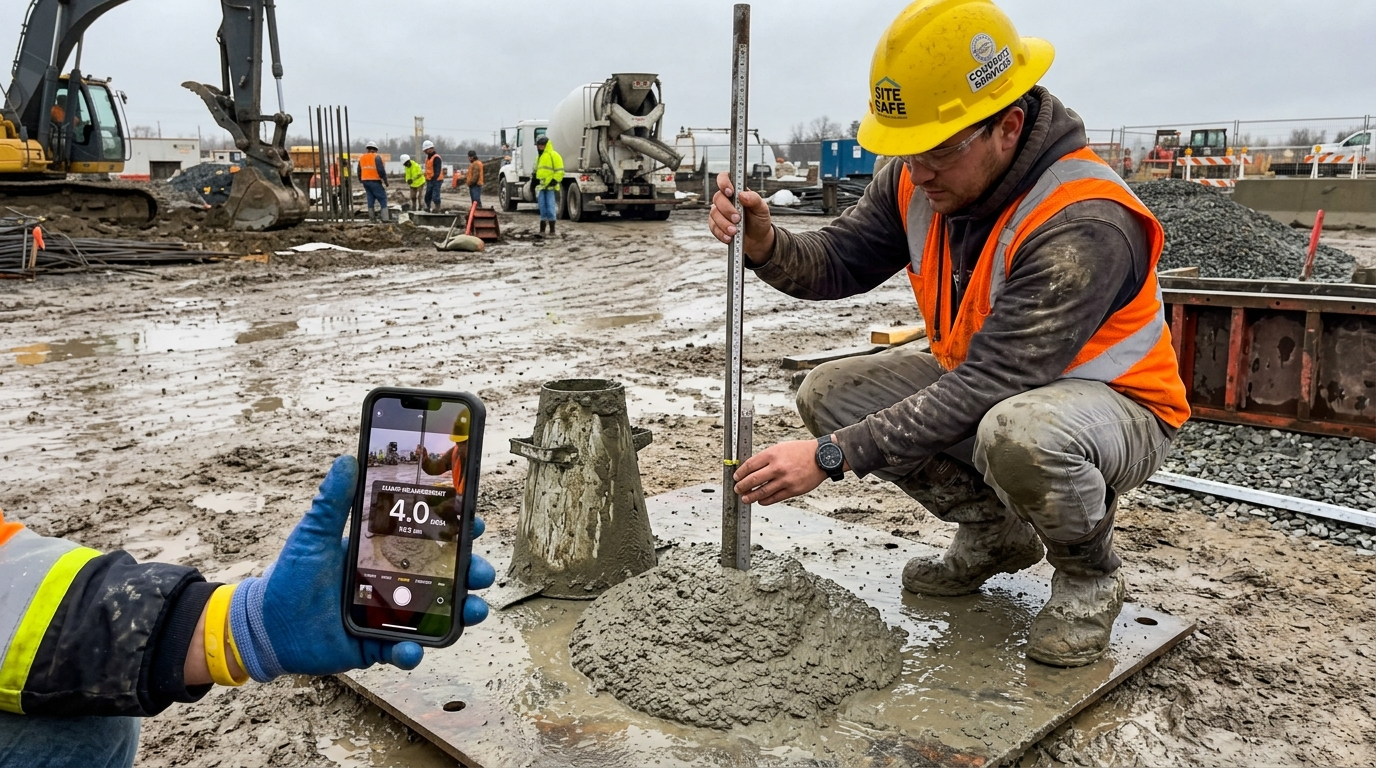
Slump is a measure of the consistency or fluidity of fresh concrete. A higher slump means a wetter, more flowable mix. The mix designer selects a target slump based on how the concrete will be placed (e.g., pumped, placed by chute) and the type of construction. Workability is about more than just slump; it’s the overall ease of placing, consolidating, and finishing the concrete. Proper aggregate proportioning and the use of admixtures are key to achieving good workability without just adding more water, which would harm the w/c ratio.
Optimizing for Sustainability and Longevity
In 2026, commercial mix design is increasingly focused on reducing the environmental footprint without sacrificing performance. By utilizing Supplementary Cementitious Materials (SCMs) like ground granulated blast-furnace slag (GGBFS) or harvested fly ash, we can create denser concrete matrices. These materials not only improve long-term durability but also reduce the heat of hydration, which is critical for mass concrete placements in large commercial foundations.
Advanced Tools: Using Admixtures for Peak Performance
Modern concrete mix design for commercial projects relies on a range of chemical admixtures to enhance properties in both the fresh and hardened state.
The Role of Pozzolans
Pozzolans are materials like fly ash (a byproduct of coal power plants) or silica fume that, when added to concrete, react with the cement to enhance performance. They can improve long term strength, significantly reduce permeability, and make the mix more workable. They are an essential ingredient in many high durability concrete mixes.
Using Water Reducers and Superplasticizers
These admixtures allow us to create workable, high slump concrete without adding more water. This makes it possible to use a very low water to cement ratio for high strength and durability while still ensuring the concrete is easy to place. They are essential for producing high performance concrete.
Why We Use Air Entrainment for Durability
In climates with freezing and thawing cycles, like those seen in Tennessee and Kentucky, air entrainment is critical. This process involves adding an admixture that creates billions of microscopic, stable air bubbles in the concrete. These bubbles act as tiny pressure relief chambers for freezing water to expand into, preventing cracking and scaling. In NRMCA’s 2025 Quality Benchmark survey, 49% of the two most common ≤5000 psi ready mixed concrete mixtures were air entrained (weighted average), making it a standard practice for exterior concrete in many regions.
Protecting Steel with Corrosion Inhibitors
For structures in highly corrosive environments, such as parking garages exposed to deicing salts or marine structures, a corrosion inhibiting admixture can be added. These chemicals are mixed into the concrete and work to protect the embedded steel reinforcement from the damaging effects of chlorides, significantly extending the service life of the structure.
Designing for the Real World: Environment and Execution
A mix design that looks good on paper is useless if it doesn’t account for the project’s environment and the realities of construction.
Environmental Exposure Considerations
A durable concrete mix design for commercial projects must be tailored to its specific environment. ACI 318 defines several exposure classes for conditions like freeze thaw cycles, sulfate attack from soil, and chloride exposure. For each class, the code specifies requirements, such as a maximum w/c ratio, a minimum strength, specific cement types, and the need for air entrainment. For example, concrete in a severe freeze thaw environment with deicers might require a w/c ratio no higher than 0.40 and a minimum strength of 5,000 psi.
|
Exposure Class |
Condition |
Max W/C Ratio |
Min. Design Strength (psi) |
|
F1 |
Moderate Freeze/Thaw |
0.50 |
3,500 |
|
F3 |
Severe Freeze/Thaw + Deicers |
0.40 |
5,000 |
|
S1 |
Moderate Sulfate Soil |
0.50 |
4,000 |
|
C2 |
Chloride Exposure (Marine/Parking) |
0.40 |
5,000 |
Curing Considerations for Low W/C Concrete and Slabs on Ground
Low water to cement ratio concrete has very little excess water. This makes it extremely sensitive to drying out too quickly after placement, especially for large surface areas like slabs on ground. Without proper curing (keeping the concrete moist and at a stable temperature), the surface can develop plastic shrinkage cracks. For scheduling and QA, review how long concrete takes to dry. Curing methods like applying a liquid membrane forming compound, covering with plastic sheeting, or continuous water fogging are essential to allow the concrete to achieve its full designed strength and durability. At Wright Construction, we understand that a great mix design is only as good as its curing procedure.
Smart Technology in Mix Verification
Modern commercial projects now utilize wireless maturity sensors embedded within the pour. These sensors provide real-time data on temperature and strength gain, allowing project managers to verify if the mix design is performing as predicted in the field. This data-driven approach ensures that formwork removal and post-tensioning occur at the precise moment the design strength is reached.
The Final Check: Mix Submittal and Verification
Before any concrete is delivered to a job site, the proposed mix design must be formally submitted to the project engineer for approval. This submittal package includes the proportions of all ingredients, data on the materials being used, and results from laboratory trial batches verifying that the mix can achieve the required strength and other properties. This verification process ensures that the concrete produced will meet all project specifications.
For any questions about your next commercial or industrial concrete project, reach out to the experienced team at Wright Construction Company.
Expert Tip: Always request the “Standard Deviation” data from the ready-mix plant’s previous 30 tests. A low standard deviation indicates a high level of plant control, which reduces the risk of low-strength “outliers” on your job site.
Frequently Asked Questions About Concrete Mix Design for Commercial Projects
1. What is the most important factor in concrete mix design for commercial projects?
The water to cement (w/c) ratio is widely considered the most critical factor. It has the largest influence on the concrete’s strength, durability, and permeability. A lower w/c ratio almost always results in higher quality concrete.
2. How does aggregate selection impact the mix design?
Aggregate selection is crucial. Using the largest practical coarse aggregate size reduces the amount of cement paste needed, which lowers cost and minimizes shrinkage. The shape and texture of aggregates also affect workability and the strength of the bond with the cement paste.
3. Can a concrete mix design be adjusted on site?
Minor adjustments, such as adding a small amount of water (within allowable limits) or a dose of superplasticizer to restore slump, can sometimes be made on site with the engineer’s approval. However, fundamental changes to the concrete mix design for commercial projects should not be made in the field as they can negatively impact performance.
4. Why is air entrainment necessary for exterior concrete?
Air entrainment creates microscopic air pockets that relieve internal pressure when water in the concrete freezes and expands. This dramatically improves the concrete’s resistance to damage from freeze thaw cycles, which is essential for pavements, sidewalks, and other exterior flatwork in colder climates.
5. How does a mix design for a heavy duty industrial slab differ from one for a building column?
An industrial slab mix prioritizes high abrasion resistance, flexural strength to handle heavy loads, and low shrinkage to minimize cracking and joint curling. A concrete column mix prioritizes high compressive strength to carry the building’s load. Both will have low w/c ratios, but the specific targets and admixture strategies will differ.
6. Does a better concrete mix design cost more?
Not necessarily. While high performance admixtures can add cost, an optimized concrete mix design for commercial projects that maximizes aggregate content can actually reduce the amount of expensive cement required, potentially lowering the overall material cost while improving performance.