
TL;DR
Concrete joint repair is the process of restoring damaged or failed joints in commercial and industrial slabs so they can handle traffic, movement, water, and load without continued edge deterioration. The right repair depends on the joint type, traffic conditions, depth of damage, and how much downtime you can afford. This is not a one-size-fits-all caulking job. Repair may mean filling, sealing, rebuilding, stabilizing, or replacing, and choosing wrong leads to recurring failures that cost more every cycle.
At a Glance: How to Choose the Right Concrete Joint Repair
To select the correct concrete joint repair method in 2026, you must match the material to the traffic type and joint function:
For Forklift/Hard-Wheel Traffic: Use Semi-Rigid Polyurea or Epoxy Filler. These support joint shoulders to prevent spalling.
For Exterior or Expansion Joints: Use Flexible Elastomeric Sealant (ASTM C920) to allow for thermal movement and water-tightness.
For Structural Failure/Rocking Slabs: Perform Slab Stabilization (polyurethane injection) before surface repairs, or the repair will shear.
For Severe Spalling (>1 inch): Use a Structural Re-nosing with epoxy grout followed by a fresh sawcut.
What Concrete Joint Repair Actually Means
Concrete joint repair restores a damaged or failed joint and the surrounding slab edges so the concrete can keep doing what it was designed to do: control cracking, transfer load, resist water and debris intrusion, and support traffic.
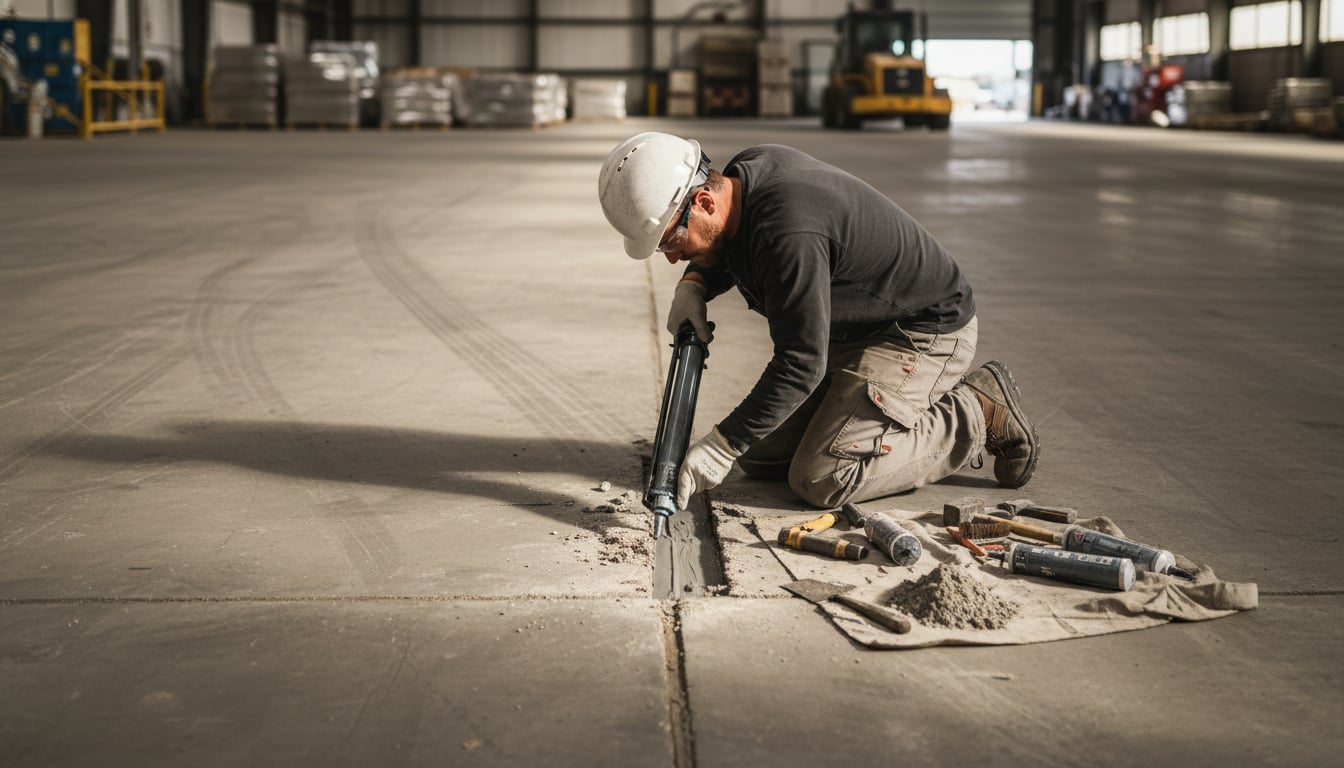
In practice, that work can include cleaning out old filler, sawcutting clean repair boundaries, removing unsound concrete, rebuilding spalled joint shoulders, installing semi-rigid filler or flexible sealant, stabilizing rocking slab panels, or replacing full-depth sections when deterioration runs through the slab.
The critical point that most people miss: concrete joint repair is not one method. It is a category that includes joint filling, joint sealing, spall repair, re-nosing, partial-depth repair, full-depth repair, load-transfer restoration, and slab stabilization. The correct approach depends on what failed and why.
If you are managing a commercial or industrial facility, understanding the vocabulary around joints and joint repair helps you ask better questions, avoid wasted money on the wrong fix, and get longer-lasting results. That is what this glossary covers.
Why Concrete Has Joints in the First Place
Concrete shrinks as it cures, expands and contracts with temperature, curls with moisture changes, and moves over time. Without joints, those forces produce random, uncontrolled cracking.
Joints are planned weak points or planned movement points. They tell the concrete where to crack, where to move, and where separate placements meet. Every concrete slab, whether it is a slab-on-grade in a warehouse or an exterior truck court, relies on joints to manage these forces.
But here is the trade-off: joints create exposed slab edges. Those edges are the most vulnerable part of the floor, especially under hard-wheeled traffic. That vulnerability is what makes concrete joint repair one of the most common maintenance needs in commercial and industrial facilities.
ACI identifies three primary joint types in slabs-on-ground: isolation joints, contraction joints, and construction joints. Each has a different purpose, and each fails differently. Source: ACI 302.1R-15, Chapter 5
Concrete Joint Repair Glossary
The terms below are the ones facility managers, general contractors, and maintenance teams actually encounter when dealing with joint problems. Each definition includes a plain-English explanation and why it matters for repair decisions.
Joint Types
Control Joint (Contraction Joint): A sawcut used to manage shrinkage. These are the most frequent source of edge damage under forklift traffic.
Construction Joint (Cold Joint): The point where two separate concrete placements meet.
Isolation/Expansion Joint: Full-depth separations designed for movement; these require flexible sealants, not rigid fillers.
Semi-Rigid Joint Filler: The industrial standard for supporting slab edges under hard-wheeled traffic.
Joint Spalling: Chipping or breaking of concrete near the joint edge—the primary indicator that repair is needed.
Materials and Components
Joint filler. A material placed inside a joint. In industrial slabs, “joint filler” typically means a semi-rigid epoxy or polyurea product that supports joint edges under hard-wheeled traffic. This is not the same as soft caulk from a hardware store.
Joint sealant. A more flexible material used to seal against water, debris, and movement. ASTM C920-18 (Standard Specification for Elastomeric Joint Sealants) covers cold-applied elastomeric sealants for building and vehicular surfaces. Sealants accommodate movement; fillers support edges. The difference is fundamental.
Semi-rigid filler. A hard but slightly resilient filler for interior concrete floor joints exposed to forklifts, pallet jacks, carts, and other hard wheels. ACI specifically recommends semi-rigid filler for contraction and construction joints exposed to hard-wheeled material-handling vehicle traffic. Source
Epoxy joint filler. A two-component semi-rigid filler with a long track record in industrial floors. For reference, Metzger/McGuire’s MM-80 lists Shore A90-95 hardness and full traffic readiness at 8 to 12 hours at 70°F. Source
Polyurea joint filler. A fast-curing two-component material often chosen when quick return-to-service matters. Modern Polyurea-Prepolymer blends are the 2026 standard for high-performance, low-VOC requirements, making them ideal for LEED-certified “green building” projects. W. R. Meadows’ REZI-WELD 360, for example, lists tack-free time of 2 to 3 minutes and light foot traffic at 30 minutes.
Backer rod. A compressible foam rod placed under flexible sealants to control sealant depth and create two-sided adhesion. Important: Manufacturer data for semi-rigid industrial fillers warns against using compressible backer rod in standard sawcut control joints because it removes the support base the filler needs to resist wheel loads.

Damage and Failure Terms
Spalling. Cracking, breaking, chipping, or flaking of concrete near the joint edge. The Concrete Society defines joint spalling as damage typically occurring within 100 mm of the joint. Spalling is the most visible sign that a joint needs repair, and it accelerates under continued traffic.
Re-nosing (joint rebuild). Rebuilding broken joint shoulders so the joint has clean, durable edges again. Needed when spalls are too wide for simple filler replacement. Spalls wider than 1 inch are usually rebuilt with structural epoxy grout, then the joint is re-sawn and filled with semi-rigid filler.

Structural and Load Terms
Load transfer. The ability of adjacent slab panels to share load as wheels cross a joint. ACI explains that load-transfer devices help both sides of a joint undergo similar vertical displacement, preventing exposed edge damage under hard wheels. Source When load transfer fails, one panel drops while the other stays put, and the joint edge takes the punishment.
Dowel. A smooth steel bar installed across a joint to transfer load while allowing horizontal movement. Dowel diameter and layout affect bearing stress and faulting potential. Source
Keyed joint. A joint with a key/keyway shape intended to provide mechanical interlock. ACI warns that keyed joints are not recommended for load transfer in slabs-on-ground where heavy-wheeled traffic is expected, because shrinkage can cause the keys to lose contact and eventually break down. Source
Repair Categories
Partial-depth repair. A repair that removes and replaces unsound concrete in the upper portion of the slab. ACPA describes this as appropriate for localized surface distress in the upper one-third to one-half of the concrete pavement. It restores rideability, deters further deterioration, and creates suitable edges for resealing. Source
Full-depth repair. A repair that removes and replaces the slab through its full thickness when damage is structural, deep, or associated with severe joint deterioration. ACPA notes joint deterioration is one of the most common distresses requiring full-depth intervention. Source
Slab stabilization. Correcting voids, pumping, rocking, or differential movement under slab panels so joint repairs are not repeatedly sheared. A Metzger/McGuire presentation puts it bluntly: repairing filler or spalls is wasted money if rocking panels are not stabilized first. Source
Preparation Terms
Concrete Surface Profile (CSP). A roughness standard used to specify or verify concrete preparation before repair materials, coatings, or overlays. ICRI defines CSP levels from CSP 1 (nearly flat) to CSP 10 (very rough, amplitude greater than 1/4 inch). The required profile depends on the repair material being installed. Source
Sounding. Tapping or dragging a chain across concrete to detect delamination beneath the surface. The Concrete Society repair guidance explains that a sharp metallic ring indicates sound concrete, while a dull or hollow sound indicates delamination. Source This simple test determines how far a repair needs to extend.
Common Signs a Concrete Joint Needs Repair
A concrete joint may need repair if:
Edges are chipped, broken, or spalling.
The old filler is missing, separated, sunken, brittle, or torn.
Forklifts, pallet jacks, or carts “thump” across the joint.
The joint holds water, dirt, food debris, chemical residue, or washdown water.
Slab panels are uneven or rocking under traffic.
The joint is widening or showing recurring cracks.
Coatings are cracking or chipping along the joint line.
Repair patches keep failing.
The joint creates a trip hazard or accessibility concern.
Exposed steel, corrosion, or full-depth cracking is present.
OSHA 1910.22 requires walking-working surfaces to be kept free of hazards. As of January 2026, the maximum OSHA penalty for willful or repeated violations is $165,514. Maintaining flush, repaired joints is a critical component of regulatory compliance and risk mitigation in any industrial environment.For commercial properties, joint deterioration can quickly become a trip hazard and accessibility issue, not just a maintenance headache.
2026 Compliance Standards for Floor Safety:
OSHA 1910.22: Ensure joints are flush to prevent trip hazards for employees and “tip-over” risks for forklifts.
ADA Standard 303: Vertical changes in level must not exceed 1/4 inch (6.4 mm). Changes between 1/4″ and 1/2″ must be beveled at a 1:2 slope.
2026 NFPA 101: Life safety codes require maintained walking surfaces in egress paths.
Why Concrete Joints Fail
Understanding the cause matters because a repair that addresses only the symptom will fail again. Here are the most common drivers of joint deterioration.
Hard-Wheeled Traffic
Forklifts, pallet jacks, and AGVs repeatedly impact joint edges. Industry data from ACI 302.1R confirms that hard-wheeled traffic is the primary driver of spalling, particularly when joints lack sufficient edge support. This pattern is consistent in high-volume facilities: industrial joint failure concentrates in aisles, not randomly across the slab, because traffic patterns repeatedly hit the same joint edges.
Missing, Shallow, or Wrong Joint Filler
If semi-rigid filler is installed too shallow or over compressible debris, it punches down under wheel loads and stops protecting the edge. Industry guidance identifies improper filler depth as a leading cause of joint failure. Source
Incompressible Debris
Sand, gravel, and hardened debris trapped in joints prevent movement and create stress concentrations that break edges. The Concrete Society identifies incompressibles as a direct cause of spalling. Source
Water Intrusion
Water entering open joints can carry contaminants, weaken subgrade support, and increase differential slab movement. According to industry technical standards, frequent scrubber washing or water entering joints contributes to subgrade softening, which leads to rocking panels and eventual joint failure under wheeled traffic.
Slab Curl, Rocking, or Voids

A joint filler or surface patch will not last if the panels underneath move vertically. Rocking slabs shear filler and cause severe edge deterioration. This is one of the most expensive mistakes in concrete joint repair: spending money on filler when the real problem is underneath the slab.
Weak Concrete or Poor Joint Construction
The Concrete Society lists weak concrete at the joint, poor joint construction, and failed load-transfer devices as direct causes of joint spalling. Source
New-Slab Shrinkage
Filler installed too early can separate as the slab continues shrinking. ACI-referenced guidance recommends deferring industrial floor joint filling 60 to 90 days after the slab pour, or as long as possible, so shrinkage and joint opening can occur before filler is placed. Freezer and cooler areas should stabilize at operating temperature before installation. Source Understanding curing and shrinkage timelines helps facility teams plan joint filling at the right time.
The Joint Repair Failure Loop
When the cause is not addressed, joint repair becomes a recurring cycle:
Joint opens or filler fails.
Debris and water enter.
Wheels impact unsupported edges.
Edges spall and the opening widens.
Filler or patch loses support.
Repairs become wider, deeper, and more disruptive each time.
Breaking this loop requires diagnosing the cause, not just refilling the gap.
Five Questions Before Choosing a Joint Repair
Before selecting a repair method or material, answer these five questions:
What kind of joint is it? Control, construction, isolation, expansion, or a random crack being mistaken for a joint?
What is the traffic? Foot traffic, cars, forklifts, pallet jacks, trucks, solid wheels, pneumatic tires, AGVs?
What is the failure mode? Missing filler, spalled edge, water intrusion, vertical offset, rocking slab, deep crack, exposed reinforcement?
What does the joint need to do? Seal water, support wheel loads, transfer load, allow movement, maintain hygiene, protect a coating system, restore rideability?
What shutdown window is available? 30 minutes, 1 hour, overnight, weekend, multi-day closure?
These questions determine whether you need to seal, fill, rebuild, stabilize, or replace.
Repair Decision Matrix
Condition | Likely Repair Category | Practical Note |
|---|---|---|
Joint is open but edges are sound | Clean and fill or seal | Semi-rigid filler for interior hard-wheel traffic. Flexible sealant for movement and water sealing. |
Filler separated but not sunken | Monitor or refill separation | Small separation may be aesthetic. Wider gaps expose edges to wheel impact. |
Filler sunken below floor surface | Remove and replace filler | Sunken filler no longer supports edges under forklift wheels. |
Minor spalling at joint edge (under 1/2 inch) | Sawcut, chase, and semi-rigid repair | Keep the joint functional. Do not bridge a moving joint with rigid patch. |
Spalling roughly over 1 inch wide or severe | Structural rebuild and re-nosing | Rebuild shoulders with structural epoxy grout, re-saw the joint, then fill. |
Damage is shallow and localized | Partial-depth repair | Appropriate when deterioration stays in the upper slab depth. |
Damage extends deep, exposes steel, or includes full-depth cracks | Full-depth repair or engineered repair | Evaluate structural capacity, load transfer, reinforcement, and subgrade support. |
Slab rocks, pumps, or deflects vertically | Slab stabilization before joint repair | Filler-only repair will shear and fail. |
Exterior expansion or isolation joint leaks | Backer rod plus flexible sealant | Correct sealant geometry and product for weather exposure. |
Food, washdown, or cold storage floor | Specialty rapid-cure or temperature-rated material | Consider sanitation, moisture, operating temperature, odor, and downtime. |
This matrix is a starting point. Field conditions, traffic, joint movement, moisture, and manufacturer guidance all influence the final decision.
Material Comparison: Epoxy vs. Polyurea vs. Flexible Sealant vs. Cementitious Repair
Semi-Rigid Epoxy Filler
Best fit: heavy-duty industrial interior floors, distribution centers, manufacturing plants, and situations where durability matters more than fastest return-to-service.
Epoxy fillers have a long track record in warehouse and industrial commercial concrete floor systems. MM-80, a widely referenced product, lists Shore A90-95 hardness and full traffic readiness at 8 to 12 hours at 70°F. Source
Epoxy’s slower cure means you need a longer shutdown window, typically overnight or a weekend. For facilities that can schedule downtime, this is often the most durable choice.
Semi-Rigid Polyurea Filler
Best fit: rapid return-to-service, retail or occupied facilities, polished concrete, cold storage, and projects with tight shutdown windows.
Polyurea products like Spal-Pro RS 88 list tack-free time at 5 minutes and traffic-ready time at 1 hour at 70°F. Source Some polyurea formulations are rated for service temperatures well below zero, making them candidates for freezer floor work.
Practitioners on Reddit report that cold storage facilities present unique challenges, with one commenter describing repairs in a -30°F freezer floor where specialized materials and extremely limited shutdown windows drove every decision. Source
Flexible Polyurethane, Silicone, or Polysulfide Sealant
Best fit: expansion and isolation joints, exterior concrete joints, wet areas, and any joint where movement accommodation and water sealing matter more than edge support under wheels.
ASTM C920 classifies elastomeric sealants by type, grade, class, and use. ASTM D6690 covers hot-applied sealants for concrete and asphalt pavements. The key point: flexible sealants seal against water and accommodate movement, but they do not provide the edge support that forklift joints need.
Cementitious Repair Mortar
Best fit: partial-depth patching where designed, prepared, bonded, and cured properly; exterior pavement repairs; and localized patching where cementitious material is specified.
Industry guidance notes that cementitious materials may be suitable for low-traffic applications but are generally not recommended for long-term durability in demanding spalled joint repair because they may shrink or become compromised over time. Source
The Concrete Joint Repair Process
This is a general overview of how commercial and industrial joint repairs proceed. It is not a DIY manual; it is a framework so facility managers and general contractors know what to expect.
Step 1: Identify the joint type. Control joint, construction joint, isolation joint, expansion joint, or a random crack being treated like a joint?
Step 2: Inspect the damage. Measure spall width, depth, vertical displacement, filler condition, traffic patterns, moisture exposure, and contaminants. Check whether panels move under load.
Step 3: Sound the concrete. Tap the area around the joint to find delamination. Sound concrete rings sharp and metallic. A dull or hollow sound means the damage extends further than what is visible on the surface.
Step 4: Determine the failure cause. This is the step most people skip. Is the failure caused by shallow filler, wrong material, debris, water, slab curl, voids, failed load transfer, weak concrete, or concentrated traffic?
Step 5: Remove failed material and unsound concrete. Sawcut clean edges where needed, remove loose concrete, and clean dust and debris to expose sound material.
Step 6: Prepare the joint walls or patch area. Use cleanout saws, vacuuming, and appropriate surface preparation methods. ICRI surface preparation guidelines and CSP standards can define the required profile for the repair system.
Step 7: Install the correct repair system. Semi-rigid filler, flexible sealant, structural rebuild material, repair mortar, dowels, or stabilization, as determined by the diagnosis.
Step 8: Finish flush and protect. For floor joints, overfilled semi-rigid filler is typically shaved flush after cure to eliminate wheel impact. For sealants, depth, shape factor, and two-sided adhesion matter.
Step 9: Return to service based on product data. Cure and return-to-service times depend on material, temperature, humidity, depth, traffic load, and manufacturer instructions. Do not assume universal cure times.
Step 10: Maintain and monitor. Inspect periodically for filler separation, edge chipping, water intrusion, debris accumulation, and recurring movement. Industry guidance suggests voids smaller than about 0.030 inch may be mostly aesthetic, while larger voids should be monitored and addressed if edge deterioration begins. Source
Understanding the broader principles of concrete durability helps frame joint repair as part of a longer-term maintenance strategy rather than a one-time fix.
Commercial and Industrial Considerations
Warehouses and Distribution Centers
Forklift aisles, pallet jack paths, AGV routes, racking aisles, dock areas, and floor scrubber routes concentrate traffic on the same joints day after day. Joint damage in these environments is not cosmetic. A LinkedIn article by industry practitioner Greg Fricks connects industrial joint spalling to forklift repair costs, accelerated equipment failure, dust and debris, slower inventory management, and lower profitability. Source
One Reddit user describing a warehouse floor problem noted that maintenance crews would fill damaged areas to make them level, but the patches were not compatible with the surrounding epoxy surface and turned black under forklift traffic. The user was concerned that coating over the patch would create a lip that would chip and restart the failure cycle. Source In polished or coated industrial floors, concrete joint repair must consider profile, finish, coating transition, and cleanability, not only compressive strength.
Manufacturing Plants
Consider chemical exposure, process water, oils, vibration from equipment foundations, and concentrated traffic patterns. For facilities evaluating concrete flatness and levelness requirements, joint deterioration that creates vertical offsets directly affects floor performance metrics.
Food, Beverage, and Washdown Facilities
Joint repairs in these environments must be compatible with sanitation protocols, cleaning chemicals, moisture, odor restrictions, and regulatory expectations. Filled joints reduce debris traps and moisture penetration, but the material and detailing must match the environment.
Cold Storage and Freezer Floors
Temperature-rated products and installation sequencing are non-negotiable. Some polyurea products support service temperatures well below zero, but each project must follow product limits and site conditions. Practitioners on Reddit report that recurring repairs every 2 to 3 years in cold storage are common when the wrong material is used, and that specialized cold-storage products and extremely limited shutdown access drive material selection. Source
Truck Courts, Exterior Pavements, and Dock Aprons
Exterior joints face water, thermal movement, UV exposure, heavy wheel loads, and drainage issues. Flexible sealants, partial-depth repairs, full-depth replacements, and load-transfer restoration may all be relevant. Preventative maintenance for concrete pavement can extend the interval between major repairs, but neglected exterior joints tend to deteriorate quickly.
ADA Routes and Safety-Sensitive Areas
OSHA 1910.22 requires employers to keep walking-working surfaces free of hazards. The ADA standards apply specific level-change thresholds on accessible routes. When joint deterioration creates vertical offsets on sidewalks, parking areas, or building entries, the damage becomes a compliance issue, not just a maintenance item.
If you manage a commercial or industrial facility with joint damage that is affecting safety, operations, or equipment, contact Wright Construction for an evaluation. Wright Construction provides concrete joint repairs and industrial concrete maintenance for facilities across the Southeast.
Common Mistakes in Concrete Joint Repair
Calling Every Joint an Expansion Joint
Most interior sawcut joints are control or contraction joints, not expansion joints. Mislabeling the joint can lead to the wrong material selection. A control joint under forklift traffic needs semi-rigid filler. An expansion joint needs flexible sealant. The name matters.
Using Flexible Caulk Where the Joint Needs Edge Support
Soft sealants can seal water, but they cannot protect joint edges from forklift impact. ACI is clear that hard-wheeled traffic zones need semi-rigid filler, not soft sealant.
Installing Semi-Rigid Filler Over Backer Rod in Standard Sawcut Joints
This is one of the most common confusion points. DIY advice online often recommends backer rod in every joint, and that advice is generally correct for flexible sealant applications. But manufacturer data for semi-rigid industrial fillers specifically warns against compressible backer rod in standard sawcut control joints because the filler needs support from below to resist wheel loads. Source
Patching Over Moving Joints
Rigid patch material over a moving joint will crack or debond. The joint must remain functional. Bridging a joint with a rigid patch eliminates the movement accommodation the joint was designed to provide.
Ignoring Slab Movement
If the slab rocks, pumps, or deflects at the joint, filler will shear and patches will fail. Stabilize the slab before spending money on repeated surface repairs.
Filling Joints Too Early on a New Slab
Early joint filling can lead to separation as the slab continues shrinking. This is not always product failure; it can be normal shrinkage movement that the filler cannot accommodate. Source
Treating Repair as Cosmetic Only
Joint damage affects safety, equipment longevity, operations efficiency, cleanability, and slab life. A commercial concrete contractor who understands industrial environments will evaluate the cause, not just fill the visible gap.
2026 Cost-Benefit Analysis
Repair Method | Avg. Downtime | Expected Life | Best Use Case |
Semi-Rigid Polyurea | 30–60 Minutes | 5–10 Years | High-traffic warehouses; quick-turn service. |
Semi-Rigid Epoxy | 8–12 Hours | 7–12 Years | Heavy manufacturing; maximum edge support. |
Flexible Sealant | 2–4 Hours | 3–5 Years | Exterior lots; washdown areas; expansion joints. |
Full-Depth Repair | 24–48 Hours | 20+ Years | Structural slab failure; heavy dock aprons. |
Frequently Asked Questions
What is concrete joint repair?
Concrete joint repair is the process of restoring damaged concrete joints and adjacent slab edges so the joint can continue controlling movement, resisting debris and water, and supporting traffic. Depending on the damage, repair may involve filling, sealing, rebuilding, stabilizing, or replacing the joint area.
What is the difference between joint filling and joint sealing?
Filling usually means installing a semi-rigid material to support interior floor joint edges under hard-wheeled traffic. Sealing usually means installing a flexible material to resist water and debris and accommodate movement. The distinction drives material selection: warehouses under forklifts generally need filler, while exterior expansion joints generally need sealant.
Should concrete control joints be filled?
In industrial and commercial floors exposed to hard-wheeled material-handling traffic, ACI recommends semi-rigid filler to reduce joint-edge wear and damage. Leaving control joints open in high-traffic areas accelerates spalling and widens the damage over time.
Is polyurea or epoxy better for concrete joint repair?
Neither is universally better. Polyurea is often selected for rapid return-to-service and colder temperature conditions. Epoxy is often selected for heavy-duty durability when the shutdown window allows 8 to 12 hours of cure time. Manufacturer data and project conditions should drive the choice.
Why does my joint filler keep separating?
Filler can separate because the slab continued shrinking after installation, the joint was not cleaned properly, the filler was installed too early, movement exceeded the filler’s capacity, or the slab is moving vertically due to voids or curl. Recurring separation usually signals a cause that was not addressed.
When does a spalled joint need rebuilding instead of refilling?
As a practical guideline, small edge spalls (under roughly 1/2 inch wide) may be repaired with semi-rigid filler after sawcutting. Spalls from 1/2 to 1 inch should follow manufacturer recommendations. Spalls wider than 1 inch usually require structural rebuilding (re-nosing) before the joint is re-sawn and filled. Source
Is a damaged concrete joint an ADA issue?
It can be if it creates a noncompliant level change on an accessible route. The ADA allows 1/4 inch vertical change, requires beveling from 1/4 to 1/2 inch, and requires ramp treatment above 1/2 inch. Not every damaged joint is on an accessible route, but the ones that are need evaluation.
Should backer rod be used in concrete joints?
For flexible sealant joints, often yes. For semi-rigid industrial joint fillers in standard sawcut control joints, manufacturer guidance typically warns against compressible backer rod because the filler needs full-depth support to resist wheel loads. The correct answer depends on the material and joint type.
Regional Expertise & Service Coverage
Wright Construction specializes in high-performance slab maintenance across the Southeast industrial corridor. Our teams provide localized expertise tailored to the specific infrastructure demands of major regional hubs, including:
Nashville: Supporting the rapid expansion of the MNAA (Nashville International Airport) logistics zone.
Memphis: Serving the global Memphis Logistics Hub and heavy-distribution centers.
Huntsville: Providing precision concrete solutions for the Huntsville Aerospace district and high-tech manufacturing facilities.
Birmingham & Chattanooga: Maintaining the structural integrity of the region’s core manufacturing and transit lines.
When to Call a Contractor
Simple filler replacement in a few joints with sound edges is a manageable maintenance task for some facility teams. But when spalling is widespread, damage is deep, patches keep failing, slabs are moving, or the work involves structural concrete repair, load-transfer restoration, or full-depth replacement, the job requires a contractor with commercial and industrial experience.
Wright Construction provides concrete joint repairs, industrial joint repairs, concrete slab repairs for heavy-duty surfaces, epoxy crack and surface repairs, and concrete paving maintenance for commercial and industrial facilities. With offices in Memphis, Nashville, Chattanooga, Birmingham, and Huntsville, Wright Construction serves facilities across the Southeast.
For concrete joint repair, slab repair, or related site work, contact Wright Construction to schedule an evaluation.