
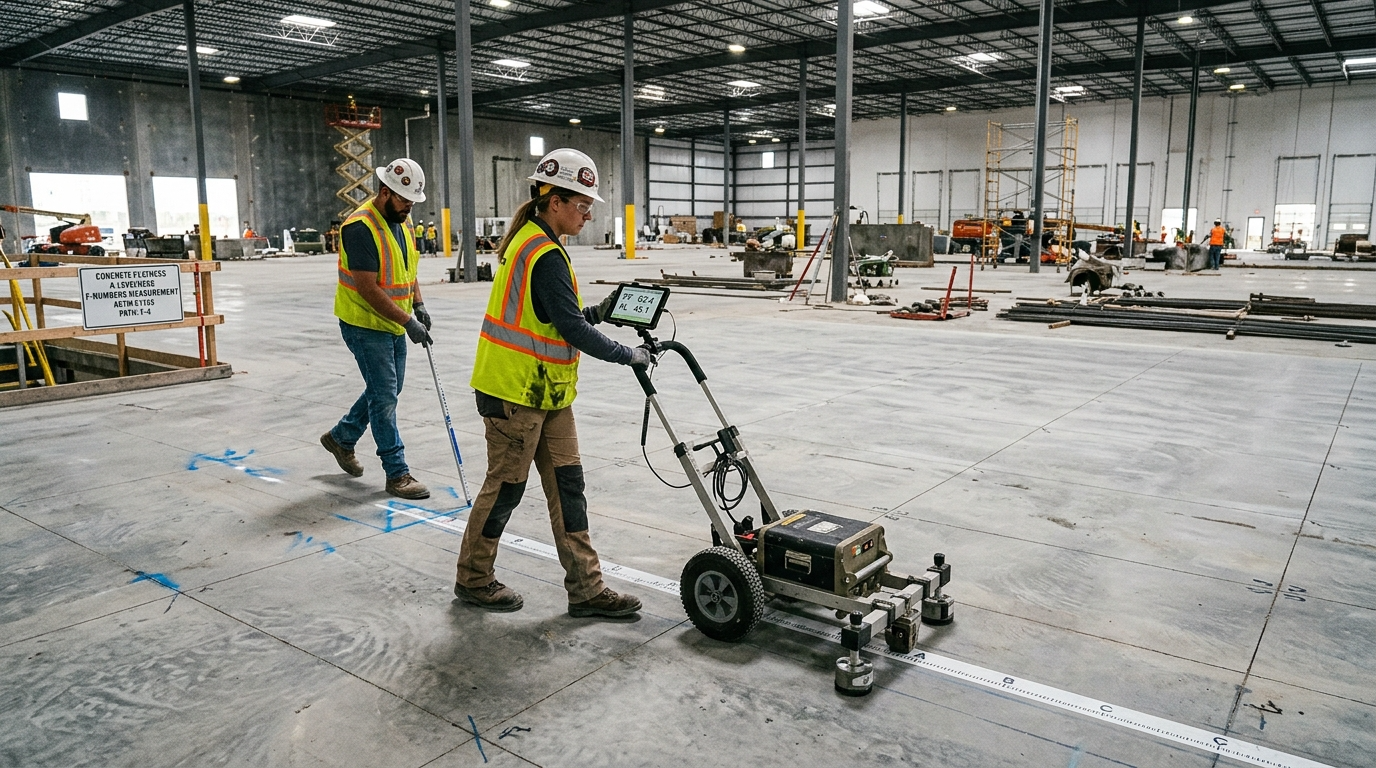
Ever walked across a concrete floor and felt subtle bumps or noticed a slight slope? In most cases, it’s no big deal. But for a high traffic warehouse, a manufacturing plant, or a television studio, the exact flatness and levelness of the concrete slab is absolutely critical. A floor that isn’t flat enough can cause forklifts to jostle, damage sensitive equipment, and even create safety hazards.
To prevent these issues, the construction industry uses a precise standard to measure a floor’s profile: the F-Number system. So, what are concrete flatness and levelness F numbers? They are two values that define a floor’s surface: FF for Floor Flatness (local bumpiness) and FL for Floor Levelness (overall slope). Higher F-numbers indicate a better quality floor, providing a clear target for architects, contractors, and owners to ensure performance and longevity. For an overview of options and tradeoffs, explore our commercial concrete floor systems guide.
What are Concrete F-Numbers? (Quick Summary)
Concrete F-Numbers are a standardized system used to measure the quality of a concrete floor’s surface profile. The system consists of two primary values:
FF (Floor Flatness): Measures the “bumpiness” or local waviness of the slab.
FL (Floor Levelness): Measures the “tilt” or overall slope of the slab relative to a horizontal plane.
In the F-Number system, higher values indicate a higher quality, flatter floor. While a standard warehouse may require an FF 35 / FL 25, specialized “superflat” facilities often require values of FF 60 or higher to ensure the safety and efficiency of high-speed equipment.
The Origin of the F-Number System
Before the 1980s, floor flatness was typically checked with a 10 foot straightedge, a method that was often inconsistent and led to frequent disputes. To create a more scientific and repeatable standard, the American Concrete Institute (ACI) adopted the F-Number system.
As mentioned, this system uses two numbers—FF for flatness and FL for levelness—to define the surface profile. The concept is straightforward: higher F-numbers mean a better floor. The scale is also linear, which makes it easy to understand. For instance, a floor with an FF 40 is twice as flat as a floor with an FF 20. This system removed the guesswork and gave architects, contractors, and owners a common language for defining quality.
FF vs. FL: Decoding the Two Key Numbers
While they work together, FF and FL measure two very different characteristics of a floor.
Understanding FF (Floor Flatness)
Floor Flatness, or FF, measures the smoothness of the slab over very short distances. Think of it as a measure of local bumpiness or waviness.
The FF number is calculated from elevation changes measured over a 1 foot interval. A high FF number indicates a very smooth, glassy surface with minimal small bumps and dips. This is crucial in environments where equipment with small, hard wheels is used, like forklifts or robotic carts, as a smoother ride reduces wear and tear and improves operational efficiency.
Understanding FL (Floor Levelness)
Floor Levelness, or FL, measures the floor’s conformity to a horizontal plane over a larger area. It tells you how much the slab tilts or slopes over a 10 foot distance.
An FL number describes how closely the finished slab matches the intended pitch (which is usually perfectly level). A high FL number means the floor has very little slope or undulation across longer spans. This is important for ensuring that pallet racking stands straight, water drains correctly, and sensitive equipment is properly calibrated.
The Standardized Process: How F-Numbers Are Measured
To ensure consistency across the industry, the process for determining concrete flatness and levelness F numbers is strictly defined by a formal standard.
The ASTM E1155 Test Method
The entire procedure is governed by ASTM E1155, “Standard Test Method for Determining FF Floor Flatness and FL Floor Levelness Numbers”. This standard outlines exactly how to survey a floor and calculate the results, ensuring that an FF 35 floor in Memphis is measured the same way as one in Nashville. It provides an objective and repeatable way to verify that a slab meets the project specifications.
Step-by-Step: How Concrete F-Numbers are Measured

Define Test Sections: Divide the slab into manageable areas (usually based on daily pour sequences).
Establish Measurement Lines: Lay out a grid of straight lines across the test section as per ASTM E1155 guidelines.
Data Collection: Use a precision instrument like a Dipstick® or F-Meter® to record elevation changes at 12-inch intervals.
Perform Measurements Within 72 Hours: Collect data before concrete curling or shrinkage occurs to ensure the contractor’s finishing work is accurately captured.
Calculate SOV and MLV: Use the software to determine the Specified Overall Value (the average) and the Minimum Local Value (the worst-case spot).
Why Testing Within 72 Hours is Critical
According to ACI standards, F-number measurements must be taken within 72 hours of concrete placement. This tight window is crucial because it assesses the floor as the contractor finished it, before natural processes like concrete shrinkage and curling can alter the surface profile. Smart reinforcement and jointing choices can also reduce curling—see our concrete slab reinforcement methods guide. Testing a week later might show a lower F-number due to curling at the slab edges, which wasn’t a result of the finishing work. Prompt testing provides a true baseline of the slab’s quality.
Sampling a Floor: Test Sections and Measurement Lines
You don’t just measure one spot. ASTM E1155 requires a systematic sampling approach.
Test Surface: This is the entire floor area being evaluated, like a 100,000 square foot warehouse slab.
Test Section: The total surface is broken down into smaller, manageable areas called test sections. Often, each day’s concrete pour is treated as a separate test section.
Sample Measurement Lines: Within each section, a grid of straight measurement lines is established. A specialized instrument is then run along these lines to collect thousands of elevation data points.
This methodical sampling ensures the final F-numbers are a statistically valid representation of the entire floor, not just a few lucky or unlucky spots.
Reading the Specs: Overall vs. Minimum Local Values
When you look at project specifications, you’ll typically see two requirements for both FF and FL.
Specified Overall Value (SOV): This is the average F-number required for the entire test surface. For example, a spec might require an “overall FF 35 / FL 25”. This ensures the floor as a whole performs as intended.
Minimum Local Value (MLV): This is the absolute minimum F-number allowed for any single test section. A spec might add a requirement for a “minimum local FF 24 / FL 17”. This acts as a safety net to prevent any one area from being significantly worse than the rest, even if the overall average is met.
Requiring both values ensures a consistent, high quality result across the entire project.
Not All Floors Are Equal: Random vs. Defined Traffic
The standard FF/FL system works for the vast majority of floors, known as random traffic floors. These are spaces where people or vehicles can move in any direction, like in an open warehouse, retail store, or office building.
However, a small percentage of floors (less than 1%) have defined traffic patterns, where vehicles travel along the exact same fixed paths every time. The classic example is a very narrow aisle (VNA) warehouse where wire guided forklifts operate in specific aisles.
For these special cases, a different metric called F-min is used. Instead of a statistical average of the whole floor, F-min measures the worst case bumps and slopes directly in the wheel paths of the equipment. An F-min value is not comparable or convertible to FF/FL numbers; it is a separate system for a highly specialized application.
What F-Numbers Do You Actually Need?
Specifying a higher F-number than necessary can add significant cost to a project, while specifying too low can lead to performance issues. The key is to match the concrete flatness and levelness F numbers to the intended use.
Typical FF/FL Values by Application
Here are some general guidelines based on ACI recommendations:
FF 20 / FL 15: Acceptable for non-critical areas like mechanical rooms or spaces receiving thick flooring.
FF 35 / FL 25: Recommended for thin-set flooring or warehouse floors with moderate or heavy traffic. Forklifts can operate smoothly, and racking can be installed level.
FF 45 / FL 35: Warehouses with air-pallet use, ice rinks. An experienced structural concrete contractor like Wright Construction Company often achieves these tolerances for demanding industrial projects across the Southeast.
FF 50+ / FL 50+: Reserved for special use “superflat” floors, such as television studios or high tech manufacturing where even the slightest vibration is unacceptable.
Common F-Number Requirements by Floor Use
Floor Classification | Typical FF (Flatness) | Typical FL (Levelness) | Common Applications |
Conventional | 20 | 15 | Mechanical rooms, carpeted areas |
Moderately Flat | 25 | 20 | Retail stores, commercial offices |
Flat | 35 | 25 | Standard warehouses, industrial labs |
Very Flat | 45 | 35 | High-traffic warehouses, ice rinks |
Superflat | 60+ | 40+ | Television studios, VNA warehouses |
Official Floor Classifications
The industry also uses general classifications for floors:
Conventional: FF 20 / FL 15
Moderately Flat: FF 25 / FL 20
Flat: FF 35 / FL 25
Very Flat: FF 45 / FL 35
Superflat: FF 60 / FL 40 (for random traffic floors). When joints must be minimized or long spans are needed, post-tension concrete slabs can help meet demanding flatness targets.
Special Considerations and Common Questions
The Old Way: Straightedge vs. F-Numbers
The old “1/8 inch in 10 feet” straightedge rule was vague, unrepeatable, and often unrealistic. The F-Number system provides a quantitative, objective assessment. While there’s no perfect conversion, an FF 50 floor roughly corresponds to the old 1/8 inch in 10 feet specification, and an FF 25 floor corresponds to about a 1/4 inch gap.
What About Elevated Slabs?
FL levelness numbers are generally not specified for elevated slabs (like the floors of a multi story building). This is because an elevated slab will naturally deflect, or sag, under its own weight once the supporting shoring is removed, making any initial levelness measurement irrelevant. For these floors, specifications typically only include an FF flatness requirement. For ground-supported work, review our slab-on-grade construction guide to understand how placement methods influence F-numbers.
The Tools of the Trade: Dipstick® and F-Meter®
Measuring F-numbers requires precision equipment. The two industry benchmarks are:
The Dipstick®: A highly accurate handheld profiler that is “walked” along the measurement line. It’s considered the reference standard instrument for F-number measurement.
The F-Meter®: A rolling profiler that can collect data much faster than a Dipstick, making it ideal for very large projects.
What Happens When a Floor Doesn’t Meet Spec?

Even with careful execution, a floor section can sometimes fall short of the specified concrete flatness and levelness F numbers. Fortunately, this is almost always correctable. Common remediation methods include:
Grinding: Using diamond grinders to shave down high spots is the most common fix for flatness (FF) issues.
Filling: Low spots can be filled with specialized epoxy mortars or cementitious compounds.
Overlays: For widespread problems, a self leveling topping can be applied over the entire slab to create a new, perfectly flat and level surface.
When a floor is out of spec, the first step is to perform a detailed survey to pinpoint the exact problem areas. An experienced industrial concrete contractor can then apply the most effective and economical solution to bring the floor into compliance. If you’re comparing vendors, start with our commercial concrete contractor guide. If you face challenges with an existing slab, the repair specialists at Wright Construction Company can provide expert remediation services.
Getting Flat and Level Floors Right the First Time
Ultimately, the best way to deal with out of spec floors is to prevent them from happening in the first place. Achieving the right concrete flatness and levelness F numbers for your facility starts with a clear specification and a contractor who has the experience, equipment, and quality control processes to deliver it. For a step-by-step view of pre-pour planning and placement, review the 6 steps to concrete slab installation.
For decades, Wright Construction Company has been the trusted partner for commercial and industrial clients requiring high quality concrete flatwork. With offices in Tennessee and Alabama, our teams serve the entire Southeastern U.S., delivering durable, functional, and precisely finished concrete slabs for warehouses, distribution centers, and manufacturing plants. For large shell projects, tilt-up concrete construction often pairs well with high-flatness slabs. Contact us today to discuss the flooring requirements for your next project.
FAQ About Concrete Flatness and Levelness F Numbers
What is a good F-number for a warehouse floor?
For a typical warehouse with random forklift traffic and standard racking, a specification of FF 35 / FL 25 is common and provides a good balance of performance and cost. For facilities with very tall racks or automated vehicles, a “Very Flat” floor (FF 50 / FL 35) may be required.
How much more does a superflat floor cost?
Achieving “Superflat” F-numbers (FF 60+) or defined traffic F-min tolerances can significantly increase costs. This is due to the need for specialized techniques like strip pouring, highly skilled labor, and continuous measurement during finishing. The cost premium can be substantial, so these floors are only specified when absolutely necessary.
Can you fix a floor that fails an F-number test?
Yes, nearly all flatness and levelness issues can be remediated. The most common methods are grinding down high spots to improve FF or applying a self leveling overlay to correct both FF and FL issues. An expert contractor can assess the floor and recommend the best course of action.
Why don’t elevated slabs usually have an FL levelness requirement?
Elevated concrete slabs are supported by a structural frame and will deflect (sag slightly) under their own weight after the temporary shoring is removed. Because this movement is unavoidable, it’s impractical to specify and hold a contractor to a final levelness tolerance. Therefore, specs for elevated floors usually only include an FF flatness value.