
TL;DR
Equipment pad installation is the process of designing and constructing a concrete slab that serves as a stable, level foundation for commercial or industrial equipment like generators, transformers, HVAC units, and heavy machinery. These pads typically range from 4 to 12 inches thick, use 2500 to 5000 PSI concrete depending on the application, and require proper subgrade compaction, reinforcement, and curing to avoid costly failures. Getting the subgrade preparation wrong is the single most common reason equipment pads crack, settle, or fail.
Equipment Pad Installation: Quick Answer
An equipment pad is a reinforced concrete slab designed to support generators, transformers, HVAC systems, industrial machinery, and other stationary equipment. Most commercial equipment pads are 6 to 12 inches thick and use 4000–5000 PSI concrete with steel reinforcement and compacted subgrade preparation.
The most important factors in equipment pad performance are:
Proper soil compaction (90–95% density)
Correct concrete thickness and PSI
Accurate anchor bolt placement
Drainage and elevation above grade
Vibration isolation when required
Poor subgrade preparation is the leading cause of cracking, settlement, and premature equipment failure.
Typical 2026 installation costs range from:
$6–12 per sq. ft. for light-duty pads
$8–18 per sq. ft. for commercial/industrial applications
Higher for engineered foundations with embeds, vibration isolation, or heavy machinery loads
What Is an Equipment Pad?
An equipment pad is a concrete slab, either poured in place or precast, built specifically to provide a stable, level foundation for stationary mechanical, electrical, or industrial equipment. These pads are flat, horizontal surfaces made of cast concrete and steel, typically between 4 and 12 inches thick depending on what they support.
The term shows up in slightly different forms depending on who you’re talking to. In mechanical and electrical engineering, you’ll often hear “housekeeping pad” used interchangeably. A housekeeping pad is a concrete slab that provides a stable surface for equipment placement, prevents floor damage, and keeps equipment elevated above the surrounding floor or grade. The function is essentially the same as an equipment pad, though the name tends to appear more in MEP specifications.
An “equipment foundation” is a different thing. It implies a deeper, more heavily engineered structure designed for very heavy or vibration-producing machinery. Think of it as a hierarchy: a housekeeping pad is the simplest version, an equipment pad covers the broad middle ground, and an equipment foundation is the most complex. For a deeper look at concrete foundation design, that distinction matters when scoping a project.
Equipment pads are raised above the surrounding floor or grade for several practical reasons. Engineers on the Eng-Tips forum explain that raised pads protect equipment from floods and floor cleaning chemicals. Additional reasons include improving net positive suction head (NPSH) for pumps, adding vibration mass, matching piping elevations, and making service access easier for maintenance crews.
If your facility needs a generator pad, transformer pad, or any heavy equipment base, contact Wright Construction to discuss project specifications and scheduling.
Types of Equipment Pads
Equipment pads are not one-size-fits-all. The type of equipment sitting on the pad dictates the thickness, concrete strength, reinforcement, and levelness tolerance required. Here are the most common categories in commercial and industrial work.
Generator Pads

Backup and prime power generators need a flat, solid base that can handle both the static weight and the vibration of a running engine. A common specification calls for 2500 PSI compression strength concrete reinforced with #6 rebar on 12-inch centers. The finished pad should be flat and level to within half an inch. Anchor bolts are critical here, both to secure the generator against shifting and to resist wind uplift in hurricane-prone Southeastern states.
Transformer Pads
Utility companies publish their own specifications for transformer pads, and those specs are strict. All equipment pads supporting oil-filled transformers must be leveled to within 1 inch in 8 feet in all directions. Cast-in-place concrete for these pads often must develop 4500 PSI compressive strength at 28 days, and some precast manufacturers push to 5000 PSI. The pad must also accommodate ground rods, conduit stub-ups, and oil containment details per the utility’s design standards.
HVAC and Chiller Pads
Mechanical engineers typically spec housekeeping pads at 4 inches high for standard equipment and 6 inches high for air handling units (AHUs). The pad should extend a minimum of 4 inches wider than the equipment base on all sides. One structural engineer on the Eng-Tips forum shared practical rules for chiller pad design: provide a pad minimum 6 inches all around the chiller, make it at least 6 inches above finish floor since water can be present in chiller plants, and use 4000 PSI concrete.
Industrial Machinery Pads
Heavy manufacturing equipment demands the thickest, most heavily reinforced pads. Western Specialty Contractors documented a project where they installed a 13-foot wide by 33-foot long, two-foot-thick concrete pad for a large printing machine. Pads of this scale require engineered reinforcement layouts, careful coordination with the equipment manufacturer’s anchor bolt templates, and precise subgrade preparation.
Dumpster Pads
Dumpster pads take a different kind of abuse. They must handle repeated impact loads from waste haulers dropping heavy containers, plus the point loads from truck outriggers during pickup. These pads are typically 6 to 8 inches thick with reinforcement designed for dynamic loading rather than just static weight.
Equipment Pad Specification Comparison
Equipment Type | Typical Thickness | Concrete Strength | Reinforcement | Special Requirements |
|---|---|---|---|---|
Residential HVAC | 4 inches | 3000 PSI | Wire mesh or #4 rebar | Level surface |
Commercial HVAC | 6 inches | 4000 PSI | #4 rebar @ 12″ O.C. | 4–6″ above grade |
Generator Pad | 6–12 inches | 4000 PSI | #6 rebar @ 12″ O.C. | Anchor bolts + vibration control |
Transformer Pad | 8–12 inches | 4500–5000 PSI | Engineered rebar layout | Utility specifications |
Industrial Machinery | 12–24+ inches | 4000–5000 PSI | Heavy engineered reinforcement | Isolation/inertia blocks |
Dumpster Pad | 6–8 inches | 4000 PSI | Rebar grid | Impact resistance |
Poured-in-Place vs. Precast Equipment Pads
There are two primary construction methods for equipment pad installation, and the right choice depends on the project constraints.
Poured-in-place pads are the strongest and most customizable option. A poured concrete foundation becomes part of the existing soil structure, making it more stable and less likely to sink or move over time. This method allows for custom anchor bolt layouts, embedded conduit, ground rods, and any non-standard geometry the equipment requires. For commercial and industrial applications, poured-in-place is almost always the right call.
Precast pads are factory-built slabs delivered to the site and set on a prepared subgrade. They reduce installation time compared to pouring on site and are usually the most cost-effective concrete pad option for standardized applications like residential HVAC units or small transformer installations. The trade-off is limited customization.
HVAC contractors on trade forums confirm that for commercial and industrial work, “poured is of course the best, but takes time and money.” Lightweight polymer pads exist for residential HVAC, and while practitioners note that plastic won’t crack like concrete over time, these pads can go unlevel within a year if not properly installed. Polymer pads are not appropriate for commercial or industrial equipment pad installation.
For more on concrete construction methods and how they apply to different project types, that guide covers the full process.
Key Design Specifications
Getting the specifications right is what separates an equipment pad that lasts decades from one that cracks within a year. Here are the numbers that matter.
Concrete Thickness by Application
Application | Typical Thickness |
|---|---|
Light-duty pads (small AC units, storage sheds) | 4 inches |
Standard equipment pads, residential driveways | 6 inches |
Heavy equipment, commercial applications | 8 to 10 inches |
Industrial machinery, heavy truck access | 12+ inches |
Industrial presses, large generators, and manufacturing equipment can push requirements to 18 or even 24 inches, as the Western Specialty printing press pad demonstrates.
Concrete Strength (PSI)
Residential equipment pads typically use 3000 PSI concrete. Commercial and industrial applications require 4000 PSI or higher. Utility transformer pads often specify 4500 PSI minimum at 28 days, and some precast manufacturers produce pads at 5000 PSI. Choosing the right mix is essential, and our guide on concrete mix design covers how PSI, aggregate, and admixtures work together.
Reinforcement Standards
Standard reinforcement includes rebar at 12-inch centers each way. Common sizes are #4 bars for lighter pads and #6 bars for heavier applications. Reinforcing steel should meet ASTM A615, Grade 40 minimum. Higher-load applications may require Grade 60 steel or custom engineered rebar layouts. For a complete breakdown of reinforcement types and methods, including when to use rebar versus mesh versus fibers, that resource goes deeper.
Anchor Bolts and Embeds
Equipment manufacturers provide anchor bolt templates that must be cast into the pad at precise locations. This coordination step happens before the pour, not after. Conduit sleeves, ground rods, and other embedded items also need to be positioned and secured to the rebar cage before concrete placement begins. Skipping or misplacing anchor bolts is one of the most expensive mistakes in equipment pad installation because it often means sawcutting or core drilling the finished pad.
Levelness Tolerances
Most equipment pads need to be flat and level to within half an inch. Transformer pads have tighter tolerances: within 1 inch across 8 feet in all directions. These tolerances affect equipment performance, vibration behavior, and the ability to properly connect piping and electrical conduit.
Elevation Above Grade
Equipment pads should be installed a minimum of 3 inches above finished grade. This prevents water intrusion and protects equipment from ground moisture, standing water, and runoff during storms.
Codes, Standards, and Engineering References
Equipment pad construction may reference several industry standards depending on the project type and jurisdiction.
Common standards include:
ACI 318 for structural concrete design
ACI 301 for concrete construction specifications
ASTM A615 for reinforcing steel
ASTM C94 for ready-mix concrete
International Building Code (IBC)
Utility-specific transformer pad standards
Equipment manufacturer installation manuals
OSHA requirements for industrial construction safety
Large industrial and utility projects typically require stamped engineering drawings showing reinforcement, anchor bolt layouts, and soil bearing assumptions.
Equipment Pad Design Checklist
Before construction begins, engineers and contractors should verify:
Equipment dimensions and total operating weight
Dynamic loads and vibration characteristics
Required concrete thickness and PSI
Reinforcement schedule and bar spacing
Soil bearing capacity
Subgrade compaction requirements
Drainage and finished elevation
Anchor bolt layout and embed depth
Conduit stub-up locations
Utility clearances
Expansion or isolation joint requirements
Wind uplift or seismic considerations
Equipment manufacturer specifications
Cure time before loading
Missing any of these items during preconstruction commonly results in change orders, delays, or costly corrective work after installation.
The Installation Process
Equipment pad installation follows a clear sequence. Cutting corners on any step creates problems that are expensive to fix later.
Step 1: Site Survey and Engineering Review
The process begins with a site survey to establish grades, identify underground utilities, and confirm soil conditions. The engineer of record reviews the equipment manufacturer’s specifications (weight, anchor bolt layout, vibration characteristics) and produces a pad design with dimensions, thickness, reinforcement, and embedded items.
Step 2: Excavation and Subgrade Preparation

This is the most critical step. The area is excavated to the required depth, and the native soil is evaluated. The subgrade must be compacted to 90 to 95 percent of maximum dry density. If native material is unsuitable, engineered fill is brought in and compacted in lifts. Poor compaction at this stage is the number one cause of pad failure.
Step 3: Stone Base Placement
A bed of crusher stone, minimum 3 inches thick, is placed and compacted over the prepared subgrade. This stone layer provides drainage, distributes load, and creates a stable working surface for formwork.
Step 4: Formwork and Rebar Installation
Forms are set to the correct dimensions and elevation, then rebar is placed per the engineering drawings. Bar chairs or supports hold the rebar at the correct height within the slab section. All splices, spacing, and cover dimensions are verified before the pour.
Step 5: Embedded Items
Anchor bolts, conduit sleeves, ground rod connections, and any other embedded items are installed and secured to the rebar cage. These must be positioned with precision, as moving them after the pour is destructive and costly.
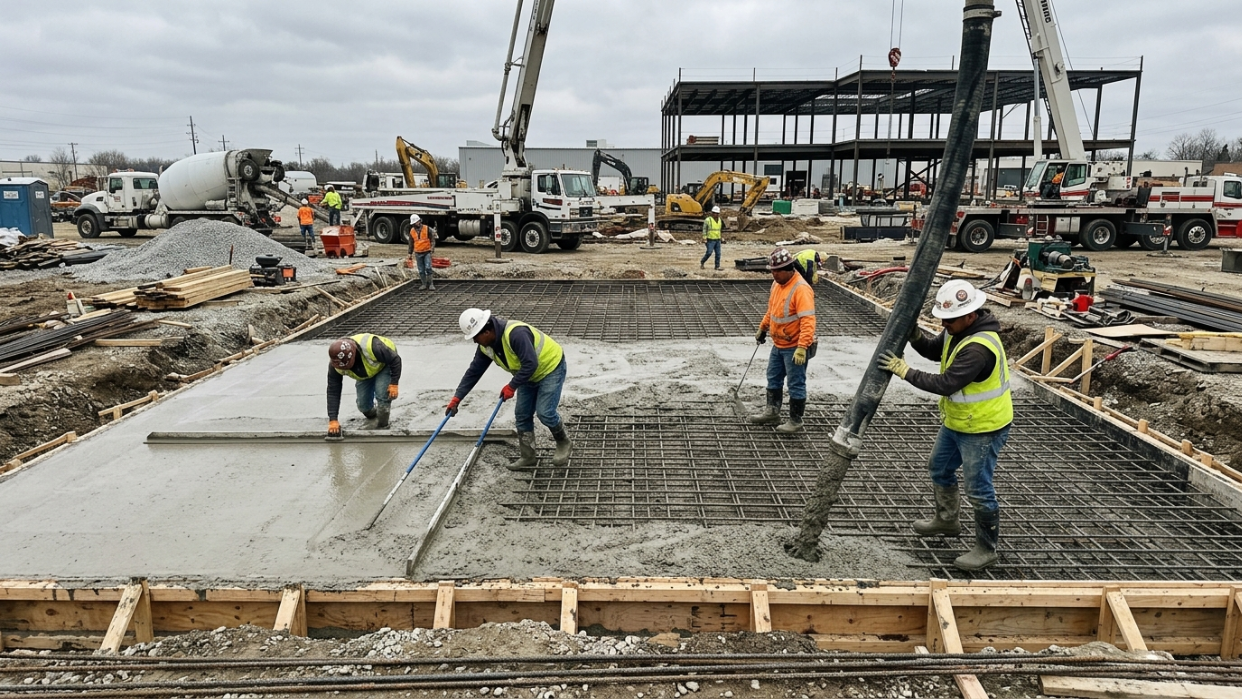
Step 6: Concrete Placement and Finishing
Concrete is placed, consolidated with vibrators to eliminate air pockets, and finished to the specified surface tolerance. The top surface is typically given a broom or float finish for traction unless a smoother finish is specified.
Step 7: Curing
Concrete must be moist-cured for at least 7 days after pouring. Full structural cure takes 28 days. For transformer pads specifically, the equipment should not be installed until at least 14 days after the pour. Interim loading may be possible with cylinder break tests and engineer approval, but rushing this step causes cracking and long-term structural problems.
Step 8: Equipment Setting and Anchoring
Once the pad reaches design strength, the equipment is set, aligned, and bolted down. Grout may be placed between the equipment base and the pad surface to ensure full contact and uniform load distribution.
Why Subgrade Preparation Matters
If there is one thing to take away from this entire guide, it’s this: subgrade preparation makes or breaks an equipment pad.
Poor compaction leads to differential settlement, which causes cracking, equipment misalignment, and eventually pad failure. The consequences go beyond the concrete itself. A generator that settles unevenly can develop fuel system problems, exhaust leaks, or vibration damage. A transformer pad that tilts can compromise oil levels and cooling.
Compaction should reach 90 to 95 percent of maximum dry density as determined by a modified Proctor test. In areas with expansive clay soils (common across the Southeast), the geotechnical engineer may require over-excavation and replacement with select fill. Drainage around the pad must be addressed too, since water collecting under a pad will erode the subgrade over time.
Vibration Isolation and Equipment Pad Design
Not every equipment pad needs vibration isolation, but the ones that do need it badly. Compressors, generators, printing presses, and other reciprocating or rotating equipment transmit vibration into the concrete and from there into the building structure.
An engineer on Eng-Tips explains that isolation pads serve two main purposes. One is to isolate vibration from surrounding areas. The other is to allow differential settlement of a heavily loaded pad compared to the surrounding lightly loaded slab on grade.
Vibration isolation typically involves one or more of these approaches:
Isolation joints that physically separate the equipment pad from the surrounding floor slab, with a compressible filler in the gap.
Isolation pads or mounts made of neoprene, rubber, or polyurethane foam installed between the equipment and the concrete surface.
Inertia blocks, which are massive concrete bases (much thicker and heavier than standard pads) that absorb vibration energy through sheer mass. These are common under large rotating equipment in manufacturing plants.
The choice depends on the equipment’s operating frequency, weight, and the sensitivity of adjacent operations. This is engineering work, not guesswork.
Common Equipment Pad Problems
Most equipment pad failures trace back to decisions made during design or installation. Here are the five problems practitioners cite most often.
1. Inadequate subgrade preparation. This is the single most common cause of failure. The pad settles unevenly, cracks propagate, and equipment goes out of alignment. Fixing it typically means removing and replacing the entire pad.
2. Undersized pads. Engineers consistently advise oversizing rather than cutting close. The pad should be bigger than the equipment and thick enough to anchor into. Some areas may also require analyzing the equipment for overturning loads, particularly for tall, narrow equipment in high-wind zones.
3. Ignoring vibration. Equipment that vibrates needs either isolation joints or vibration isolation mounts. Without them, the vibration transfers into the building structure and can damage adjacent equipment, piping, and even the building itself.
4. Skipping anchor bolts. Every piece of equipment should be anchored to its pad. Anchoring prevents shifting from vibration, theft, and wind uplift. In the Southeastern United States, wind uplift from hurricanes and severe storms is a real design consideration.
5. Premature loading. Placing heavy equipment on a pad before it reaches design strength causes microcracking that worsens over time. The 28-day cure period exists for a reason. For guidance on proper concrete curing practices, that guide covers timelines and methods in detail.
If your facility is dealing with cracked or failing equipment pads, industrial concrete repair options range from epoxy injection to full pad replacement depending on the severity.
Signs an Equipment Pad Is Failing
Equipment pad problems usually start small before becoming major structural or operational failures. Facility managers should watch for these warning signs:
Visible cracking wider than hairline shrinkage cracks
Uneven settlement or tilting
Water pooling around the pad
Rust staining from exposed reinforcement
Anchor bolts pulling loose
Equipment vibration increasing over time
Gaps forming beneath the slab edges
Spalling or surface deterioration
Misaligned piping or conduit connections
In industrial environments, even minor settlement can create serious alignment issues for rotating equipment, generators, compressors, and transformers. Early intervention is significantly less expensive than full pad replacement.
Equipment Pad Installation in Active Facilities
Installing an equipment pad in a new building on open ground is straightforward. Installing one inside an operating warehouse, manufacturing plant, or distribution center is a different challenge entirely.
The real-world complexity shows up in case studies like the one from Western Specialty Contractors. Because the plant operates 24 hours a day, their crews used an electric mini excavator and other electrical equipment to minimize fumes and noise while digging a trench through the plant’s 5-inch-thick existing concrete floor for the new pad. That level of operational sensitivity, minimizing disruption to production while maintaining safety and quality, is what separates experienced industrial concrete contractors from general contractors doing occasional pad work.
Key considerations for equipment pad installation in active facilities include:
Noise and dust control. Operating plants often have strict limits on airborne particulates and decibel levels during production hours.
Fume management. Diesel-powered equipment may not be permitted inside enclosed facilities, requiring electric alternatives.
Production scheduling. Concrete work often must happen during maintenance shutdowns, weekends, or off-shifts to avoid disrupting operations.
Existing utilities. Active facilities have live electrical, plumbing, and process piping below the slab that must be located and protected before any sawcutting or excavation begins.
Access logistics. Getting concrete trucks, rebar, and equipment into the middle of a working warehouse floor requires careful path planning to avoid damaging existing surfaces and disrupting traffic flow.
Wright Construction provides industrial concrete services across the Southeast, with self-perform crews experienced in working within active manufacturing and distribution facilities.
Equipment Pad Cost Estimates (2026)
In 2026, concrete pad costs range from $6 to $12 per square foot for standard 4-inch residential pads, including materials, labor, excavation, and site preparation. Thicker pads (6 to 8 inches) run $8 to $15 per square foot. Regional pricing varies, with urban areas running $12 to $18 per square foot and competitive Southern markets coming in at $5 to $10 per square foot.
These numbers are useful benchmarks but can be misleading for commercial and industrial work. A pad with engineered reinforcement, an anchor bolt template, embedded conduit, ground rods, and coordination with an equipment manufacturer will cost significantly more than a plain slab. The engineering alone can add substantial cost, and rightly so, because underdesigning an equipment pad costs far more to fix than to do correctly the first time.
For budgeting purposes, commercial facility managers should get project-specific quotes based on the actual equipment specifications, soil conditions, and site access constraints.
Typical Equipment Pad Cost Breakdown (2026)
Cost Factor | Typical Range |
|---|---|
Excavation and grading | $1–3/sq. ft. |
Stone base installation | $1–2/sq. ft. |
Reinforcement steel | $2–5/sq. ft. |
Concrete placement | $4–10/sq. ft. |
Anchor bolts and embeds | $200–2,000+ |
Engineering/design | $500–5,000+ |
Heavy industrial foundations | Custom quoted |
Actual pricing varies based on:
Soil conditions
Access constraints
Reinforcement complexity
Equipment loads
Regional labor rates
Cure schedule requirements
Active facility conditions
Related Terms: Quick-Reference Glossary
Equipment foundation. A deeper, more heavily engineered concrete structure for very heavy or vibration-sensitive equipment. Often includes piles, grade beams, or thickened sections.
Housekeeping pad. A concrete slab (typically 4 to 6 inches thick) that provides a clean, level surface for equipment. Used interchangeably with “equipment pad” in many MEP specifications.
Inertia block. A massive concrete base designed to absorb vibration energy through weight. Used under large compressors, chillers, and rotating equipment.
Isolation joint. A joint that physically separates an equipment pad from the surrounding slab to prevent vibration transfer and accommodate differential settlement.
Turned-down edge footing. A thickened edge around the perimeter of an equipment pad that acts as an integral footing, providing additional bearing capacity and resistance to lateral loads.
Anchor bolt template. A pattern or jig provided by the equipment manufacturer that positions anchor bolts in the wet concrete at exact locations to match the equipment’s mounting holes.
Embedded conduit / stub-up. Electrical conduit or pipe cast into the equipment pad during the pour, providing a pathway for wiring or piping to reach the equipment from below.
For any equipment pad project across the Southeast, from generator pads to heavy industrial machinery foundations, reach out to Wright Construction for a project consultation.
Equipment Pad vs Equipment Foundation
Feature | Equipment Pad | Equipment Foundation |
|---|---|---|
Typical Thickness | 4–12 inches | 12–48+ inches |
Purpose | General equipment support | Heavy/vibration-sensitive machinery |
Reinforcement | Standard rebar grid | Engineered structural reinforcement |
Soil Integration | Surface slab | Deep structural system |
Vibration Control | Limited | Engineered isolation |
Typical Applications | HVAC, generators, transformers | Turbines, presses, compressors |
Engineering Complexity | Moderate | High |
Frequently Asked Questions
How thick should a concrete equipment pad be?
Thickness depends on the equipment. Light-duty pads for small AC units need 4 inches. Standard commercial equipment pads run 6 to 8 inches. Heavy industrial machinery can require 12 inches or more, and some applications (like large printing presses) call for pads up to 24 inches thick. The equipment manufacturer’s specifications and a structural engineer’s review should drive this decision.
What PSI concrete is used for equipment pads?
Residential pads typically use 3000 PSI. Commercial and industrial pads require 4000 PSI or higher. Utility transformer pads often specify 4500 PSI at 28 days, and some precast pads reach 5000 PSI. Higher PSI provides greater compressive strength and durability under heavy, sustained loads.
How long does an equipment pad need to cure before equipment can be placed on it?
Moist-cure for a minimum of 7 days. Full structural cure takes 28 days. For transformer pads, many utilities require waiting at least 14 days before setting the transformer. Loading a pad before it reaches design strength causes microcracking that leads to long-term structural problems.
What is the difference between a housekeeping pad and an equipment foundation?
A housekeeping pad is a relatively thin concrete slab (4 to 6 inches) that provides a clean, level surface for equipment. An equipment foundation is a deeper, more heavily engineered structure designed for very heavy loads, significant vibration, or poor soil conditions. The foundation may include deep footings, piles, or grade beams that a housekeeping pad does not.
How far should an equipment pad extend beyond the equipment?
Most specifications require a minimum of 4 inches beyond the equipment base on all sides. For chillers and large mechanical equipment, engineers recommend 6 inches minimum. The extra width provides room for anchor bolts, service access, and prevents edge loading that can cause spalling.
Why are equipment pads raised above the surrounding grade?
Raised pads protect equipment from flooding, standing water, floor cleaning chemicals, and ground moisture. The standard minimum is 3 inches above finished grade. For chiller plants where water is routinely present, engineers recommend 6 inches above finish floor to keep moisture away from the equipment’s base and mounting hardware.
Can a precast pad be used for heavy industrial equipment?
Precast pads work well for standardized, lighter-duty applications like residential HVAC units and small utility transformers. For heavy industrial equipment, poured-in-place pads are almost always preferred because they allow custom reinforcement, anchor bolt placement, embedded conduit, and integration with the existing soil for greater stability.
What causes equipment pads to crack or fail?
The most common cause is inadequate subgrade compaction, which leads to differential settlement and cracking. Other frequent causes include undersized pad dimensions, insufficient reinforcement, lack of vibration isolation for equipment that vibrates, missing anchor bolts, and placing equipment on the pad before the concrete has reached full design strength.