
TL;DR
Truck court paving in Huntsville is a specialized discipline driven by the city’s booming industrial and logistics growth. Concrete is the preferred material for dock aprons and high-stress zones because it resists the point loads and heat damage that destroy asphalt in Alabama’s climate. A properly built truck court requires 131 to 185 feet of depth, 6 to 8 inches of reinforced concrete (or more for heavy-duty applications), and careful subgrade preparation. This glossary defines every term facility managers and property owners encounter during a Huntsville truck court paving project.
Quick Answer: What Is the Best Truck Court Paving Solution in Huntsville?
For most Huntsville warehouses, manufacturing plants, and distribution centers, the best truck court design combines reinforced concrete in high-stress loading areas with heavy-duty asphalt in lower-stress traffic lanes.
Concrete performs better at loading docks because it resists:
– Landing gear point loads
– Forklift traffic
– Slow truck turning movements
– Alabama summer heat
– Fuel and oil exposure
Asphalt remains a cost-effective option for:
– Drive aisles
– Trailer storage areas
– Employee parking
– Low-stress circulation lanes
A properly engineered truck court also requires adequate pavement thickness, subgrade preparation, drainage, and truck maneuvering space. Choosing the correct pavement system typically lowers lifecycle costs even when initial construction costs are higher.
Truck Court Design at a Glance
Component | Typical Recommendation |
|---|---|
Dock Apron | Reinforced Concrete |
Turning Areas | Reinforced Concrete |
Drive Lanes | Heavy-Duty Asphalt or Concrete |
Trailer Storage | Heavy-Duty Asphalt |
Concrete Thickness | 6–8 in. minimum |
Heavy Distribution Centers | 10–12 in.+ |
Stone Base | 4–8 in. |
Truck Court Depth | 131–185 ft |
Concrete Strength | 3,500–4,000 PSI |
Expected Concrete Life | 25–30 years |
Expected Asphalt Life (Dock Area) | 7–10 years |
Why Huntsville Needs a Truck Court Paving Glossary
Huntsville’s construction activity surpassed $1 billion in the first half of 2025 alone. The city gained roughly 34,000 new residents in five years, pushing its population past 249,000. Much of this growth is industrial. The 2.2 million square foot Huntsville Logistics Center is adding 700+ permanent jobs. Companies like Mazda Toyota, Polaris, and Eli Lilly chose Huntsville because the city had development-ready sites and speed to market.
All of this industrial expansion means one thing for pavement: more truck courts. Every distribution center, every manufacturing plant, and every logistics hub needs a properly engineered area where tractor-trailers can load, unload, and maneuver safely.
Truck court paving has its own vocabulary, its own specs, and its own failure modes that differ sharply from standard parking lot work. This glossary exists so that facility managers, commercial property owners, and general contractors in Huntsville can speak the same language as their paving contractor and make better decisions.
Get a Huntsville truck court paving estimate from Wright Construction.
Core Truck Court Terms
Truck Court
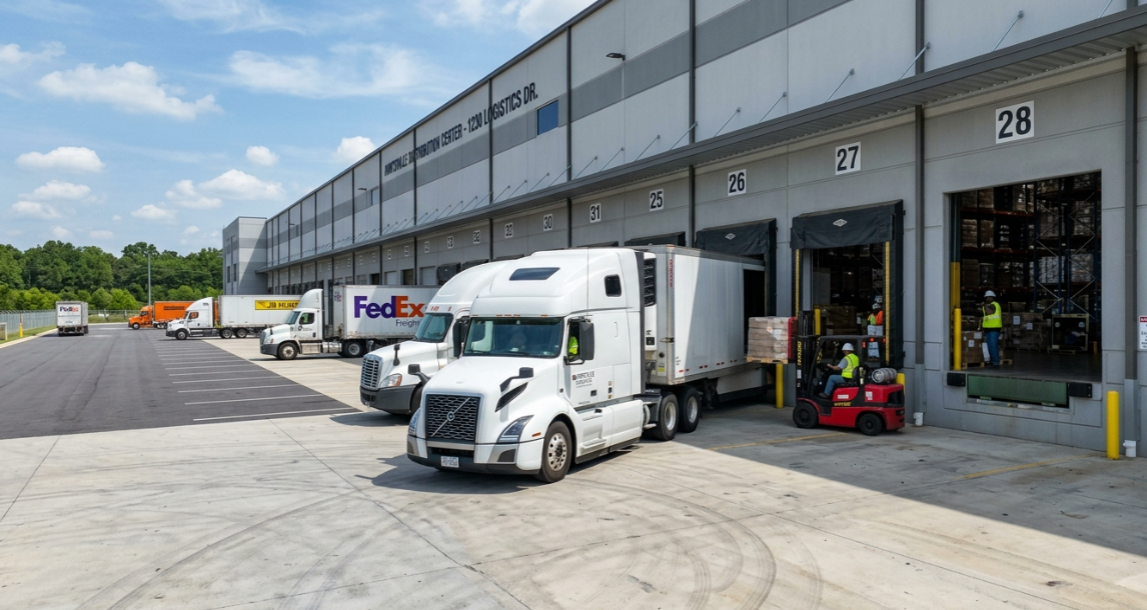
The paved area adjacent to a building’s loading docks that includes both the loading zone and the truck maneuvering zone. NAIOP, the commercial real estate development association, defines it as the space where trucks back into dock positions and pull away. A truck court is not a parking lot. It handles concentrated, repeated loads from vehicles weighing up to 80,000 pounds, and it must be designed for tight turning movements that standard pavement cannot survive.
Why it matters: Treating a truck court like a parking lot is the most expensive mistake a property owner can make. The pavement section, materials, and subgrade requirements are fundamentally different.
Dock Apron
The first 20 to 40 feet of pavement directly in front of the dock doors. This is the highest-stress zone in any truck court. Trailers park here for hours or days at a time, landing gear presses into the surface, and forklifts transition between the building interior and the yard. In Huntsville’s summer heat, this zone takes the worst punishment.
Why it matters: The dock apron should almost always be concrete. It experiences every destructive condition simultaneously: slow-moving loads, sharp turns, prolonged static weight, and (in Alabama) heat-softened surfaces. For more on how different zones within a facility demand different materials, see this guide on distribution center paving zones.
Apron Depth
The total distance from the dock face to the edge of the truck court. Industry analysis shows that approximately 131 feet is the optimal depth for a standard 53-foot trailer to execute a 90-degree back-in maneuver in a single motion. Modern Class A industrial facilities commonly specify a minimum of 135 feet. If a facility needs to stage or park additional trailers parallel to the maneuvering lane, the depth extends to 185 feet.
Why it matters: Insufficient apron depth forces drivers to make multiple repositioning attempts, which compounds pavement stress and slows dock operations. A Huntsville truck court paving project that skimps on depth will pay for it in both operational inefficiency and accelerated pavement damage.
Turning Radius
The outside path a truck traces during a turn. A 53-foot trailer requires roughly a 105-foot outside turning radius to spot cleanly at a dock position. This dimension drives the geometric layout of the entire truck court.
Why it matters: Tight turns at slow speed concentrate enormous shear forces on the pavement surface. These are the areas where asphalt fails first, through shoving and rutting.
ESAL (Equivalent Single Axle Load)
The standard unit for measuring pavement damage. A typical passenger car generates about 0.003 ESALs, while a fully loaded tractor-trailer generates roughly 3 ESALs. That means one semi-truck inflicts about 1,000 times the damage of one car. National studies put the number even higher by a different measurement: one fully loaded 80,000 pound truck causes as much pavement wear as up to 10,643 car passes.
Why it matters: ESAL calculations determine the required pavement thickness. Property owners who compare truck court costs to parking lot costs without accounting for ESALs will underbuild every time.
Landing Gear Damage
The destructive effect of a trailer’s retractable support legs (landing gear) on pavement. When a trailer is dropped at a dock, the full weight of the loaded trailer concentrates through two small steel pads. This point pressure can punch holes through asphalt, especially in warm weather. Concrete resists this type of damage.
Why it matters: Landing gear damage is the single most common argument for concrete over asphalt in Huntsville truck court paving. Practitioners on forums like Practical Machinist are blunt about it. One user stated: “I can say for a fact that at 90 degrees the asphalt will not survive” when discussing heavy point loads on pavement.
Pavement Material Terms
Rigid Pavement (Concrete)

A pavement system that distributes loads across a wide area through the stiffness of the slab itself. Concrete is rigid, meaning it does not deform under sustained pressure the way asphalt does. It resists rutting, point loads from landing gear, and damage from oil and diesel spills. Most older truck courts were paved with asphalt, but concrete has become increasingly popular in recent years for good reason.
Why it matters in Huntsville: Alabama’s hot climate makes asphalt especially vulnerable in dock areas. Heat and UV exposure accelerate asphalt aging faster than in northern climates, compounding the destructive effects of heavy truck loads. Concrete avoids these problems entirely.
Flexible Pavement (Asphalt)
A pavement system that flexes under load and relies on layered construction (surface course, base, subbase) to distribute weight. Asphalt costs less upfront, installs faster, and is easier to repair in small sections. It works well for commercial parking areas, drive aisles, and trailer parking zones where trucks are moving rather than sitting.
Why it matters: Asphalt has a legitimate place in truck court design, just not in the dock apron or heavy turning areas. The zone-by-zone approach (concrete at the docks, asphalt in the drive lanes and trailer storage) balances cost and performance.
Reinforced Concrete Slab
A concrete slab that includes steel reinforcement (wire mesh or rebar) to control cracking and increase load capacity. For truck courts, specifications typically call for 6×6 #10 welded wire mesh or 1/2-inch (#4) steel rebar placed in a criss-cross pattern and tied with wire. The reinforcement holds the slab together when control joints activate and prevents small cracks from becoming structural failures.
For a deeper look at reinforcement options, see this guide on concrete reinforcement types.
Air-Entrained Concrete
A concrete mix that contains intentionally introduced microscopic air bubbles. These bubbles give water room to expand during freeze-thaw cycles, preventing surface scaling and spalling. Truck court specs typically call for 3,500 to 4,000 psi air-entrained concrete for exterior slabs.
Why it matters: While Huntsville doesn’t experience the brutal freeze-thaw cycles of northern states, winter temperatures do drop below freezing regularly. Air-entrained mix is standard practice for any exterior truck court slab.
Control Joints and Expansion Joints
Planned weak points cut or formed into concrete slabs to control where cracking occurs. Control joints are saw-cut grooves that guide shrinkage cracks into straight lines. Expansion joints are full-depth separations filled with compressible material that allow adjacent slabs to move independently.
For truck court concrete, the largest control joint panel should be no more than 15 feet by 15 feet. Joint maintenance is critical to long-term performance, and neglected joints are a leading cause of slab deterioration. More on that topic is covered in this concrete joint repair guide.
PSI (Compressive Strength)
The measure of how much force a concrete slab can withstand before failing, expressed in pounds per square inch. Truck court concrete is typically specified at 3,500 to 4,000 psi, compared to 2,500 to 3,000 psi for lighter-duty applications like sidewalks.
Roller Compacted Concrete (RCC)
An emerging alternative that uses a zero-slump concrete mix placed by asphalt paving equipment and compacted with vibratory rollers. RCC offers the rigidity of concrete at a lower cost and faster placement speed. It is gaining traction in industrial yards and truck courts where surface finish is less important than structural performance.
Subgrade and Base Terms
Subgrade
The native soil beneath the pavement structure. Everything built above it, the stone base, the concrete or asphalt surface, depends on the subgrade for support. Weak or expansive clay soils (common in parts of North Alabama) can undermine even the thickest pavement section.
Why it matters: The number one factor in truck court longevity is what’s underneath the pavement, not what’s on top. Proper subgrade evaluation before construction begins is non-negotiable. For a thorough overview, see this guide on site grading and base preparation.
CBR (California Bearing Ratio)
A laboratory test that measures the strength of subgrade soil by comparing its resistance to penetration against a standard crushed stone baseline. A CBR of 10 or higher is generally acceptable for truck court construction. Values below that threshold typically require remediation.
Why it matters: CBR testing tells the pavement engineer whether the subgrade can support the designed section or whether additional stone, lime stabilization, or cement treatment is needed. Skipping this test is gambling with the entire project.
Stone Base / Aggregate Base
A layer of compacted crushed stone placed between the subgrade and the pavement surface. For concrete truck courts, the spec often calls for 4 to 8 inches of crushed stone, compacted thoroughly with a vibratory tamper. For heavy-duty asphalt sections, 12 inches of base is common.
Subgrade Remediation
The process of improving weak native soil before paving. Methods include removing and replacing unsuitable material, stabilizing with cement or lime, or adding geotextile fabric to separate soft soil from the stone base. Wright Construction performs subgrade remediation with stone base or cement treatment as part of its paving services.
Talk to Wright Construction about your Huntsville truck court project.
Truck Court Concrete Specifications at a Glance
Understanding the numbers behind Huntsville truck court paving helps property owners evaluate contractor proposals and catch underengineered designs before they become expensive problems.
Minimum slab thickness: 6 inches with good subgrade conditions. Increase to 8 inches or more if the subgrade is poor. For heavy-duty new construction at distribution centers, a 12-inch reinforced section with edge beam support is becoming standard.
Concrete strength: 3,500 to 4,000 psi air-entrained mix.
Reinforcement: 6×6 #10 welded wire mesh or 1/2-inch (#4) rebar in a criss-cross pattern.
Control joint spacing: Maximum 15 feet by 15 feet panels.
Stone base: 4 to 8 inches of crushed stone, compacted.
Cure time before traffic: Minimum 7 days. Keep the truck court free of heavy traffic during this period.
For comparison, a heavy-duty asphalt truck court section requires 4+ inches of asphalt over 12 inches of aggregate base, roughly double the base thickness of a standard parking lot.
How Truck Court Construction Works
Understanding the construction process helps property owners compare contractor proposals and identify shortcuts before construction begins.
1. Site Investigation
The contractor evaluates:
Existing pavement
Soil conditions
Drainage
Truck traffic
Utility conflicts
Weak soils are identified before pavement design begins.
2. Demolition
Existing pavement is removed.
Unsuitable soils are excavated if necessary.
3. Subgrade Preparation
The native soil is graded and compacted.
Poor soils may require:
lime stabilization
cement stabilization
additional aggregate
geotextile separation fabric
4. Stone Base Installation
Crushed aggregate is placed in lifts and compacted to design density.
Proper compaction is one of the biggest predictors of pavement life.
5. Concrete or Asphalt Placement
The contractor installs the pavement according to engineering specifications.
Concrete is reinforced before placement.
Asphalt is installed in multiple compacted lifts.
6. Joint Cutting and Curing
Concrete joints are saw-cut after placement.
Concrete cures for approximately seven days before heavy truck traffic resumes.
7. Striping and Final Inspection
The finished truck court receives pavement markings, bollards, wheel stops, and final quality inspections before opening.
Failure and Distress Terms
Every Huntsville truck court paving project, whether new construction or rehabilitation, starts with understanding what went wrong. These are the failure modes that drive repair and reconstruction decisions.
Rutting
Permanent depressions in the wheel paths caused by repeated loading. The pavement surface sinks into channels that collect water, which accelerates further deterioration. In truck courts, rutting usually traces back to inadequate base thickness or an unstable subgrade rather than a surface-layer problem.
Alligator Cracking (Fatigue Cracking)
A pattern of interconnected cracks resembling alligator skin. This is a structural failure signal, not a cosmetic issue. It means the pavement section has exhausted its load-bearing capacity. When you see alligator cracking in a truck court, a surface treatment will not fix it. The base or subgrade has failed. For more on diagnosing pavement distress across a facility, the warehouse floor damage guide covers related interior failures.
Shoving
Horizontal displacement of the pavement surface, creating ripples or waves. Shoving happens at turning areas and stopping zones where truck tires exert lateral forces on heat-softened asphalt. It is extremely common in Huntsville truck courts that were paved with asphalt instead of concrete.
Spalling
Surface breaking or flaking at concrete joints or edges. Spalling exposes aggregate, creates rough spots that damage forklift tires and loads, and allows water into the slab. It is usually caused by poor joint construction, insufficient curing, or impact damage. Epoxy concrete repair is a common fix for localized spalling.
Raveling
The progressive loss of aggregate particles from an asphalt surface. UV exposure and oxidation harden the asphalt binder until it can no longer hold the aggregate together. In Alabama’s climate, where heat and UV exposure are intense year-round, raveling occurs faster than in northern markets.
Subgrade Pumping
The upward displacement of wet, fine-grained subgrade soil through cracks or joints in the pavement. Water trapped beneath the slab turns the soil into a slurry that gets squeezed to the surface by truck loads. Pumping is a sign that drainage has failed and the subgrade is compromised.
Truck Court Paving Costs
Cost transparency helps property owners budget accurately and evaluate bids. Here are the ranges for Huntsville truck court paving based on current industry data.
Heavy-duty asphalt section: Roughly $7.00 to $12.00 per square foot, depending on design specifications and soil conditions.
Concrete truck court paving: Typically $10 to $15+ per square foot, reflecting the reinforced slab designs these applications demand.
Site work as percentage of project cost: Grading, utilities, the truck court and aprons, stormwater systems, and paving typically account for 15 to 25 percent of total project cost on industrial facilities.
The cost gap between concrete and asphalt narrows significantly when you factor in lifecycle costs. A concrete truck court may last 25 to 30 years with proper joint maintenance, while an asphalt truck court in a high-stress dock area may need major rehabilitation in 7 to 10 years. Pavement designed for a 20-year lifespan under standard truck loads may fail in only 7 years if actual loads exceed design assumptions, a common scenario in busy logistics yards.
Factors That Affect Truck Court Paving Costs
No two truck courts cost exactly the same because pavement design depends on traffic, soil, and operational requirements.
Major cost factors include:
Size of the Truck Court
Larger projects reduce the cost per square foot through economies of scale.
Soil Conditions
Weak soils often require:
excavation
stabilization
thicker aggregate base
These items significantly increase project costs.
Truck Traffic
Facilities serving:
distribution centers
food warehouses
manufacturing plants
typically require thicker pavement than facilities with occasional truck deliveries.
Drainage Requirements
Stormwater systems, grading, and detention requirements can represent a substantial portion of the total paving budget.
Material Selection
Concrete costs more initially but often lowers lifetime ownership costs because it requires fewer structural repairs.
Huntsville Truck Court Paving: Local Context
Why the Market Is Growing
Huntsville is positioning itself as a regional logistics and advanced manufacturing hub. Anchors like Jetplex Industrial Park and Cummings Research Park sustain ongoing activity, while Amazon’s long-term lease renewal and Norfolk Southern’s $200 million rail investment in Alabama’s 3B Corridor reflect lasting market confidence. Industrial assets are the strongest category in the region, thanks to Alabama’s manufacturing boom.
Every new warehouse, every distribution center expansion, and every logistics facility upgrade requires Huntsville truck court paving that meets the demands of modern tractor-trailer operations.
Alabama’s Climate Factor
Across Alabama’s commercial markets, heat and UV exposure accelerate asphalt aging faster than in northern climates. Loading dock areas and truck courts hit all four destructive conditions simultaneously during summer months: trucks maneuvering slowly, turning sharply while backing into dock positions, idling for extended periods, and sitting on pavement softened by heat. This is why dock areas fail first and fail worst.
The climate factor makes the concrete versus asphalt decision especially consequential in Huntsville. A dock apron paved in asphalt will face heat-amplified stress from day one. Concrete avoids the thermal softening problem entirely.
Zone-Based Material Selection

The smartest approach to Huntsville truck court paving uses different materials in different zones based on the specific stresses each area faces.
Dock apron (0 to 40 feet from building): Concrete. Non-negotiable for most applications. This is where landing gear sits, forklifts transition, and slow-speed maneuvering concentrates load.
Truck maneuvering zone (40 to 135+ feet): Concrete preferred, especially at turning areas. Asphalt is acceptable in straight drive lanes where trucks move at consistent speed.
Trailer staging and parking (beyond the maneuvering zone): Asphalt is often the cost-effective choice here. Trailers roll through rather than sit, and the forces are less concentrated.
Drive aisles connecting to public roads: Asphalt works well here, with concrete transitions at the points where trucks decelerate and turn.
Why Multi-Trade Contractors Matter
Truck court projects involve more than just paving. They require site grading, stone base installation, stormwater drainage, concrete work, asphalt work, curb and gutter, bollard installation, and sometimes ADA compliance work for adjacent pedestrian areas. Working with a contractor who self-performs across these trades reduces coordination complexity and keeps the project moving.
Contact Wright Construction for Huntsville truck court paving.
Maintenance and Lifecycle Terms
Crack Sealing
The process of filling cracks in asphalt with hot rubberized sealant to prevent water infiltration. For asphalt truck court surfaces, crack sealing should be performed annually. It is the single most cost-effective maintenance action for extending asphalt life.
Sealcoating
A protective coating applied to asphalt surfaces to slow UV oxidation and minor chemical damage. Sealcoating works well on parking lots and light-duty drive aisles. It is not recommended for truck court turning zones, where the coating will be stripped off by tire scrubbing within months.
Mill and Overlay
A rehabilitation method that removes the top layer of deteriorated asphalt (milling) and replaces it with new material (overlay). Mill and overlay works when the base layer and subgrade are still structurally sound. If the base has failed, as is common in truck courts, this approach is a waste of money. For a detailed comparison of overlay options, see the mill and overlay guide.
Full-Depth Reconstruction
Complete removal of the existing pavement and base, followed by subgrade preparation and construction of an entirely new pavement section. This is the appropriate response when alligator cracking, severe rutting, or subgrade pumping indicates structural failure throughout the pavement.
Joint Repair
Maintenance of control joints and expansion joints in concrete truck court slabs. Joints that are cracked, spalled, or filled with incompressible debris allow water to enter the slab and accelerate deterioration. Timely joint repair is the most important maintenance task for concrete truck courts.
Phased Construction
Building or rehabilitating a truck court in stages to keep portions of the facility operational during the work. For active distribution centers in Huntsville that cannot shut down dock operations, phased construction is typically the only viable approach. It requires careful sequencing and a contractor experienced in working around live truck traffic.
Common Truck Court Design Mistakes
The most expensive truck court failures usually begin during design rather than construction.
Common mistakes include:
Using Parking Lot Specifications
Parking lots are not designed for repeated tractor-trailer traffic.
Underestimating Truck Traffic
Future expansion often doubles truck volume within a few years.
Designing for today’s traffic instead of tomorrow’s traffic shortens pavement life.
Poor Drainage
Standing water weakens the base and accelerates pavement failure.
Inadequate Base Compaction
Even thick concrete fails if the supporting base is unstable.
Choosing Asphalt for Dock Aprons
Landing gear loads routinely destroy asphalt loading areas.
Concrete is usually the better long-term investment.
Frequently Asked Questions
What is the difference between a truck court and a parking lot?
A truck court is the paved maneuvering and loading zone adjacent to dock doors, designed for fully loaded tractor-trailers weighing up to 80,000 pounds. A parking lot is designed for passenger vehicles. The pavement section for a truck court is two to four times thicker than a parking lot, and the material requirements are more demanding because one truck inflicts roughly 1,000 times the pavement damage of one car.
Should a Huntsville truck court be paved with concrete or asphalt?
Concrete is strongly preferred for dock aprons and turning areas, where point loads from landing gear, slow-speed maneuvering, and Alabama’s summer heat make asphalt vulnerable to rutting, shoving, and penetration damage. Asphalt can work well for drive lanes and trailer staging areas where trucks move through without stopping. Most successful Huntsville truck court paving projects use both materials in a zone-based approach.
How deep does a truck court need to be?
Industry standards recommend 130 to 185 feet of apron depth. The optimal depth for a 53-foot trailer to execute a 90-degree back-in maneuver in a single motion is approximately 131 feet. If the facility needs to stage or park trailers parallel to the maneuvering lane, 185 feet is more appropriate. Modern Class A industrial facilities in Huntsville commonly specify a minimum of 135 feet.
How thick should truck court concrete be?
A minimum of 6 inches with good subgrade conditions, increasing to 8 inches or more if the subgrade is poor. Heavy-duty distribution center applications may require 12 inches of reinforced concrete with edge beam support. The concrete should be a 3,500 to 4,000 psi air-entrained mix with welded wire mesh or rebar reinforcement.
How much does Huntsville truck court paving cost?
Heavy-duty asphalt sections run roughly $7 to $12 per square foot. Concrete truck court paving typically costs $10 to $15+ per square foot due to the reinforced slab designs required. Total site work (including grading, drainage, and paving) usually accounts for 15 to 25 percent of the overall industrial facility construction cost.
How long does concrete need to cure before trucks can use the truck court?
A minimum of seven days with no heavy traffic. Premature loading is a leading cause of early cracking in new truck court slabs. The concrete continues to gain strength beyond seven days, but most specifications consider one week sufficient for normal truck operations to resume.
Why do truck courts in Alabama fail faster than expected?
Alabama’s heat amplifies every destructive mechanism that truck traffic creates. Asphalt softens in high temperatures, making it more susceptible to rutting, shoving, and landing gear penetration. If the original pavement was designed using standard assumptions rather than heavy-duty truck court specifications, a surface meant to last 20 years can fail in as few as 7.
Can an existing asphalt truck court be converted to concrete?
Yes. The process involves removing the existing asphalt, evaluating and remediating the subgrade, installing a compacted stone base, and pouring a reinforced concrete slab. Phased construction allows portions of the truck court to remain operational during the conversion.
Does every truck court need reinforced concrete?
Not always. Facilities with limited truck traffic may successfully use heavy-duty asphalt in some areas, but most loading dock aprons benefit from reinforced concrete because of concentrated point loads and slow-moving truck traffic.
How often should a truck court be inspected?
Commercial truck courts should be visually inspected several times per year and professionally evaluated after major cracking, rutting, drainage issues, or unusually heavy truck traffic.
Can damaged truck courts be repaired without full replacement?
Sometimes. Surface repairs, joint repair, crack sealing, and partial-depth concrete replacement may extend pavement life when structural failure has not reached the base or subgrade.
How long does truck court construction take?
Most projects take several weeks depending on project size, demolition requirements, weather, curing time, and whether the work is completed in phases.
Request a consultation for your Huntsville truck court paving project.