
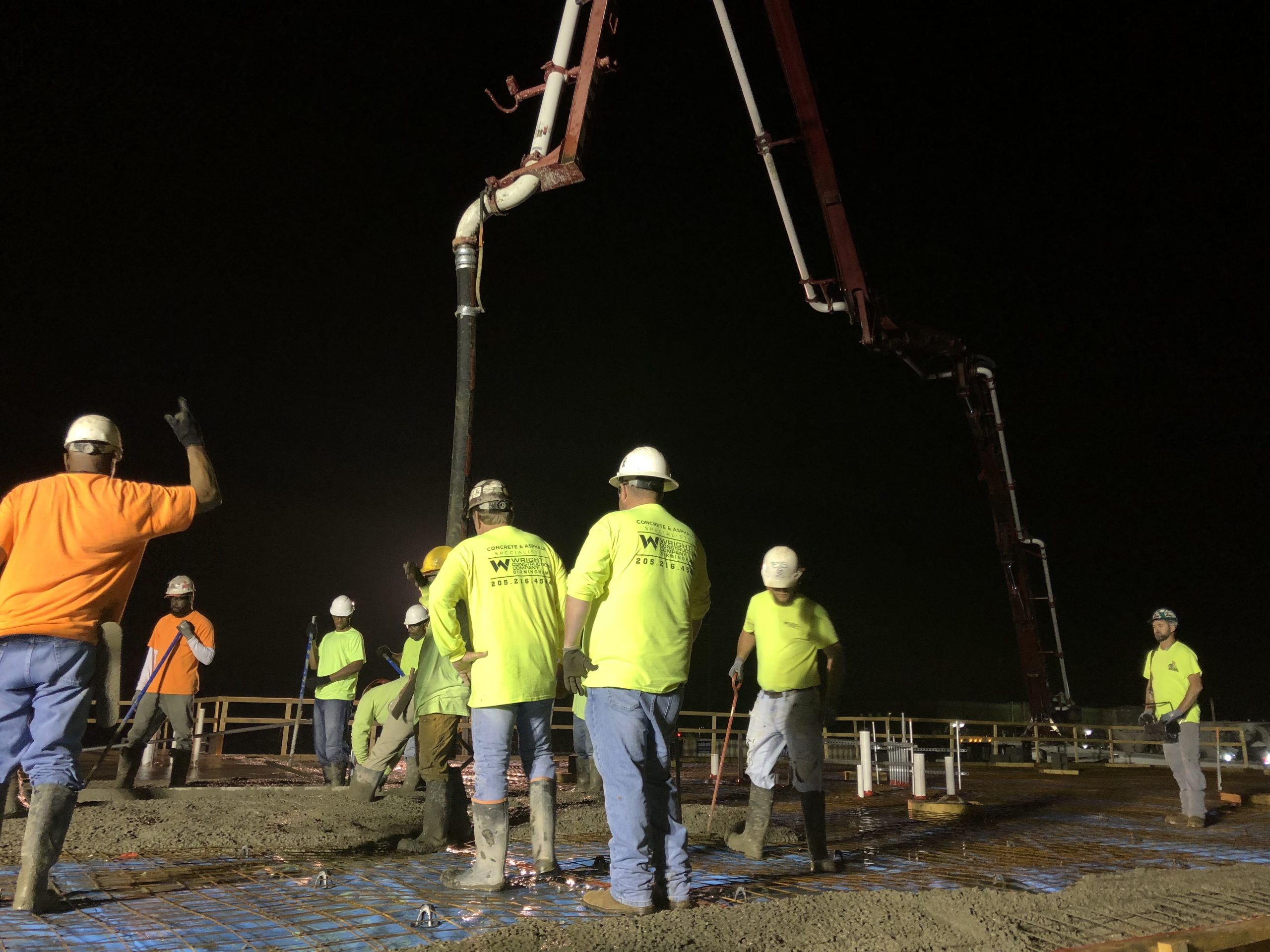
Pouring concrete might seem as simple as mixing and dumping, but getting a strong, durable, and crack-free surface is a science. Concrete placement techniques are the specific methods for transporting, placing, consolidating, and finishing concrete to meet project requirements. The difference between a slab that lasts for decades and one that fails in a few years often comes down to the skill and knowledge behind the pour. This is where mastering professional concrete placement techniques becomes crucial.
From the initial planning stages to the final surface texture, every step has a purpose. Whether you’re overseeing a massive industrial slab in Tennessee or a commercial foundation in Alabama, understanding these methods ensures your project stands on solid ground.
Let’s walk through the essential concrete placement techniques that professionals use to deliver quality results every time.
At a Glance: Professional Concrete Placement (2026 Standards)
What is the best concrete placement technique? For most commercial projects in 2026, concrete pumping is the gold standard due to its speed (30–100 yd³/hr) and ability to maintain mix integrity.
3 Golden Rules for a Perfect Pour:
Placement Window: Deposit concrete within 30–90 minutes of batching.
Free Fall Limit: Modern mixes allow drops over 5 feet only if the fall is strictly vertical and unobstructed to prevent segregation.
Consolidation: Always vibrate in 5–15 second vertical bursts to eliminate honeycombing without causing paste separation.
Part 1: Planning for a Perfect Pour
Success starts long before the concrete truck arrives. Proper planning prevents common problems like delays, waste, and weak spots.
Concrete Placement Planning
This is the master plan for the entire operation. It involves organizing every resource and step before the pour begins. In fact, experts consider it the single most important step in placing concrete because it helps avoid costly delays and material segregation. Good planning can cut material waste by up to 15 percent by preventing over ordering or spillage. The plan covers everything from scheduling deliveries and preparing formwork to ensuring the crew is ready for a continuous pour, even accounting for weather conditions.
Site Access Planning
How will the concrete get from the truck to the form? Site access planning is all about creating a clear and safe path for trucks, pumps, and workers. A fully loaded mixer truck can weigh between 25 and 40 tons, so the ground must be stable enough to support it. The goal is to get the concrete as close to its final position as possible, minimizing the time it spends in the truck. Ideally, concrete should be placed within 30 minutes of mixing to maintain its workability. For tight job sites, a solid plan might include using a concrete pump or extended chutes to get the job done efficiently.
Equipment Selection for Placement

Not all pours are the same, so you can’t use the same equipment for every job. Choosing the right tools is a critical step in all concrete placement techniques and depends on the project’s size, the type of structure (like a slab versus a wall), and site accessibility.
Common equipment includes:
Placement Method | Best Use Case | Max Efficiency | Primary Benefit |
Concrete Pump | High-rises, large slabs, tight access | 100+ yd³/hr | Minimal labor; high versatility |
Crane & Bucket | Elevated decks & bridge piers | 10–20 yd³/hr | Precise placement in vertical forms |
Conveyor Belt | Mass pours (dams, mat foundations) | 200+ yd³/hr | Continuous flow; handles low slump |
Direct Chute | Slab-on-grade near access roads | Limited by truck | Zero equipment cost; fast setup |
The right equipment ensures concrete is placed quickly and without segregating.
Jobsite Material Management
A clean and organized jobsite is an efficient jobsite. Material management involves coordinating the delivery, storage, and handling of everything from rebar and formwork to the concrete itself. Aggregates must be kept clean and separated to ensure mix consistency. Reinforcement and forms should be staged near the work area to prevent delays. Most importantly, ready mix truck deliveries should be timed to match the crew’s placement speed, preventing traffic jams and ensuring a steady supply of fresh concrete.
Part 2: The Art of the Pour
With a solid plan in place, the focus shifts to the physical act of placing the concrete. These techniques ensure the material gets into the forms correctly.
Minimizing Placement Time and Rehandling
Once concrete is mixed, the clock is ticking. The goal is to get it into its final position as quickly as possible, ideally without moving it around too much. Pushing or dragging concrete across the form with shovels or vibrators is a recipe for segregation, where the heavy aggregates separate from the cement paste. Instead, concrete should be deposited in its approximate final location. A continuous pour is also critical to prevent “cold joints,” which are weak points that form when one layer of concrete starts to set before the next one is added.
Pro-Tip: Preventing Cold Joints
Calculate Pour Rate: Ensure your pump or delivery speed exceeds the concrete’s chemical setting rate (check the weather—heat speeds this up!).
Step the Pour: In large slabs, use a “stair-step” placement pattern rather than long, thin strips to keep the leading edge “alive.”
Vibrator Re-penetration: Always sink the internal vibrator 6 inches into the previous lift to “knit” the layers together seamlessly.
Concrete Transportation Methods
Getting concrete from the mixer to the forms while maintaining its quality is a key challenge. The chosen transportation method must prevent segregation and moisture loss. Simple methods like direct discharge from a truck chute work well for slab-on-grade construction, while a crane and bucket can lift concrete to elevated decks. For large or complex projects, pumping through a pipeline is often the most efficient method. No matter the technique, the mix must remain uniform from start to finish.
Pumping Concrete
Pumping is one of the most common and efficient concrete placement techniques today. A pump can move 30 to 100 cubic yards of concrete per hour, making it perfect for large slabs, walls, and high rise buildings. The key to successful pumping is a “pumpable” mix, which has the right consistency to flow through the hoses without clogging. When filling walls or columns, the pump hose should be kept submerged in the fresh concrete to prevent it from free falling and trapping air.
Segregation Control During Placement
Segregation is the enemy of strong concrete. It happens when the heavy gravel separates from the lighter sand and cement paste. To prevent this, concrete should always be placed vertically and as close to its final position as possible. If it hits rebar or the side of the formwork at an angle, it can cause the components to separate. Using drop chutes or tremie pipes for tall drops, placing concrete in manageable layers (lifts), and using a well designed mix are all critical for segregation control.
Vertical Drop Placement Limit
There’s an old rule of thumb that you shouldn’t let concrete free fall more than 3 to 5 feet. However, modern research has shown this is not always true. Studies, including one by the Alabama Highway Department, have found that concrete can be dropped from heights of 75 feet or more without any harmful segregation, as long as it falls straight down and doesn’t hit any obstructions. In that study, the concrete that fell the farthest actually showed the highest compressive strength. The key is ensuring a clear, vertical path to avoid ricocheting off rebar or forms.
Casting in Lifts
For tall structures like walls or columns (see our concrete column construction guide), pouring all the concrete at once would create immense pressure on the bottom of the formwork, risking a blowout. To manage this, concrete is “cast in lifts,” or horizontal layers. A typical lift is around 4 feet high. The crew pours the first lift and lets it stiffen for about an hour before pouring the next one on top. To ensure the layers bond together into a single solid piece, a vibrator is inserted through the fresh top lift and a few inches into the one below, knitting them together.
Part 3: Specialized Concrete Placement Techniques
Some projects require specialized approaches to overcome unique challenges like underwater construction or the need for seamless, tall structures.
Underwater Placement Methods
You can’t just dump concrete into water; the cement would wash away. Specialized underwater concrete placement techniques are needed to protect the mix. The most common methods are the tremie method and the preplaced aggregate method. Both are designed to place concrete without exposing it directly to water, ensuring it cures into a solid, durable mass. For any underwater pour, the goal is to displace the water with the concrete, not mix with it.
The Tremie Method
The tremie method is the go to technique for pouring concrete underwater. It uses a long, vertical pipe called a tremie, which has a hopper at the top. The bottom end of the pipe is placed at the bottom of the pour. Concrete is fed into the hopper, and it flows down the pipe, pushing the water out. The key is to keep the end of the pipe buried in the fresh concrete at all times. This creates a seal that prevents water from mixing with the new concrete, resulting in a high quality underwater structure.
The Preplaced Aggregate Method
This unique method flips the script. First, the formwork is filled with clean, coarse aggregate (rocks). Then, a specialized cement grout is pumped into the form from the bottom up. The grout flows into the voids between the rocks, displacing any water and air, and binding the aggregate together to form solid concrete. This technique is excellent for underwater repairs and in areas with dense rebar where traditional concrete would be difficult to place and vibrate. It also results in less shrinkage because the aggregate skeleton is already in place.
Slip Form Construction
For building tall, continuous structures like silos, chimneys, and the core of a high rise, slip forming is the technique of choice. In this method, the formwork moves (or “slips”) slowly and continuously upward as the concrete is poured. A stiff, low slump concrete mix is used, which hardens just enough to hold its shape by the time the form slides past it. This allows for a seamless, joint free structure to be built very quickly, often in a nonstop, 24/7 operation.
Shotcrete Placement
Shotcrete, or sprayed concrete, is applied at high velocity using a hose and nozzle. It requires no formwork on one side, as the force of the application compacts the material against the receiving surface, whether it’s a hillside, a tunnel wall, or the curved shape of a swimming pool. The operator, or nozzleman, builds up the concrete in layers, creating a dense and strong final product. It’s an ideal solution for creating complex shapes or repairing existing structures.
Modern Innovation: Sustainability in 2026 Placement

As of 2026, placement techniques are evolving to accommodate Low-Carbon Concrete (LCC) and LC3 cements.
Carbon Injection: Some placement pumps now integrate carbon mineralization technology, injecting CO2 directly into the mix during the pour to increase compressive strength while sequestering emissions.
Smart Maturity Sensors: Placement is no longer guesswork. Crews now embed wireless sensors during the pour to track real-time temperature and strength gain, providing mobile alerts when it’s time to begin saw-cutting joints.
Alternative Binders: Techniques like Vacuum Dewatering are seeing a resurgence to help high-supplementary cementitious material (SCM) mixes reach finishing hardness faster, offsetting the slower set times of eco-friendly binders.
Part 4: Quality Control and Consolidation
Pouring the concrete is only half the battle. Ensuring it’s dense, free of air pockets, and meets all specifications is what guarantees long-term performance. These quality control steps are just as important as the physical concrete placement techniques themselves.
Concrete Quality Control
During the pour, it’s vital to test the fresh concrete to make sure it meets project requirements. Technicians on site will perform tests for:
Slump: Measures the concrete’s consistency or workability. Too much slump can indicate excess water, which weakens the final product.
Air Content: In cold climates, tiny air bubbles are intentionally added to concrete (air entrainment) to improve its resistance to freeze thaw cycles. The air content must be within a specific range (usually 4 to 7 percent).
Water to Cement Ratio: This is the most critical factor for strength and durability. A lower ratio leads to stronger concrete. Adding extra water on site is highly discouraged as it compromises strength.
Consolidation by Vibration
Freshly placed concrete contains trapped air bubbles that can create weak spots called “honeycombs.” Consolidation is the process of removing these air pockets to make the concrete dense and uniform. The most common method is vibration, which temporarily liquefies the concrete, allowing air to escape and ensuring the mix flows tightly around rebar and into every corner of the form.
Internal Vibrator Technique
An internal vibrator, also known as a poker or spud vibrator, is the most common tool for consolidation. It’s a vibrating metal tube that is inserted directly into the fresh concrete. The operator should insert the vibrator vertically and quickly, hold it in place for 5 to 15 seconds until air bubbles stop surfacing, and then withdraw it slowly to allow the concrete to fill the void. The insertions should be systematic and overlapping to ensure the entire area is consolidated.
External Vibrator Technique
For thin sections or areas with congested reinforcement where an internal vibrator won’t fit, external vibrators are used. These devices are clamped directly to the outside of the formwork. They send vibrations through the forms and into the concrete, compacting it from the outside in. This method requires sturdy formwork and is often used in the precast concrete industry.
Vacuum Dewatering
For floor slabs where very high strength and abrasion resistance are needed, vacuum dewatering can be used. After the concrete is placed and leveled, a special mat is laid over the surface. A vacuum pump is connected to the mat, which sucks out excess water from the top layer of the concrete. This process significantly lowers the water to cement ratio in the surface zone, resulting in a much stronger, denser, and more durable finish.
Part 5: Finishing Touches
The final steps in any concrete flatwork project involve creating the desired surface texture and ensuring it cures properly.
Slab Construction Sequence
A quality slab isn’t made by chance; it follows a precise sequence.
Formwork: The slab’s perimeter is set with forms to hold the wet concrete.
Reinforcement: Rebar or wire mesh is placed to add tensile strength (see concrete slab reinforcement methods).
Pour and Finish: Concrete is placed, leveled, and finished to the desired texture.
Cure: The slab is protected from moisture loss for at least 7 days to allow it to gain strength properly (learn how long does concrete take to dry and why wait and why waiting matters).
Following this sequence is fundamental to any successful flatwork project. Wright Construction Company expertly manages this process for commercial and industrial clients, ensuring every slab meets the highest standards.
Screed Strike Off
Immediately after pouring, the concrete needs to be leveled. Screeding, or striking off, is the process of dragging a straightedge across the top of the forms to remove excess concrete and fill in low spots. This establishes the final grade and flatness of the slab and is the first crucial step in the finishing process.
Bull Floating
After screeding, the surface is still rough. A bull float, which is a wide, flat tool on a long handle, is pushed and pulled across the surface. This smooths out the ridges left by the screed, embeds coarse aggregate just below the surface, and brings a layer of cement paste to the top, preparing it for the next finishing steps.
Contraction Joints
Concrete shrinks as it dries, which creates stress that can cause random, ugly cracks. Contraction joints, also known as control joints, are planned cracks. They are grooves cut into the slab to a depth of about one quarter of the slab’s thickness. These grooves create a weakened plane, encouraging the concrete to crack in a neat, straight line inside the joint where it can’t be seen.
The Finishing Textures
The final surface texture depends on the slab’s intended use.
Float Finish
A float finish is created using a magnesium or wood hand float after the concrete has stiffened slightly. It produces a matte, slightly gritty texture that is more slip resistant than a smooth finish. It’s a common choice for areas that will receive a floor covering or for some exterior surfaces.
Steel Trowel Finish
For a very smooth, hard, and dense surface, a steel trowel finish is used. This is typically done on interior floors like warehouses or garages and is common in commercial concrete floor systems. After floating, finishers use steel trowels (by hand or with a power trowel machine) to compact and polish the surface. The result is a glossy, easy to clean floor, but it can be slippery when wet.
Broom Finish
For sidewalks, ramps, and driveways, a broom finish is standard. A stiff bristled broom is dragged across the surface just before the concrete fully hardens. This creates fine grooves that provide excellent traction and slip resistance, making it a safe choice for outdoor flatwork. This is a key technique for ensuring ADA compliance on public walkways. If your property needs an ADA compliance review, see how ADA compliance affects paving projects.
Your Partner for Expert Concrete Work
Mastering these concrete placement techniques requires experience, skill, and the right equipment. From massive industrial foundations to precision ADA ramps, the quality of the work depends on the expertise of the crew.
At Wright Construction Company, we bring decades of experience to commercial and industrial projects across the Southeast. Our self performing crews are experts in all facets of concrete construction, ensuring your project is built to last.
Ready to start your next project? Contact Wright Construction Company today for a consultation.
Frequently Asked Questions
What are the most common concrete placement techniques?
The most common techniques include direct discharge from a truck chute for simple pours, pumping for its versatility and speed on larger projects, and using a crane and bucket for elevated or hard to reach areas. The best technique depends on the specific jobsite conditions and project requirements.
How do you place concrete without segregation?
To prevent segregation, you should deposit the concrete as close to its final location as possible. Avoid long horizontal movements with shovels or vibrators. When dropping concrete from a height, ensure it falls vertically and use a drop chute or tremie if necessary to control the fall and prevent it from hitting rebar or forms.
What is the purpose of vibrating concrete?
Vibration consolidates fresh concrete by removing trapped air pockets. This process makes the concrete denser, stronger, and more durable. It also helps the concrete flow around reinforcement and completely fill the formwork, preventing voids and weak spots known as honeycombs.
What is the difference between a float finish and a trowel finish?
A float finish uses a wood or magnesium float to create a slightly gritty, matte surface that offers good traction. A steel trowel finish uses steel blades to produce a very smooth, hard, and dense surface that is glossy. Trowel finishes are common for indoor floors, while float or broom finishes are preferred for exterior surfaces.
Why are joints cut into concrete slabs?
Joints, specifically contraction or control joints, are cut into concrete to manage natural shrinkage cracking. As concrete cures and dries, it shrinks, creating tensile forces. The joints create a pre planned weak spot, encouraging the concrete to crack in a straight, controlled line within the joint instead of randomly across the slab surface.
What are the key steps in placing a concrete slab?
The main steps are preparing the subgrade and setting up formwork, placing and securing steel reinforcement, pouring and consolidating the concrete, striking it off and finishing the surface (e.g., bull floating, troweling, or brooming), and finally, properly curing the slab for at least seven days to ensure it reaches its designed strength. For heavy-duty floors, a post-tensioned slab may be specified to reduce cracking and allow longer spans.