
TL;DR
Nashville’s booming warehouse sector means thousands of industrial concrete slabs under constant stress from forklifts, temperature swings, and heavy loads. This glossary covers every damage type, joint classification, and repair method that warehouse owners and facility managers need to understand when evaluating Nashville warehouse concrete repair. It includes cost benchmarks, downtime considerations, and a clear repair vs. replace framework tied to Middle Tennessee’s specific climate challenges.
Nashville sits within a two-day ground delivery reach of 72% of the U.S. population, making it one of the most active logistics corridors in the country. That status shows in the numbers. As of early 2025, industrial investment volumes in the Nashville market exceeded $2.2 billion, vacancy rates remain well below national averages at roughly 3.3%, and the Nashville Area Chamber of Commerce reported that 79% of 2024 business relocations and expansions involved industrial users. Prologis alone operates over 17 million square feet of industrial real estate across greater Nashville.
All of that activity translates into one practical reality: a massive and growing inventory of warehouse concrete floors taking daily punishment from forklifts, pallet jacks, and seasonal temperature extremes. Nashville warehouse concrete repair is not a one-time event for most facilities. It is an ongoing maintenance category that directly affects safety, operations, and equipment costs.
This glossary exists to give facility managers, property owners, and general contractors the terminology they need to diagnose problems accurately, communicate clearly with contractors, and make informed decisions about repair methods. Every term below is defined in the context of real warehouse conditions.
If your warehouse floors need professional assessment, contact Wright Construction to discuss your facility’s specific conditions.
Quick Answer: Nashville Warehouse Concrete Repair
Warehouse concrete repair in Nashville typically involves fixing cracks, spalling, joint deterioration, settlement, and surface wear caused by forklift traffic, heavy loads, and Middle Tennessee freeze-thaw cycles. Common repair methods include epoxy injection, joint rebuilds, polyurethane slab leveling, resurfacing, and partial-depth repairs. Costs generally range from $3 to $30 per square foot depending on severity, downtime requirements, and whether the slab needs repair or full replacement.
The most common warehouse concrete failures in Nashville include:
– Joint spalling from forklift traffic
– Curling slab edges
– Differential settlement
– Freeze-thaw crack expansion
– Surface abrasion and dusting
– Full-depth slab cracking in high-load areas
For most facilities, proactive joint maintenance and crack repair cost significantly less than full slab replacement and help reduce forklift wear, safety risks, and operational downtime.
Nashville Warehouse Concrete Repair At a Glance
Issue | Common Cause | Typical Repair | Estimated Cost |
|---|---|---|---|
Joint Spalling | Forklift traffic | Joint rebuild | $8–$25/sq ft |
Structural Cracks | Settlement or overload | Epoxy injection | $5–$15/linear ft |
Surface Abrasion | Heavy traffic wear | Resurfacing | $2–$8/sq ft |
Differential Settlement | Poor subgrade compaction | Foam injection | $5–$25/sq ft |
Dusting | Weak surface finish | Surface hardener | $0.75–$3/sq ft |
Full Slab Failure | Subgrade collapse | Slab replacement | $12–$30/sq ft |
Common Warehouse Concrete Damage Types
These are the conditions you will encounter most often in Nashville warehouse environments. Understanding the correct terminology helps you describe problems accurately when requesting quotes and speeds up the assessment process.
Cracking (Structural vs. Surface)
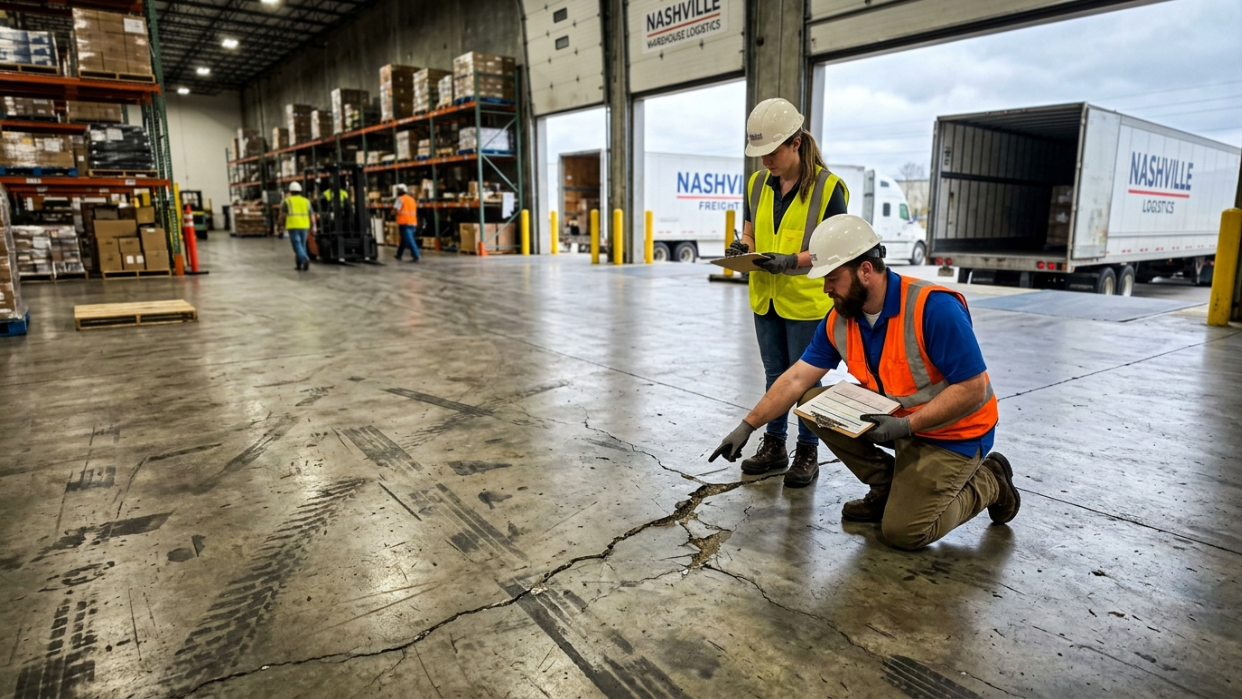
Cracks are the most common form of warehouse concrete damage, but not all cracks are equal. Structural (moving) cracks penetrate the full depth of the slab and indicate active movement from settlement, overloading, or subgrade failure. Surface (static) cracks are random, non-moving hairline fractures that affect only the top layer. The distinction matters because structural cracks require stabilization before any surface repair will hold. Practitioners in the industrial concrete space consistently stress this point: if you repair the surface without addressing the underlying movement, the crack will return. For a deeper look at how to diagnose different crack types, see this warehouse floor repair guide.
Crazing
A network of fine, shallow, random cracks on the surface, sometimes resembling a dried mud flat. Crazing is caused by shrinkage of the surface mortar during curing. It rarely affects structural integrity, but it can trap dirt and moisture, accelerating other forms of deterioration in high-traffic warehouse environments.
Curling
When slab edges lift upward, creating raised transitions between panels, the condition is called curling. It happens because the top and bottom of the slab dry and shrink at different rates. In warehouses, curled edges are a serious operational problem. Industrial concrete specialists note that raised edges on concrete slabs can damage forklifts, shift loads, and cause product spills. Curling is one of the most common triggers for joint rebuild projects.
Delamination
Delamination is the separation of a thin surface layer from the concrete beneath it. You can often detect it by tapping the slab with a hammer or chain drag; delaminated areas produce a distinctive hollow sound. This condition is particularly dangerous in warehouses because the delaminated layer can break loose under forklift traffic without warning, creating sudden surface hazards. Learn more about slab-on-grade construction to understand how proper initial installation prevents delamination.
Differential Settlement
When the soil beneath a warehouse slab settles unevenly, different sections of the floor sink to different elevations. The result is cracking, tilting panels, and operational problems with material handling equipment. Differential settlement is especially common in Nashville’s expanding industrial corridors where new construction sometimes occurs on fill soil that was not adequately compacted.
Dusting
A surface condition where fine powder continually forms on and comes off the concrete. Dusting usually results from a weak finish, premature troweling, or carbonation of the surface during initial curing. In a warehouse, dusting creates housekeeping problems and can contaminate products stored at floor level. It also indicates that the surface layer lacks the hardness needed for long-term forklift traffic.
Efflorescence
The white, crystalline salt deposits that appear on concrete surfaces as water migrates through the slab and evaporates. Efflorescence itself is mostly cosmetic, but it signals that water is moving through the concrete, which can contribute to more serious problems like freeze-thaw damage or reinforcement corrosion over time.
Pitting
Small, drilled-looking holes scattered across the slab surface. Pitting usually results from chemical exposure, poor finishing, or aggregate pop-outs. In warehouses that handle chemicals, de-icing agents, or acidic materials, pitting can progress rapidly. The tiny holes also catch forklift wheels and can accelerate tire wear.
Spalling
Spalling is the flaking, crumbling, or peeling of the concrete surface, sometimes described as looking like a skin rash spreading across the floor. In warehouses, the constant movement of heavy equipment exerts immense pressure on the surface, and spalling often starts at joints or cracks before spreading outward. Spalled areas are rough and uneven, creating both safety hazards and equipment damage. Surface repair costs for spalling typically range from $3 to $25 per square foot depending on severity and method.
Surface Abrasion
The gradual wearing down of the concrete surface from repeated traffic. Forklifts, pallet jacks, foot traffic, and dragged pallets all contribute. Over time, wear patterns, scratches, and aggregate exposure become more prominent. Surface abrasion accelerates when the original concrete was finished without a surface hardener or when the slab has already begun dusting.
Warehouse Concrete Joint Types

Joints are the planned weak points in a warehouse floor, and they are consistently the number one failure point in industrial concrete. Understanding joint types is essential for anyone dealing with Nashville warehouse concrete repair, because most repair projects start at the joints.
Warehouse floor specialists point out that forklift operators driving over deteriorated joints causes cascading costs that most facility managers overlook: accelerated tire wear from uneven surface transitions, product damage from load shifting, and increased maintenance on the forklifts themselves from hard braking and vibration.
Control (Contraction) Joint
A sawed or tooled groove in the slab surface, typically cut within 24 hours of placement. Control joints create a predetermined weak line so that shrinkage cracking occurs at the joint rather than randomly across the slab. In warehouse floors, these joints are spaced at regular intervals (usually 12 to 15 feet in each direction) and are the joints most commonly exposed to forklift traffic.
Construction Joint
The boundary where two separate concrete placements meet, typically at the end of a day’s pour. Construction joints require careful detailing because the bond between old and new concrete is inherently weaker than monolithic placement. In large warehouse pours, construction joints are unavoidable, and their long-term performance depends heavily on proper preparation and, often, dowel bar installation.
Expansion Joint
A full-depth separation built into the slab to accommodate thermal expansion and contraction. Nashville’s climate produces meaningful temperature swings, and without properly maintained expansion joints, thermal movement creates compressive stress that leads to cracking or buckling. Expansion joints are wider than control joints and filled with compressible material.
Isolation Joint
An isolation joint separates the concrete slab from adjacent structural elements like walls, columns, or equipment pads. It allows movement in three directions (horizontal, vertical, and rotational) without transferring stress between the slab and the fixed structure. When isolation joints fail in warehouses, cracks radiate outward from columns and wall connections.
Dowel Bar
A smooth steel bar installed across a joint to transfer load from one slab panel to the next while still allowing horizontal movement. Dowel bars prevent the “faulting” condition where one side of a joint sits higher than the other. In heavy-duty warehouse floors carrying forklift loads of 10,000 pounds or more, properly installed dowel bars are critical to joint longevity.
Joint Filler
The material installed in joints to prevent debris infiltration and support joint edges. Common filler materials include polyurea, semi-rigid epoxy, and silicone-based sealants. Each has different properties for hardness, flexibility, and cure time. Joint filler selection depends on the type of traffic, temperature range, and joint width.
For a complete breakdown of joint repair terminology and methods, see this concrete joint repair glossary.
Joint Rebuild
A comprehensive repair that involves cutting keyways on both sides of a deteriorated joint, grinding down raised edges, repairing spalled edges, recutting the joint to proper depth, filling with polyurea or similar material, and sealing the surface. Joint rebuilds restore the smooth, level transitions that forklifts need. This is one of the most common Nashville warehouse concrete repair procedures and one of the most immediately impactful for operations.
Signs Your Warehouse Floor Needs Immediate Repair
Warehouse floors rarely fail all at once. Most industrial slabs show warning signs months or years before major structural problems develop. Early identification reduces downtime, prevents forklift damage, and lowers repair costs.
Warning Signs Facility Managers Should Watch For
Forklifts bouncing or vibrating near joints
Cracks widening over time
Uneven slab elevations between panels
Surface dust accumulation after cleaning
Hollow sounds when tapping the slab
Water intrusion through cracks or joints
Repeated pallet instability in the same area
Tire wear increasing faster than expected
Spalled concrete near dock doors
Recurring trip hazards along travel lanes
Why Early Repairs Matter
Small warehouse concrete defects become expensive quickly in active logistics environments. Forklift traffic continuously enlarges cracks, weakens joint edges, and accelerates slab deterioration. Repairing minor damage early often costs a fraction of full-depth replacement later.
Repair Methods and Techniques
Each repair method below addresses a specific type and severity of damage. The right choice depends on the root cause, the extent of deterioration, and (often most importantly for warehouse operators) the available downtime window. A major determining factor in product and method selection is downtime. Most facilities have a limited window to get the crew in and complete the repair as fast as possible.
Crack Chasing
Routing out cracks with a saw or angle grinder to create a clean, uniform channel before filling with repair material. Crack chasing prepares the surface for better adhesion and a more durable fill. It is a preparatory step rather than a standalone repair, used before routing and sealing or before applying epoxy.
Crack Stitching
A method for restoring tensile strength across a crack. The process involves drilling holes on both sides of the crack and anchoring U-shaped metal staples across it. Crack stitching prevents further propagation and is appropriate for structural cracks that have been stabilized. It is often used in combination with epoxy injection.
Epoxy Injection
A structural repair method where low-viscosity epoxy resin is injected under pressure into a crack, filling it to full depth. Properly injected epoxy cures to a tensile strength that meets or exceeds the surrounding concrete. Epoxy injection is the correct method when a crack has penetrated through a structural slab. It bonds the crack back together rather than simply sealing it.
Epoxy coating costs range from $3 to $12 per square foot depending on thickness and product. For more detail on when and how epoxy repair applies to industrial settings, see this epoxy concrete repair guide.
Epoxy Overlay/Coating
A surface treatment where epoxy resin is applied as a coating or thin overlay across the floor. Epoxy coatings transform an industrial concrete floor into a smoother, easier-to-clean surface with superior chemical resistance. They are often applied after surface repairs are complete, serving as both a protective layer and a finished wearing surface.
Full-Depth Slab Replacement
When deterioration extends through the entire slab thickness and the subgrade has failed, full-depth replacement is the only viable option. The damaged section is saw-cut and removed, the subgrade is recompacted or replaced, and new concrete is placed. This is the most expensive and disruptive repair method, with new concrete floor costs running $12 to $30 per square foot. It is the last resort, reserved for sections where repair is no longer cost-effective.
Mudjacking (Slabjacking)
A traditional method for lifting and leveling sunken concrete. A mixture of cement, soil, and water is pumped through holes drilled in the slab to raise it back to grade. Mudjacking is less expensive than polyurethane foam injection but uses heavier material and requires larger access holes. It works well for moderate settlement where the slab is otherwise sound.
Partial Depth Repair
When damage affects only the top 1 to 3 inches of the slab, partial depth repair removes the deteriorated surface layer by saw-cutting a square perimeter down to sound concrete and filling with a bonded repair material. This method preserves the structural slab below while restoring the wearing surface. It is commonly used for spalling and surface delamination.
Polyurethane Foam Injection (Slab Leveling)
A modern alternative to mudjacking. Expanding polyurethane foam is injected beneath the slab through small holes, lifting it back to level as the foam expands and cures. The material is lightweight (preventing further settlement from added weight), cures in minutes rather than days, and causes minimal operational disruption. For warehouse managers who cannot afford extended downtime, foam injection is often the preferred leveling method.
Resurfacing
Applying a thin new layer of concrete or cementitious material over an existing slab to restore surface quality. Resurfacing is appropriate when the existing slab is structurally sound but the surface is worn, abraded, or lightly spalled. It is not suitable for slabs with active structural movement.
Routing and Sealing
A straightforward crack repair method. The crack is enlarged with a router to create a uniform reservoir, filled with a flexible sealant, and finished flush with the surrounding surface. Routing and sealing is appropriate for static, non-structural cracks where full-depth bonding is not required. It is faster and less expensive than epoxy injection.
Shot Blasting
A mechanical surface preparation method that propels steel shot at the concrete surface to clean it, remove coatings, and create a uniform profile for bonding. Shot blasting is typically the first step in any resurfacing, overlay, or coating project. The International Concrete Repair Institute (ICRI) has defined nine distinct concrete surface profiles (CSPs) that correspond to different preparation methods.
Surface Hardener
A chemical treatment (typically lithium, sodium, or potassium silicate) applied to the concrete surface to increase hardness and abrasion resistance. Surface hardeners react with the calcium hydroxide in concrete to form a harder, denser surface. Applying a surface hardener during or after construction can significantly extend slab service life in warehouse environments. It is also used as a maintenance treatment on existing floors.
Polished Concrete
A multi-step grinding and densifying process that produces a smooth, highly durable floor surface. Polished concrete is one of the most cost-effective and forklift-safe flooring options for large warehouses because it eliminates the need for coatings, reduces dusting, and improves light reflectivity. However, polishing is a finishing treatment rather than a repair method. It works best on slabs that are structurally sound.
Assessment and Technical Terms
These terms come up during professional assessments and engineering evaluations. Understanding them helps facility managers follow the diagnostic process and evaluate contractor recommendations.
Concrete Surface Profile (CSP)
The degree of roughness of a concrete surface, measured on a scale from CSP 1 (nearly smooth) through CSP 9 (very rough). Different repair and coating systems require specific CSP levels for proper adhesion. ICRI publishes standards that correlate each CSP level with the preparation method needed to achieve it. When a contractor specifies “CSP 3 preparation,” they are describing a specific surface roughness, not an arbitrary preference.
F-Numbers (FF and FL)
F-numbers quantify floor flatness (FF) and floor levelness (FL). Higher numbers indicate flatter, more level floors. Warehouse floors with heavy forklift traffic typically require minimum FF/FL values in the range of 25/20 to 50/30, depending on the type of material handling equipment. After repair, F-numbers should be verified to confirm the floor meets operational requirements. For a complete explanation of how these measurements work, see this F-numbers guide.
Freeze-Thaw Resistance
The ability of concrete to withstand repeated cycles of freezing and thawing without deteriorating. This is directly relevant to Nashville warehouse concrete repair. Middle Tennessee experiences regular freeze-thaw cycles during winter, and when water seeps into existing cracks, it can expand by up to 9% upon freezing. Since concrete is not flexible, this expansion widens cracks and accelerates spalling. Warehouses with unheated or partially heated interiors are especially vulnerable. Proper air entrainment during original construction and prompt crack sealing are the primary defenses. Our concrete durability guide covers these protective measures in depth.
Laitance
A weak, milky layer of fines and water that forms on the surface of freshly placed concrete if it is over-worked or over-watered during finishing. Laitance creates a surface layer that does not bond well with coatings, overlays, or repair materials. It must be removed (usually by shot blasting or grinding) before any repair or coating is applied.
Load-Bearing Capacity
The maximum weight a slab can support without structural failure. Warehouse floor load-bearing capacity depends on slab thickness, concrete strength, reinforcement, and subgrade support. When damage compromises load-bearing capacity, the repair must restore structural integrity, not just surface appearance. Facilities handling heavier loads or adding new racking systems should have their slabs evaluated for current load-bearing capacity. For related information, see this guide on slab reinforcement methods.
Subgrade
The compacted soil or aggregate base beneath the concrete slab. Subgrade quality is the single largest factor in long-term slab performance. Poorly compacted subgrade leads to differential settlement, void formation, and eventual slab cracking. In Nashville, where construction on fill soil is common in developing industrial areas, subgrade problems are a frequent root cause of warehouse floor failures.
Substrate
The existing concrete surface that receives an overlay, coating, repair material, or other treatment. Substrate preparation (cleaning, profiling, removing contamination) is critical to the success of any bonded repair. A well-prepared substrate is the difference between a repair that lasts five years and one that fails in six months.
Why Nashville Warehouses Need Proactive Concrete Maintenance
Nashville’s industrial market is not slowing down. The local warehouse labor force of 54,204 is expected to grow by 11.3% by 2034. Vacancy rates remain well below the long-term average, meaning existing facilities are running at high utilization. That combination of growth and intensity puts enormous pressure on warehouse infrastructure, starting with the floors.
The Forklift Factor

The daily operation of forklifts is the primary source of warehouse concrete damage. Sharp turns, sudden stops, and the continual sliding of pallets (especially those with exposed nails or broken wood) cause nicks, gouges, abrasions, and cracks. When concrete begins showing these signs, it is not just cosmetic. It becomes a safety hazard.
According to USG data on reportable incidents, forklifts were involved in 8,140 non-fatal injuries and 79 work-related fatalities in a single year. Non-fatal forklift injuries increased 33% between 2011 and 2019. The average cost of a medically consulted workplace injury was $42,000, and the average cost per fatality reached $1.22 million. Damaged concrete floors contribute directly to these statistics by causing loads to shift, tires to catch, and operators to swerve.
Industrial floor specialists also point to hidden operational costs that most facility managers underestimate. Driving forklifts over or around damaged joints means replacing tires more often due to uneven surface transitions, overheating, and hard braking. The ripple effect of a neglected $5,000 joint repair can include tens of thousands of dollars in accelerated equipment maintenance.
Nashville’s Climate Challenge
Middle Tennessee’s transitional climate creates a specific problem for warehouse concrete. Winter temperatures regularly cycle above and below freezing, subjecting slabs to repeated freeze-thaw stress. Water that enters through unsealed cracks or deteriorated joints expands upon freezing, widening the damage with each cycle. Facilities with dock doors that remain open during loading operations are especially exposed, because cold air reaching the interior slab creates localized freeze-thaw conditions even when the rest of the building is heated.
Repair vs. Replacement Comparison
Condition | Repair Recommended? | Typical Solution |
|---|---|---|
Surface wear only | Yes | Resurfacing or densifier |
Static cracks | Yes | Routing and sealing |
Active structural cracks | Usually | Epoxy injection + stabilization |
Minor settlement | Yes | Foam injection |
Widespread settlement | Sometimes | Partial replacement |
Failed subgrade | No | Full-depth replacement |
Multiple recurring repairs | Usually no | Slab replacement |
The critical principle, as specialists in industrial concrete consistently emphasize: if the cause of failure is not resolved during the repair process, further damage will continue. Repairing surface damage over an unstable base is wasted money.
If you are unsure whether your Nashville warehouse floors need repair or replacement, request an assessment from a contractor with industrial concrete experience.
How Wright Construction Handles Nashville Warehouse Concrete Repair
Wright Construction operates from a Nashville office and serves the broader Middle Tennessee region with self-performing crews trained in industrial concrete work. The company’s service scope covers the full range of warehouse concrete repair needs: industrial joint repairs, concrete slab repairs for heavy-duty surfaces, epoxy crack and surface repairs, dock leveler pit construction and repairs, concrete wall and column repairs, and equipment foundation and pad installation.
The multi-trade advantage matters in warehouse environments. Rather than coordinating separate subcontractors for joint work, slab repair, epoxy application, and bollard installation, a single contractor handles the full scope. That reduces scheduling complexity and shortens the total project timeline, which directly translates to less operational downtime.
Wright Construction also performs structural concrete work including footing and foundation construction, slab-on-grade installation, and industrial facility construction, giving the company firsthand knowledge of how warehouse floors are built and why they fail.
Contact Wright Construction to discuss your Nashville warehouse concrete repair project.
How to Choose a Warehouse Concrete Repair Contractor in Nashville
Industrial concrete repair requires different expertise than standard commercial flatwork. Warehouse floors must withstand concentrated wheel loads, continuous traffic, and operational downtime constraints.
Questions to Ask Before Hiring a Contractor
Do you specialize in industrial warehouse concrete repair?
Can repairs be phased to reduce downtime?
What repair materials do you use for forklift traffic?
Do you self-perform the work?
Can you evaluate subgrade failure?
What cure times should operations expect?
Do you provide FF/FL testing after repairs?
What warranty applies to joint rebuilds and crack repairs?
Red Flags to Avoid
Contractors who only address surface symptoms
No discussion of movement or subgrade conditions
No downtime planning process
Residential-focused concrete companies
Extremely low bids without repair specifications
Frequently Asked Questions
What causes most warehouse concrete floor damage in Nashville?
Forklift traffic is the primary cause. The combination of heavy axle loads, sharp turning, sudden braking, and pallet dragging creates constant surface and joint stress. Nashville’s freeze-thaw climate accelerates existing damage by expanding water in cracks and joints during winter temperature cycles.
How much does warehouse concrete repair cost per square foot?
Costs vary widely by method. Surface restoration runs $0.75 to $3.00 per square foot. Spall repairs cost $3 to $25 per square foot. Epoxy coatings fall between $3 and $12 per square foot. Full slab replacement ranges from $12 to $30 per square foot. The total project cost depends on damage severity, access constraints, and the operational downtime window.
How long does a typical Nashville warehouse concrete repair take?
Timeline depends on the repair method and scope. Polyurethane foam injection for slab leveling can cure in minutes, allowing same-day return to service. Joint rebuilds and epoxy injection typically require 24 to 72 hours of cure time per section. Full-depth slab replacement requires the longest downtime, often 7 to 14 days per section including curing.
Can warehouse concrete be repaired without shutting down operations?
In many cases, yes. Phased repair plans allow contractors to work on sections of the floor while the facility continues operating in other areas. Methods like polyurethane foam injection and rapid-set repair materials minimize the out-of-service window for each section.
What is the difference between mudjacking and polyurethane foam injection?
Both methods lift and level sunken slabs. Mudjacking pumps a heavy cement-soil-water mixture beneath the slab. Polyurethane foam injection uses lightweight expanding foam that cures in minutes. Foam injection causes less disruption, prevents additional settlement from material weight, and typically requires smaller access holes. It costs more per application but often saves money through reduced downtime.
How does Nashville’s climate affect warehouse concrete floors?
Middle Tennessee experiences regular freeze-thaw cycles from November through March. Water that enters cracks and joints expands by up to 9% when it freezes, widening damage with each cycle. Warehouses with frequently opened dock doors or unheated interiors face accelerated freeze-thaw deterioration compared to climate-controlled buildings.
When should a warehouse floor be replaced instead of repaired?
Replace rather than repair when damage is widespread across the slab, when structural movement has not been stabilized, when the subgrade has failed beneath large sections, or when the cumulative cost of multiple repairs approaches the cost of new placement. A professional assessment can determine which sections are repairable and which have reached end of service life.