
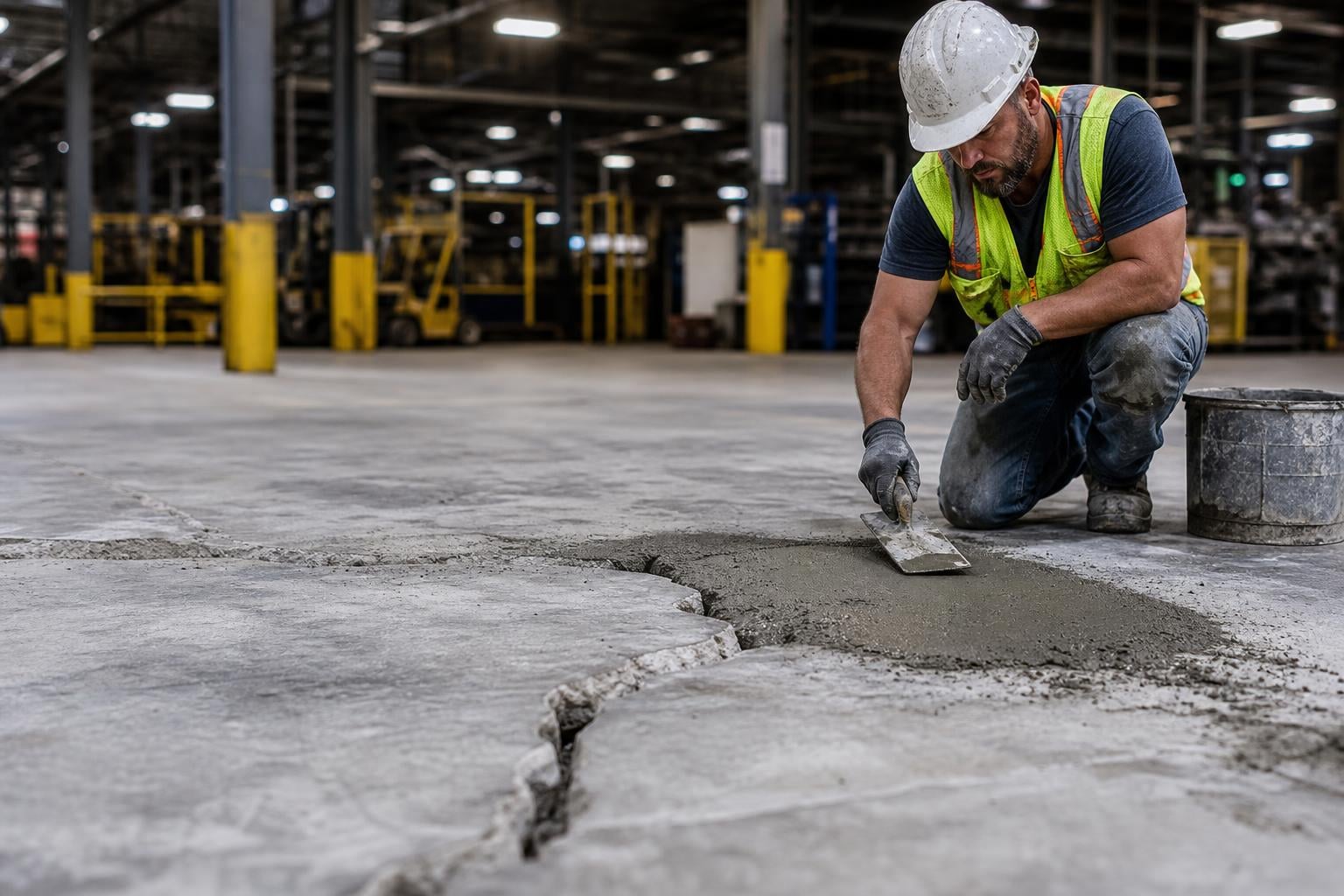
TLDR: Industrial slab repair covers the inspection and restoration of concrete floors in warehouses, plants, distribution centers, loading docks, and equipment areas. The right fix depends on what failed, why it failed, and how quickly the area must return to service. Joint damage from hard-wheel forklift traffic is one of the most common problems. This guide defines key terms, walks through common damage types, compares repair methods, and explains when to call a contractor or engineer.
Quick Answer
Industrial slab repair involves identifying the cause of concrete floor damage before selecting the repair method. Most industrial floor failures fall into one of four categories:
Problem | Typical Repair |
|---|---|
Cracks | Epoxy injection, routing and sealing, or full-depth repair |
Joint Damage | Polyurea joint filler or joint re-nosing |
Rocking Slabs | Slab stabilization before surface repairs |
Settlement | Void filling or subgrade remediation |
Surface Wear | Grinding, patching, overlays, or coatings |
Choosing the correct repair depends on whether the damage is structural, cosmetic, or caused by movement beneath the slab. Treating only the visible damage without correcting the underlying cause usually leads to repeated failures.
What Is Industrial Slab Repair?
Industrial slab repair means fixing damaged concrete floors or slabs that carry forklifts, pallet jacks, racks, trucks, equipment, or other heavy industrial loads. It applies to warehouses, manufacturing plants, distribution centers, loading docks, truck courts, wash bays, and equipment areas.
This is not one repair method. It is a category that includes crack repair, joint repair, spall repair, slab stabilization, surface grinding, partial-depth patching, full-depth replacement, epoxy injection, polyurea filler, and subgrade remediation. The correct approach depends on what failed, what caused the failure, what traffic the slab carries, and how fast the area must reopen.
The distinction from residential concrete work matters. Industrial slabs must handle hard-wheel traffic, concentrated point loads, impact, vibration, chemical exposure, and tight downtime windows. OSHA requires that operating surfaces for forklifts be strong enough to support the forklift, load, and operator while remaining free of holes, obstructions, or conditions that could cause skidding, bouncing, or tipover.
ACI 360R, the industry guide for slabs-on-ground, acknowledges that crack-free, curl-free floors are unrealistic even with good design. The question is not whether cracks exist. The question is whether cracks, joints, or surface damage affect safety, operations, or structural performance.
For industrial facilities in the Southeast dealing with slab damage, request a field review from Wright Construction to evaluate the condition and plan the repair.
When Does an Industrial Slab Need Repair?
An industrial slab likely needs attention when:
Forklifts bounce, shimmy, or slam at joints
Joint edges are chipping or breaking apart
Cracks are widening, offset, or spreading
Slab panels rock or shift under forklift traffic
Holes, loose concrete, exposed reinforcement, or trip hazards are present
Dock pits, ramp areas, or equipment pads show deterioration
The same patch keeps failing
Floor conditions interfere with forklift travel, pallet jack movement, rack stability, or pedestrian safety
OSHA 29 CFR 1910.22 requires walking-working surfaces to support the maximum intended load, be inspected regularly, and be maintained in safe condition. Hazardous conditions must be corrected before employees use the surface again. Repairs involving structural integrity must be performed or supervised by a qualified person.
The safety stakes are real. From 2011 to 2017, 614 workers died in forklift-related incidents, and more than 7,000 nonfatal injuries with days away from work occurred every year. In 2017, the median time away from work for forklift injuries was 13 days. Not all of these are caused by floor conditions, but OSHA identifies floor and surface condition as a forklift safety factor, and that alone makes concrete slab repair an operations priority, not a cosmetic one.
For a deeper look at what causes these problems in the first place, see this guide on warehouse floor damage causes.
How Industrial Slab Damage Progresses
Industrial slab failures rarely happen overnight. Most begin with small defects that become progressively worse under repeated heavy-wheel traffic.
Stage 1 – Hairline Cracks
Small shrinkage cracks appear with little operational impact.
Typical repair:
Monitor
Seal if necessary
Prevent water intrusion
Stage 2 – Joint Breakdown
Forklift wheels begin striking unsupported joint edges.
Signs include:
Chipping
Spalling
Loose filler
Rough ride quality
Typical repair:
Semi-rigid joint filler
Joint re-nosing
Stage 3 – Slab Movement
Voids or settlement allow panels to rock under load.
Signs include:
Hollow sounds
Vertical movement
Repeated patch failures
Typical repair:
Slab stabilization
Void filling
Ground improvement
Stage 4 – Structural Failure
The slab can no longer safely support design loads.
Typical repair:
Full-depth replacement
Structural engineering review
Subgrade reconstruction
The Industrial Slab Repair Stack: Fix From the Bottom Up

Most failed industrial slab repairs fail because someone treated a symptom as the problem. A surface patch will not fix a rocking slab. Flexible sealant will not protect a hard-wheel forklift joint. Epoxy injection will not solve active settlement.
Think of the repair as a stack, starting from the bottom:
Subgrade and support. Is the slab resting on solid, compacted base material, or is there settlement, erosion, voiding, or pumping? If the support has failed, the surface repair will fail too.
Slab structure. Is the concrete section intact through its full depth? Is there full-depth cracking, exposed rebar, corrosion, or load capacity concern?
Joint system. Are joints filled, protected, and transferring load properly? Do the joint materials match the traffic and movement conditions?
Surface profile. Is the travel path smooth enough for forklifts, pallet jacks, and pedestrians?
Protection and maintenance. Does the slab need sealers, coatings, drainage fixes, or a scheduled joint maintenance program?
This bottom-up approach matters because a visible chip at a joint may be the top layer of a deeper support problem. A practitioner on LinkedIn described a repair sequence at a facility where joint curl had raised slab edges and created impact points: they filled the void under the slab first, then repaired the joint, installed joint fill material, and ground the high spot to restore a smooth transition. That sequence (support, then joint, then surface) is what separates durable industrial concrete repairs from quick patches that fail within months.
When subgrade failure is the root cause, base preparation practices matter as much as the concrete work itself.
What Facility Teams See vs. What It Usually Means
Before calling a contractor, it helps to connect visible symptoms to likely causes. This diagnostic table translates what you observe on the floor into the questions worth asking.
What You See | What It May Mean | First Question to Ask |
|---|---|---|
Forklift hits a joint with a bang | Joint spall, wide joint, failed filler, unsupported edge | Is the joint edge broken, or is the slab moving? |
Patch keeps breaking out | Wrong material, poor prep, active movement, traffic too early | Did we fix the cause or only the surface? |
Slab clunks under a forklift | Rocking slab, void, settlement, curled panel | Is there support below the slab? |
Crack has one side higher | Differential settlement or heave | Is this structural or subgrade related? |
Surface sounds hollow when tapped | Delamination or debonding | How deep is the unsound layer? |
Joints turn into potholes | Hard-wheel impact plus edge failure | Was the joint filled with semi-rigid material? |
Floor is too rough for pallet jacks | Flatness or profile issue, joint damage, spalls | Does it need repair, grinding, or replacement? |
Industrial Slab Repair Glossary
This glossary covers the terms facility managers, property owners, and operations teams are most likely to encounter when evaluating industrial concrete slab damage or talking to a repair contractor.
Slab and Load Terms
Industrial slab. A concrete slab built for industrial loads, traffic, storage, equipment, or production use. Includes warehouse floors, plant floors, dock slabs, truck courts, and equipment areas.
Slab-on-grade (slab-on-ground). A slab supported directly by the ground below. Most warehouse and plant floors are slabs-on-grade. ACI 360R defines a slab-on-ground as a slab whose main purpose is supporting applied loads by bearing on the ground.
Hard-wheel traffic. Forklifts and pallet jacks with polyurethane, nylon, or steel wheels that concentrate load on a small contact area and deliver high impact at joints and cracks. Hard wheels are the primary cause of joint edge breakdown in warehouses. For more on forklift traffic concrete design, including thickness and joint requirements, see this separate guide.
Load transfer. The ability to transfer a wheel load across a joint or crack so both sides share the load. When load transfer fails, wheels pound one side of the joint, accelerating damage.
FF/FL numbers. Floor flatness (FF) and floor levelness (FL) are measurements of a concrete floor’s surface profile. ASTM E1155 provides the standard test method. FF measures bump-to-bump variation over short distances. FL measures levelness across longer distances. These numbers matter when floor smoothness affects forklift operations or high-rack storage.
Return-to-service time. The time required before a repaired area can reopen to traffic. Some polyurea joint fillers can reopen to traffic in 30 minutes. Full-depth concrete replacement may require days. Functional cure (when you can drive on it) and full cure (when it reaches design strength) are not the same thing.
Crack Terms
Crack. A complete or incomplete separation of concrete into two or more parts. ICRI defines a crack as separation caused by breaking or fracturing.
Active crack. A crack that is still moving, widening seasonally, or reopening after repair. Active cracks require movement-tolerant repair or root-cause correction, not rigid bonding alone.
Dormant crack. A crack not expected to move significantly. May be suitable for rigid repair methods like epoxy injection, depending on the purpose.
Shrinkage crack. A crack caused by concrete shrinking as it cures and dries. Some shrinkage cracking is normal per ACI 360R, though uncontrolled cracks in traffic areas often need repair.
Structural crack. A crack that may affect load-bearing capacity. Cracks near columns, rack footplates, equipment foundations, or elevated slabs should be evaluated by a qualified professional.
Joint Terms
Contraction (control) joint. A sawed, formed, or tooled groove intended to regulate where shrinkage cracking occurs. These are the straight sawcut lines visible in most warehouse floors.
Construction joint. The interface between two separate concrete placements. Often a “pour break” or day-joint. Vulnerable under forklift traffic if the edges are unsupported.
Isolation joint. A separation that allows relative movement in three directions, typically placed around columns, walls, foundations, or machinery bases.
Expansion joint. A separation that accommodates expansion and contraction, usually wider than control joints and filled with compressible material.
Joint spall. A fragment of concrete broken away from the edge of a joint. Joint spalls are among the most common industrial floor problems because hard-wheel traffic hammers joint edges thousands of times per day.
Arris. The edge or shoulder of a joint. When the arris breaks, the joint develops a rough, chipped profile that accelerates further damage with every wheel pass.
Impact gap. A practical way to describe the open, broken, soft, or unsupported space that hard wheels strike when crossing a crack or joint. This is not a formal standard term, but it captures the core issue: the worse the impact gap, the more each forklift crossing acts like a hammer blow. The repair goal is to restore a supported, flush transition.
Joint filler. A material installed in joints to help maintain surface continuity and support joint edges under traffic. Industrial hard-wheel joints usually require semi-rigid filler, not soft sealant. Euclid Chemical’s technical guidance says joints subjected to heavy or hard-wheeled traffic need semi-rigid filler, while flexible sealants are appropriate for joints not subject to traffic.
Joint sealant. A flexible material used to seal joints against water, debris, and contaminant intrusion while accommodating movement. Sealants work well at isolation joints, wall joints, and other locations where traffic is not crossing the joint.
Semi-rigid filler. A joint filler stiff enough to support traffic while allowing minimal movement. Metzger/McGuire’s industrial floor joint guide references ACI and PCA guidelines calling for semi-rigid fillers with a minimum Shore A80 hardness, with many products moving toward A85 to A95 because of smaller, harder material-handling wheels.
Re-nosing. Rebuilding broken joint shoulders or edges by sawcutting a blockout around the damaged area, removing failed concrete, and placing high-strength repair material with a new joint line.
For a full breakdown of joint repair approaches and material selection, see this joint repair methods guide.
Surface and Support Terms
Spall. A fragment detached from a larger concrete mass. Large spalls exceed 20 mm in depth and 150 mm in greatest dimension per ICRI definitions. Spalls on traffic surfaces create wheel impact points and trip hazards.
Delamination. A separation plane parallel to the surface, usually near the top of the slab. Delaminated concrete sounds hollow when tapped (a technique called “sounding”) and can break loose in sheets under traffic.
Curling. When slab edges or corners rise because of moisture or temperature gradients between the top and bottom of the slab. Curling creates raised edges at joints, which then get hammered by forklift wheels.
Rocking slab. A slab panel that tilts, shifts, or moves under load. This usually means voids, erosion, settlement, or poor support exist below the slab. Surface repair alone will not fix a rocking slab.
Void. An empty space beneath the slab where support has been lost due to erosion, washout, poor compaction, or moisture migration.
Pumping. Water or fine material being forced up through joints or cracks under load. A sign that voids or saturated base material exist below the slab.
Settlement. Downward movement of a slab caused by soil compression, consolidation, or washout beneath the slab.
Repair Method Terms
Epoxy injection. Injection of structural epoxy into cracks to bond the concrete together. Best for dormant cracks where the goal is restoring bond and strength. Not appropriate for active movement unless the root cause is resolved first. For more detail on when and how epoxy is used, see this epoxy repair guide.
Polyurea joint filler. A fast-curing, semi-rigid filler pumped into joints and shaved flush with the surface. Popular in warehouse and distribution center repairs because some products allow traffic reopening in as little as 30 minutes. Product selection depends on joint type, temperature, moisture, traffic, and manufacturer requirements.
Partial-depth repair. Removal and replacement of damaged concrete through only part of the slab depth. Used for spalls, shallow delamination, and surface defects where the lower slab and subgrade are sound.
Full-depth repair. Removal and replacement of concrete through the entire slab thickness. Required when damage extends through the full slab, when the base has failed, or when the slab section is no longer structurally adequate.
Slab stabilization. The process of stopping slab movement before performing surface or joint repairs. Often involves injecting polyurethane foam, geopolymer grout, or cementitious grout beneath the slab to fill voids and restore support.
Surface grinding. Removing high spots with diamond grinding equipment to improve smoothness. Often used after slab stabilization or repair to restore a flat travel surface at joints and transitions.
Doweling. Installing steel dowel bars between old and new concrete sections during full-depth repair to restore load transfer across the joint.
Subgrade remediation. Repairing or improving the base and soil support beneath the slab. May involve removing and replacing failed base material, adding stone, or applying cement treatment.
Cold-storage slab repair. Repair of slabs in freezer or cold-storage environments, where temperatures, insulation layers, vapor drive, and return-to-service constraints change material selection and repair sequencing. Practitioners on Reddit warn that in freezer conditions with insulation or voids beneath a thick slab, skim-coating the surface will not solve support-related problems.
Industry Standards That Apply to Industrial Slab Repair
Common standards referenced during industrial slab repair projects include:
Standard | Purpose |
|---|---|
ACI 360R | Design of slabs-on-ground |
ACI 302 | Concrete floor construction |
ACI 562 | Existing concrete assessment and repair |
ICRI 310 | Surface preparation |
ASTM E1155 | Floor flatness (FF/FL) |
OSHA 1910.22 | Walking-working surfaces |
Common Industrial Slab Problems
Cracks
Not all cracks are emergencies. ACI 360R states that crack-free floors are unrealistic even with good design and construction. But cracks with movement, vertical offset, exposed reinforcement, repeated failure, or forklift impact need evaluation.
Hairline shrinkage cracks in a warehouse floor may be cosmetic. A crack near a column footing with one side higher than the other is a different situation entirely. Active cracks that reopen after every repair attempt are telling you the slab is moving, and the movement source matters more than the patch material.
Joint Spalling
In warehouse and distribution environments, joint repair is often the most common and most urgent industrial slab repair need. Hard wheels and heavy impact loads from materials-handling equipment cause major damage to joint edges. Every loaded forklift crossing a joint delivers impact to the concrete shoulder. Multiply that by hundreds or thousands of crossings per day, and even well-built joints deteriorate.
The confusion between joint filler and joint sealant causes many joint failures. A flexible “caulk” in a hard-wheel forklift aisle deflects under load and lets the wheel hammer the concrete edges directly. Semi-rigid filler, by contrast, supports the joint edges and restores surface continuity. This single distinction, filler vs. sealant, is one of the most important things a facility manager can understand about industrial concrete slab repair.
Rocking or Settled Slabs

A slab that clunks, bounces, or tilts when a forklift crosses it usually has voids or lost support underneath. Practitioners on Reddit describe repeatedly returning every two to three years to patch the same cracks that forklifts keep tearing up. Others point out that when a slab sounds hollow, surface patching is not going to solve the problem.
The repair sequence matters. If the slab is moving, stabilize it first. Filling the voids with polyurethane injection or cementitious grout, then rebuilding the joints, then grinding the surface flat is far more likely to last than skipping straight to a patch. One LinkedIn practitioner posting about a full-depth joint repair argued that replacing a failed straight joint with another straight joint can repeat the same failure pattern, suggesting that when full-depth work is already required, the owner should evaluate whether the original joint design contributed to the problem.
Surface Wear and Delamination
Abrasion, pitting, dusting, and delamination are surface-layer problems. Abrasion comes from traffic. Pitting can result from poor surface paste or chemical exposure. Delamination creates a hollow separation plane that eventually breaks loose.
The key step before any surface repair is removing all unsound concrete. Bonding new material to weak, contaminated, or delaminated concrete guarantees failure.
Dock and Equipment Area Damage
Loading docks take repeated truck impacts, forklift traffic, water intrusion, and embedded steel corrosion. Dock leveler pits, ramp edges, and bollard bases are high-stress zones that often need specialized repair geometry.
Equipment pads and machinery bases can crack from vibration, overload, or settlement. In manufacturing plants, production floor conditions create additional challenges from chemical exposure, temperature swings, and heavy point loads.
What Causes Industrial Slab Damage?
Industrial slabs usually fail because one or more conditions act together over time.
The most common causes include:
Cause | Typical Damage |
|---|---|
Heavy forklift traffic | Joint spalling |
Poor subgrade compaction | Settlement |
Water infiltration | Pumping and voids |
Curling | Unsupported joint edges |
Thermal movement | Cracking |
Overloaded racks | Structural cracking |
Chemical attack | Surface deterioration |
Freeze-thaw exposure | Scaling and spalling |
Improper joint filler | Joint edge failure |
Poor original construction | Multiple recurring defects |
Industrial Slab Repair Methods Compared
Repair Method | Best For | Not Best For | Key Consideration |
|---|---|---|---|
Crack filling | Nonstructural cracks, debris exclusion | Active movement, structural cracks | May not restore structural strength |
Epoxy injection | Dormant cracks needing bond and strength | Moving cracks, settlement cracks | Must confirm the crack is stable |
Polyurea joint filling | Fast-turn industrial joints, forklift aisles | Expansion joints needing large movement range | Match hardness to traffic type |
Joint re-nosing | Broken joint shoulders too damaged for filler alone | Moving or unsupported slabs | Stabilize the slab before re-nosing |
Partial-depth patching | Shallow spalls, surface defects, delamination | Full-depth cracking, support loss | Avoid feathered edges in traffic zones |
Full-depth replacement | Severe slab failure, deep damage, failed base | Minor surface wear | Requires staging, cure time, and possibly doweling |
Slab stabilization | Rocking slabs, hollow panels, voids | Surface-only wear | Always before surface or joint repair |
Surface grinding | Raised edges, curling, transitions | Structural cracks, soft concrete | Removes bumps but does not restore support |
Overlay or coating | Surface protection, chemical resistance | Moving cracks, contaminated substrate | Prep and moisture control are critical |
Subgrade remediation | Settlement, pumping, failed base material | Isolated surface chips | Requires investigation and disruption |
Repair vs Replacement
Condition | Repair | Replacement |
|---|---|---|
Hairline cracks | ✓ | |
Joint spalls | ✓ | |
Minor settlement | ✓ | |
Rocking slab | ✓ after stabilization | |
Widespread structural cracking | ✓ | |
Failed subgrade | Sometimes | ✓ |
Severe deterioration | ✓ |
How to Choose the Right Repair Method
Every industrial slab repair method should pass four filters before it is selected.
Load filter. What loads and wheel types will cross the repaired area? A warehouse aisle with 15,000-pound sit-down forklifts on polyurethane wheels demands different materials than a pedestrian corridor.
Movement filter. Is the crack, joint, or slab actively moving? If yes, rigid patches and rigid injection will fail. Fix the movement source first.
Environment filter. Is the area wet, cold, chemically exposed, food-grade, dusty, or temperature-sensitive? Cold-storage slab repairs at minus-30 degrees Fahrenheit require different materials and cure conditions than a dry warehouse at 70 degrees. Practitioners on Reddit warn that in freezer environments with insulation and potential voids beneath a thick slab, skim-coating the surface will not solve support-related failures.
Downtime filter. How long can the area be closed? Some semi-rigid polyurea joint fillers allow forklift traffic within 30 minutes. Full-depth concrete replacement may take days before it can carry full loads. Staged repairs, where the contractor works in sections and keeps adjacent aisles open, are standard practice in active facilities.
A straightforward decision sequence:
Is the slab moving? If yes, investigate support and stabilize first.
Is the damage at a joint? Determine whether it needs cleaning and refilling, re-nosing, or full-depth reconstruction.
Is a crack active or dormant? Active cracks need root-cause resolution. Dormant cracks may accept epoxy injection or routing and sealing.
Is the damage partial-depth or full-depth? This determines whether patching, replacement, or both apply.
What are the facility constraints? Forklift traffic, production schedules, rack loads, cold storage, chemical exposure, and safety controls all shape the repair plan.
Why Industrial Slab Repairs Fail
If the same joint or crack keeps failing, stop asking “what patch should I use?” and start asking “why is the slab moving?”
Here are the most common reasons industrial concrete slab repairs fail.
Wrong material. Flexible sealant in a hard-wheel forklift joint. Bag-mix patch under 10,000-pound wheel loads. A warehouse worker on Reddit described patching broken floor spots with a recommended product that “crumbles to dust” after forklift traffic. Replies advised DOT-grade repair products, proper prep tools like needle scalers or scabblers, and epoxy-bonded repair mortar instead of repeating the failed patch.
The slab was moving. Rocking slabs shear surface repairs off. The patch bonds fine to the concrete, but the concrete tilts back and forth under every forklift pass.
Unsound concrete was left in place. New material bonded to weak, delaminated, or contaminated concrete debonds at the weakest layer.
Edges were feathered too thin. Thin, tapered patch edges break under impact. Patches in traffic areas need defined, sawcut edges and minimum thickness.
Traffic returned too early. Functional cure does not equal full cure. Opening to heavy loads before the material reaches adequate strength causes premature failure.
Oil, grease, moisture, or chemicals contaminated the bond surface. Surface contamination prevents adhesion.
The repair ignored load transfer. Without load transfer across a joint, one side carries the full wheel load and breaks down again.
The subgrade or base failed. Settlement, voids, pumping, or erosion beneath the slab will destroy any surface repair placed above it.
In severe forklift impact zones, some practitioners go beyond standard patching. One Reddit contributor proposed sawcutting beyond the failed area, removing concrete, placing steel bar grating parallel to forklift travel, setting it slightly below the surface, and filling with high-strength epoxy grout. Not every situation calls for that level of detail, but in extreme cases, repair solutions may need reinforcement, full-depth removal, or engineered approaches rather than another feathered patch.
When to Call a Contractor or Engineer
Call a qualified industrial concrete contractor when:
Forklifts are bouncing or striking joint edges
Joints are repeatedly failing despite repairs
Spalls are deep or widespread
The repair must reopen quickly without disrupting operations
Damage involves a dock, ramp, truck court, production aisle, wash bay, or equipment area
The slab needs sawcutting, re-nosing, semi-rigid filler, epoxy repair, or slab replacement
Surface defects create trip hazards or forklift travel hazards
Call an engineer or qualified design professional when:
There is vertical displacement across cracks
The slab supports heavy equipment, rack legs, columns, structural walls, or elevated loads
Reinforcement is exposed or corroded
The slab is heaving, settling, or rocking over a large area
There may be structural capacity concerns
The repair affects the structural integrity of a load-bearing element
OSHA requires that repairs involving structural integrity of a walking-working surface be performed or supervised by a qualified person. ACI 562 provides minimum requirements for assessment, repair, and rehabilitation of existing concrete structures and is written for use by licensed design professionals.
Wright Construction provides industrial concrete maintenance, joint repairs, concrete slab repairs for heavy-duty surfaces, epoxy crack and surface repairs, dock leveler pit construction and repairs, and related services across the Southeast. Explore Wright’s concrete services.
Industrial Slab Repair Across the Southeast
Warehouse, distribution, and manufacturing facilities across the Southeast face specific slab repair challenges. High humidity drives moisture-related issues in coatings and overlays. Hot summers accelerate cure times but demand careful scheduling. Aging industrial buildings with original slabs from decades ago often carry loads far beyond their original design intent.
Wright Construction serves commercial and industrial facilities from offices in Memphis, Nashville, Chattanooga, Birmingham, and Huntsville, covering most of the Southeastern United States. Services span industrial joint repairs, concrete slab repairs for heavy-duty surfaces, epoxy crack and surface repairs, dock leveler pit construction and repairs, equipment foundation and pad installation, industrial wash bay construction, heavy-duty truck ramp construction, and related site and concrete work. With self-perform crews across multiple trades, Wright reduces subcontractor coordination and focuses on minimizing operational downtime.
Contact Wright Construction to discuss slab conditions, operating constraints, and repair scheduling for your facility.
Industrial Slab Repair Cost
Repair costs vary depending on the damage, slab thickness, access, production downtime, and repair method.
Repair Type | Typical Relative Cost |
|---|---|
Crack sealing | Low |
Joint filler replacement | Low–Medium |
Joint re-nosing | Medium |
Partial-depth repair | Medium |
Slab stabilization | Medium–High |
Full-depth replacement | High |
Subgrade reconstruction | Highest |
Because every industrial facility differs, contractors normally inspect the slab before providing pricing.
Factors affecting cost include:
repair size
slab thickness
reinforcement
access restrictions
overnight work
production shutdowns
material selection
cure requirements
Do not make up dollar figures unless you have reliable regional pricing.
Frequently Asked Questions
What is industrial slab repair?
Industrial slab repair is the inspection, preparation, and repair of concrete slabs in warehouses, manufacturing plants, distribution centers, loading docks, truck courts, and other heavy-use facilities. It can include crack repair, joint repair, spall repair, slab stabilization, grinding, partial-depth patching, full-depth replacement, and subgrade remediation.
What is the most common industrial slab repair?
In warehouse and distribution environments, joint repair is often the most common need. Hard-wheel forklifts and pallet jacks repeatedly impact joint edges, causing spalling, filler failure, and edge breakdown that worsen with every shift of traffic.
What is the difference between joint filler and joint sealant?
Joint filler supports joint edges under hard-wheel traffic and maintains surface continuity. Joint sealant is more flexible and is used to keep out water and debris while accommodating movement. Industrial floor joints under forklift traffic generally need semi-rigid filler, not flexible sealant.
Can you repair an industrial slab without shutting down the facility?
Often yes, but it depends on the damage and method. Some polyurea joint fillers allow forklift traffic within 30 minutes. Full-depth slab replacement or subgrade work may require staged closures, cure time, and traffic control. Staged repairs that keep adjacent aisles open are standard in active warehouses.
Why do warehouse floor patches keep failing?
Common causes include using the wrong material, skipping surface preparation, leaving unsound concrete in place, ignoring active slab movement, allowing traffic too early, and failing to address voids beneath the slab. If the same patch fails repeatedly, the root cause has not been resolved.
What is a rocking slab?
A rocking slab is a concrete panel that tilts or shifts under load because of voids, erosion, or settlement beneath it. Surface repair will not fix a rocking slab. The support must be restored through void filling or stabilization before any joint or surface work begins.
When should an industrial slab be replaced instead of repaired?
Replacement is more appropriate when damage extends through the full slab depth, the base has failed, the slab has severe settlement or heave, the slab cannot support current loads, or repeated repairs are no longer cost-effective. Structural or safety-critical conditions should be evaluated by a qualified professional.
Are cracks always a sign of bad construction?
No. ACI 360R states that crack-free and curl-free floors are unrealistic even with good design and construction. The question is whether the cracking affects safety, operations, load support, or facility performance. Cracks with movement, vertical offset, or exposure to heavy traffic usually do require repair.